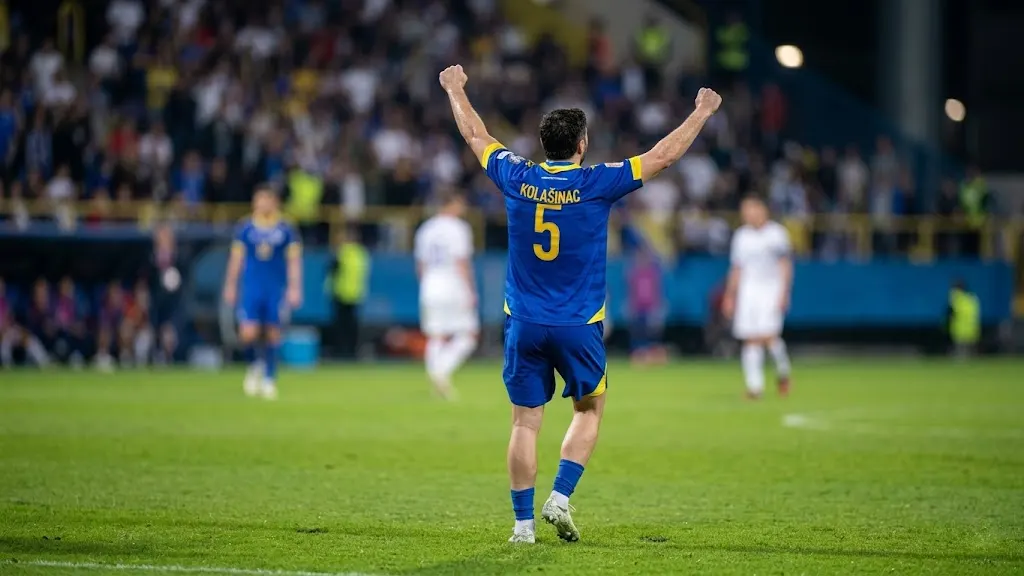
It was the kind of evening that becomes folklore, the type retold for generations in cafés, living rooms, and stadium concourses. Under the lights of Zenica, Bosnia and Herzegovina delivered the most significant result in their modern footballing history, defeating Italy in a dramatic UEFA play off final to secure a place at the 2026 FIFA World Cup.
For the hosts, it was pure euphoria. For the four-time champions, it was something far darker, a collapse that cements one of the most astonishing declines in international football.
A Match That Flipped on a Single Moment
At kickoff, the narrative felt familiar. Italy, bruised by previous qualification failures, came out with urgency and control. Their early dominance translated into a deserved lead in the 15th minute, when Moise Kean finished clinically to silence the Zenica crowd.
At 1–0, Italy appeared composed, technically superior, and firmly in control. Their midfield dictated tempo, and Bosnia struggled to impose themselves in the final third.
But football, especially at this level, often pivots on a single incident.
That moment arrived in the 41st minute.
A reckless challenge from Alessandro Bastoni on Amar Memić resulted in a straight red card, an inflection point that transformed the tactical and psychological complexion of the match. From that instant onward, Italy were no longer dictating terms; they were surviving.
Reduced to 10 men for 79 minutes, including extra time, the Azzurri retreated into a defensive block. The initiative shifted decisively.
Bosnia’s Relentless Pressure Pays Off
What followed was not immediate brilliance but sustained, suffocating pressure.
Bosnia’s approach was methodical rather than frantic circulating possession,
probing wide areas, and gradually increasing territorial dominance.
The numbers tell the story: 31 shots to Italy’s 9. This was no smash and grab, it was territorial siege warfare.
The breakthrough came in the 79th minute, and fittingly, it was a moment born of persistence rather than elegance. Substitute Haris Tabaković reacted quickest to a loose ball in the penalty area, poking it home to level the score at 1–1.
The stadium erupted. Zenica, already tense, became electric.
From there, the momentum was irreversible. Bosnia carried the psychological edge into extra time, even as veteran striker Edin Džeko, battling a shoulder injury, continued to lead the line with grit and experience.
Penalty Shootout: Precision vs Pressure
If the match had tilted toward Bosnia, the penalty shootout was definitive.
Italy’s long-standing frailty from the spot resurfaced at the worst possible time. Pio Esposito missed the opening penalty, blasting over the bar, an immediate psychological blow. Later, Bryan Cristante struck the woodwork, compounding the pressure.
In contrast, Bosnia were clinical. Composed. Ruthless.
Benjamin Tahirović and Haris Tabaković converted with authority, setting the stage for the decisive moment. When Esmir Bajraktarević stepped up, the weight of history hung in the air.
His strike, driven past Gianluigi Donnarumma, sealed a 4–1 shootout victory and with it, Bosnia’s place at the World Cup.
Italy’s Collapse: A Historic Low Point
The ramifications for Italy are seismic.
This defeat confirms their absence from a third consecutive World Cup (2018, 2022, 2026) an unprecedented failure for a nation with four titles. By the time the next tournament arrives in 2030, it will have been 16 years since Italy last played a World Cup match.
The underlying metrics from this defeat are damning:
- 1 successful penalty out of 4 attempts
- Over 70 minutes played with 10 men
- A defensive posture that conceded 31 shots
But beyond the numbers lies a deeper issue: a recurring inability to manage high pressure qualification scenarios. The red card to Alessandro Bastoni will dominate post match analysis, but it is only one chapter in a broader systemic decline.
For Italian football, this is no longer a crisis, it is structural failure.
Group B: A Door Opens for Bosnia
While Italy confront introspection, Bosnia turn their focus to opportunity.
Drawn into Group B of the 2026 FIFA World Cup, Bosnia and Herzegovina find themselves in what can only be described as a finely balanced group:
- Canada (Co-hosts)
- Switzerland (European consistency specialists)
- Qatar (Asian champions)
There is no traditional superpower here, no Brazil, no France. Instead, it is a group defined by parity and unpredictability.
The Fixtures That Will Define Their Campaign
Bosnia’s journey across North America will test both their tactical adaptability and physical resilience:
- June 13, 2026 – vs Canada (BMO Field, Toronto)
- June 19, 2026 – vs Qatar (Levi’s Stadium, Santa Clara)
- June 24, 2026 – vs Switzerland (BC Place, Vancouver)
Each match presents a distinct tactical puzzle.
Tactical Outlook: Where Bosnia Can Thrive
1. The Canada Test: Atmosphere Meets Opportunity
Facing Canada in Toronto is both a challenge and an opportunity. As co hosts, Canada will benefit from crowd energy, but the significant Bosnian diaspora could neutralize that advantage.
Canada’s pace in transition will test Bosnia’s defensive structure, particularly in wide areas. However, Bosnia’s experience and composure could prove decisive in controlling midfield phases.
2. Qatar: A Must Win Scenario
Against Qatar, Bosnia will likely adopt a more proactive role. Qatar’s technical style and possession based approach require disciplined pressing structures, but this is the fixture Bosnia must target for maximum points.
3. Switzerland: Tactical Chess
The clash with Switzerland may ultimately decide qualification. Both sides are tactically organized, defensively compact, and comfortable without the ball.
Expect a low margin contest defined by set pieces, transitions, and moments of individual quality.
The Bigger Picture: A Shifting European Hierarchy
Bosnia’s triumph is not an isolated shock, it is part of a broader trend.
Across the UEFA playoffs, traditional hierarchies were disrupted:
- Sweden eliminated Poland
- Czechia overcame Denmark
- Türkiye knocked out Kosovo
The expansion to a 48 team World Cup has widened the competitive landscape, but it has also exposed vulnerabilities among established powers.
For Bosnia, this is validation. For Italy, it is a warning.
From Underdogs to Contenders?
Bosnia and Herzegovina arrive at the 2026 tournament not as passengers, but as a team forged in adversity.
They have demonstrated:
- Resilience (coming from behind against elite opposition)
- Tactical discipline (controlling the game against 10 men)
- Composure under pressure (dominant penalty execution)
The question now is whether they can translate that playoff intensity into sustained tournament performance.
Because this is no longer just about qualification.
It’s about legacy.
A Night That Redefined Two Nations
In Zenica, football delivered its most compelling narrative: the rise of one nation intertwined with the fall of another.
For Bosnia and Herzegovina, this is a historic breakthrough, a moment that redefines their place on the global stage.
For Italy, it is a reckoning. A third consecutive absence from the World Cup is not just failure, it is a rupture in identity.
And as the world turns toward North America in 2026, one storyline is already set:
Bosnia will arrive with belief.
Italy will be watching from home.