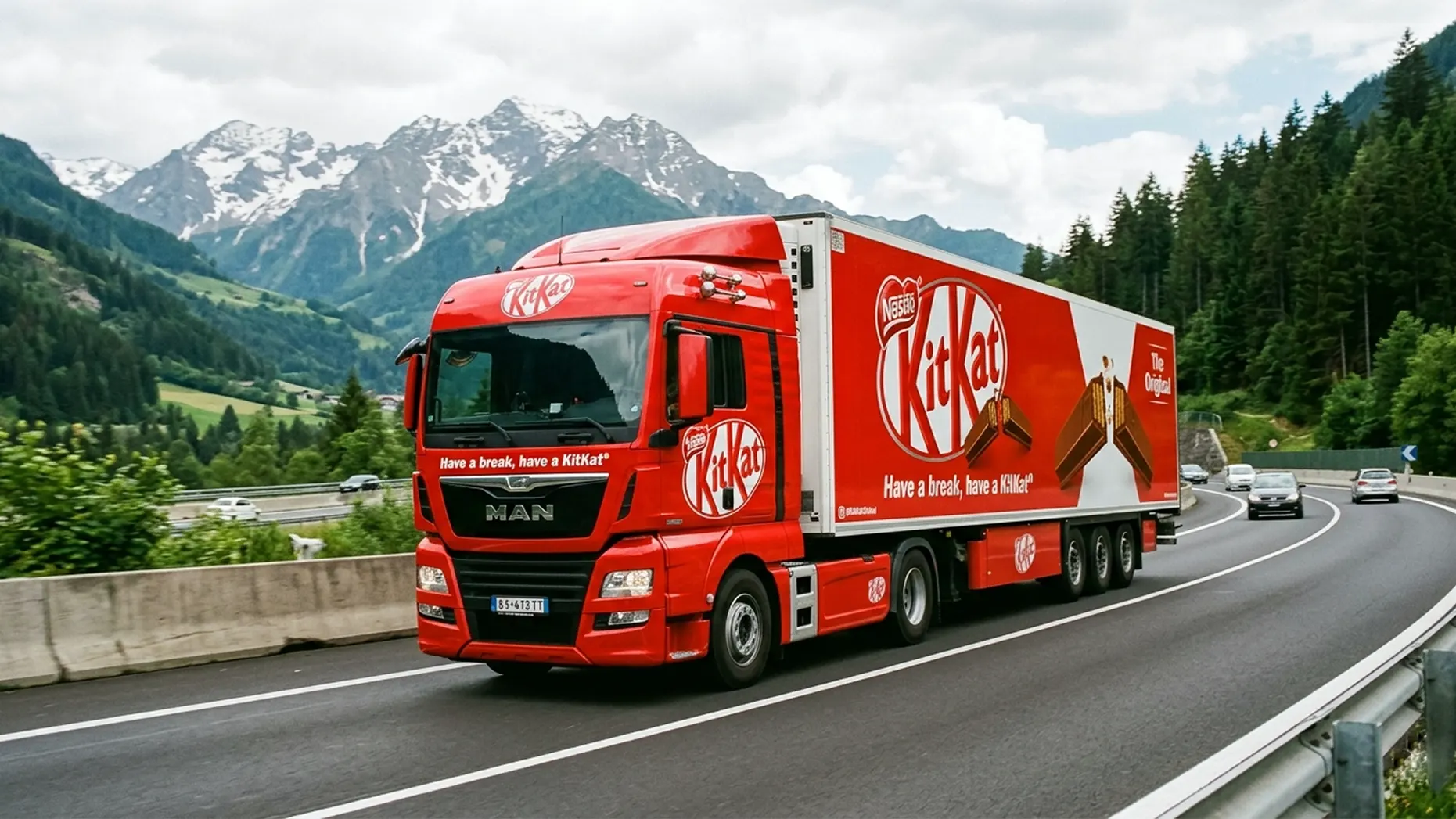
A truck loaded with more than 400,000 KitKat bars has disappeared somewhere between Italy and Poland, leaving behind one of the most unusual and revealing crime stories
of the year. What might sound like a quirky headline is, in reality, a sophisticated cross border operation that exposes growing vulnerabilities in global supply chains.
A Sweet Shipment That Never Arrived
The shipment was routine on paper. A truck carrying 413,793 KitKat bars, weighing roughly 12 tonnes, departed from a factory in central Italy, bound for a distribution hub in Poland. The route, spanning 1,350 kilometers across multiple European countries, is
a well traveled commercial corridor.
But the truck never made it.
Somewhere along the journey, the vehicle and its entire cargo vanished without a trace. No confirmed sightings, no recovery of the truck, and no contact with the driver.
As of March 29, 2026, authorities still classify the shipment as “missing in transit.”
A Crime Designed to Disappear
As investigators began piecing together the timeline, a clear pattern emerged. This was not a random theft. Experts believe the operation fits the model of a “phantom load”
a highly organized form of freight fraud.
In such schemes, criminals pose as legitimate logistics companies. They use convincing websites, forged insurance documents, and stolen corporate identities to win transport contracts. Once the goods are loaded, the “driver” simply disappears.
The most striking detail is the driver himself. Authorities have not confirmed whether he was a victim or never existed at all. In many similar cases, the individual behind the wheel operates under a fabricated identity, making them effectively untraceable.
The Vanishing Act
The truck’s disappearance appears to have been swift and deliberate. GPS tracking was reportedly disabled shortly after departure, a hallmark of professional cargo theft.
From there, investigators believe the shipment was quickly moved.
This is where the operation becomes particularly difficult to trace. Within hours, stolen goods are often transferred to multiple smaller vehicles, a process known as cross docking. The original truck may then be abandoned or never flagged at all if it carried cloned license plates.
As a result, what began as a single, traceable shipment transforms into dozens of smaller, untraceable loads scattered across borders.
Why 12 Tonnes of Chocolate Can Still Go Missing
At first glance, hiding such a large quantity of chocolate seems implausible. Yet logistics experts say the opposite is true. Modern cargo networks are vast, fragmented, and fast moving making them surprisingly easy to exploit.
There’s also the challenge of storage. Chocolate requires controlled temperatures to prevent spoilage. The thieves likely had immediate access to refrigerated transport or storage facilities, suggesting a level of planning that goes beyond opportunistic crime.
This level of coordination reinforces a key point: this was not a spontaneous heist
it was a “made to order” operation.
Nestlé’s Digital Counterattack
Faced with a missing shipment and no clear suspects, Nestlé has turned to technology
and the public for help. Every bar in the stolen batch carries a unique code, effectively giving each product a digital identity.
The company has activated what it calls a “tripwire” system. If any of the stolen bars are scanned whether by retailers or consumers, the system can flag them instantly
and provide instructions for reporting the product.
In effect, Nestlé is crowdsourcing the investigation, turning ordinary shoppers into potential detection points across Europe.
The Race Against the Easter Clock
Timing is critical. The theft comes just weeks before Easter, one of the busiest periods for chocolate sales. Authorities believe the stolen goods will be rapidly distributed through unofficial channels, including small independent shops and online marketplaces.
This creates both urgency and risk. The longer the chocolate remains unsold, the more likely it is to be flagged. But if it floods the market quickly especially at discounted prices
it may blend in before detection systems can catch up.
A Mystery Still Unfolding
Despite coordinated efforts by Interpol and national police forces, the case remains unsolved. There are no named suspects, no confirmed location of the truck, and no verified sightings of the cargo.
The investigation has effectively shifted from chasing a vehicle to tracking a product waiting for a digital signal, a suspicious sale, or a mistake by those trying to profit
from the haul.
More Than Just a Chocolate Theft
At its core, the “KitKat Heist” is more than an oddity. It highlights a growing trend in organized crime: the exploitation of digital logistics systems and globalized trade networks.
As supply chains become more complex and interconnected, they also become more vulnerable. And as this case shows, even something as ordinary as a chocolate bar can become the center of a highly sophisticated international operation.
For now, the missing truck remains out there somewhere in Europe or beyond. And until it resurfaces, the mystery of 400,000 vanished KitKats serves as a reminder that in modern logistics, disappearance can be engineered with precision.