For years, the global conversation around artificial intelligence has focused on chatbots, image generators, and the race to build smarter software. But in China, the center of gravity has shifted.
AI is no longer just something you talk to, it’s something that runs factories, power grids, and entire industries.
As of early 2026, China has quietly built one of the largest and most deeply integrated AI ecosystems in the world. And while headlines often focus on flashy consumer tools, the real story is happening somewhere less visible: the factory floor.
The Patent Surge That Put China Ahead
One of the clearest signs of China’s rise in AI is its dominance in patents.
China now holds roughly 60% of the world’s active AI patents, with more than 25,000 granted inventions. That puts it well ahead of the United States, which has around 17,000.
But what does that actually mean?
A patent is a legal right that protects an invention. In this case, these patents cover technologies like:
- Computer vision — systems that let machines “see,” used in facial recognition or quality control
- Natural language processing — the technology behind chatbots and translation tools
- Industrial AI — systems that manage factories, logistics, and infrastructure
Much of this innovation is coming from companies like Tencent and Baidu, alongside state backed research groups.
But there’s an important nuance here.
Most of these patents around 96% are filed only inside China. That means they are designed to dominate the domestic market, not necessarily to compete globally. Meanwhile, U.S. patents are cited far more often in research, suggesting they still lead in foundational breakthroughs.
So while China leads in scale, the race between quantity and quality is still very much open.
From Apps to Assembly Lines
If patents tell you where innovation is happening, factories tell you where it’s actually being used.
And this is where China is pulling ahead.
As of 2026, more than 30% of large manufacturing companies in China are already using AI in production. That’s significantly higher than the United States or Europe.
This shift is often described as “AI Plus”, a strategy to embed AI into traditional industries rather than just build new apps.
In practical terms, that means:
- AI systems running entire production lines
- Machines inspecting products instead of humans
- Software predicting failures before they happen
The result is not just automation, it’s a new kind of industrial intelligence.
Inside the “Smart Factory”
To understand what this looks like, imagine a factory that can think ahead.
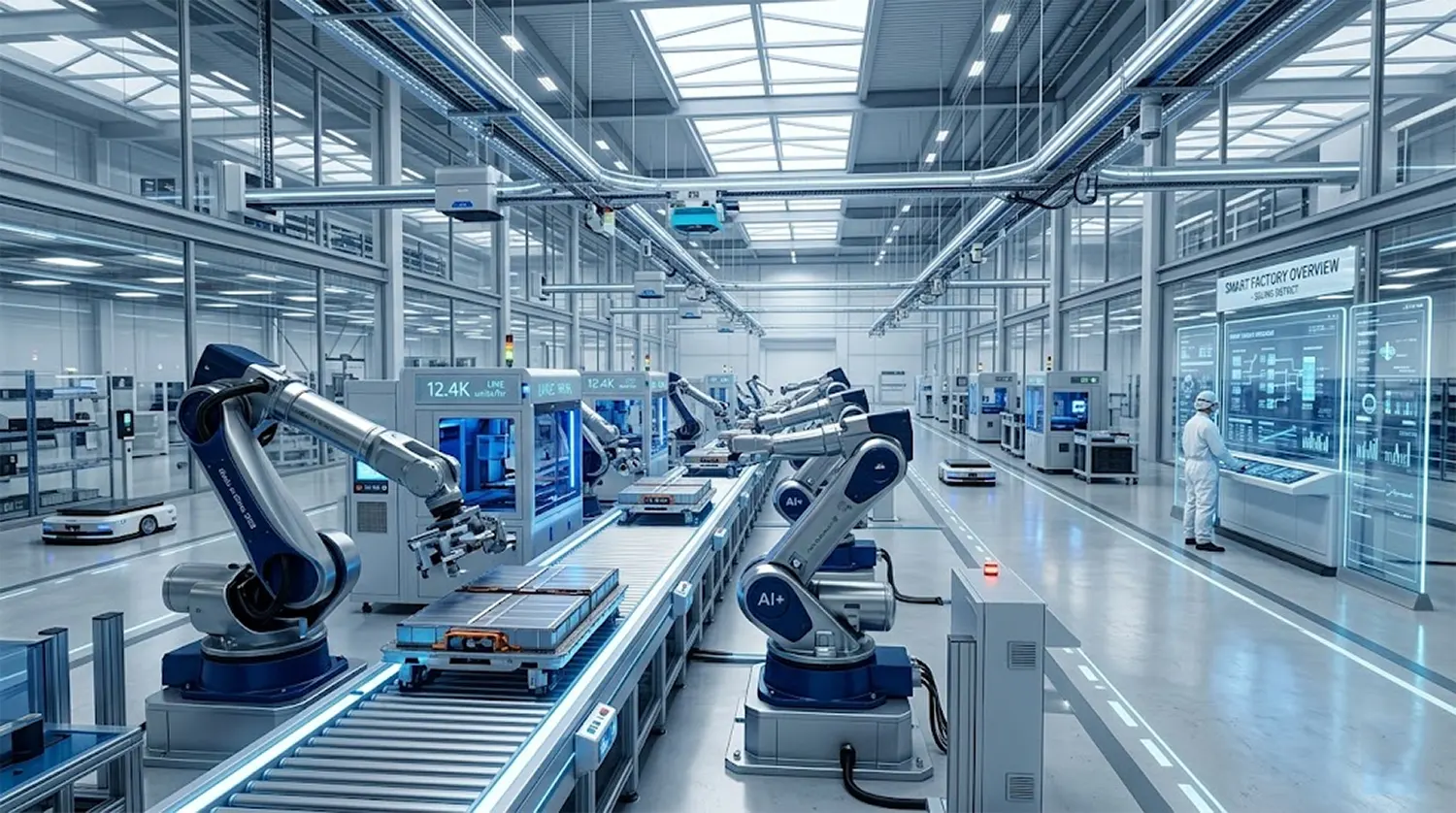
Many Chinese companies are now using something called a “digital twin.” This is a virtual copy of a real factory. Engineers can run simulations on it, testing changes, spotting inefficiencies before anything happens in the real world.
Then there’s computer vision, where cameras powered by AI scan products for defects in milliseconds. This has increased efficiency by over 20% in some cases.
And perhaps most impactful is predictive maintenance.
Instead of waiting for a machine to break, sensors monitor tiny vibrations and patterns.
AI can predict failures weeks in advance, avoiding costly shutdowns.
Put together, these systems are transforming factories into environments that are not just automated but adaptive.
The Rise of “Physical AI”
This shift has a name: “Physical AI.”
Unlike the AI most people interact with chatbots or recommendation systems, physical AI
is embedded in the real world. It controls machines, coordinates supply chains, and manages infrastructure.
In industries like electric vehicles, companies are now running so called “dark factories” fully automated plants that don’t even need lights because no humans are on the floor.
Meanwhile, robotics is scaling rapidly. Chinese firms released over 300 types of humanoid robots in a single year, more than half the global total.
This is AI moving from the screen into the physical economy.
The Government’s Quiet but Massive Push
Behind this transformation is a coordinated national strategy.
China’s “AI Plus” plan is designed to bring the remaining 70% of manufacturers into the AI era. The goal is ambitious: over 50,000 smart factories by 2028.
To make that possible, the government is investing heavily in infrastructure especially computing power. Today, China operates a massive AI computing network capable of handling over 140 trillion daily AI processing tasks, often called “tokens.”
Think of tokens as the basic units of AI work, the more you process, the more intelligence you can deploy.
This scale is what allows even smaller factories to access advanced AI without building their own systems.
The Debate: Scale vs. Breakthroughs
Despite its rapid progress, China’s AI rise comes with ongoing questions.
Critics point out that while China leads in deployment and patents, the most influential, widely cited research still often comes from the United States.
There’s also a growing focus on regulation. As of 2026, China has introduced stricter rules requiring AI systems to:
- Avoid biased or discriminatory outcomes
- Use data that is legally and ethically sourced
In other words, scale is no longer enough, systems must also meet new standards of trust.
Why This Matters Beyond China
At first glance, this might seem like a story about one country’s tech industry. It’s not.
What’s happening in China is redefining what AI leadership actually looks like.
In the West, AI is often measured by model performance, how smart a chatbot is, how realistic an image looks.
In China, the metric is different: how deeply AI is embedded into the real economy.
That distinction could shape the next phase of global competition.
Because the future of AI may not be decided by who builds the smartest model but by
who uses it at scale, in the systems that power everyday life.