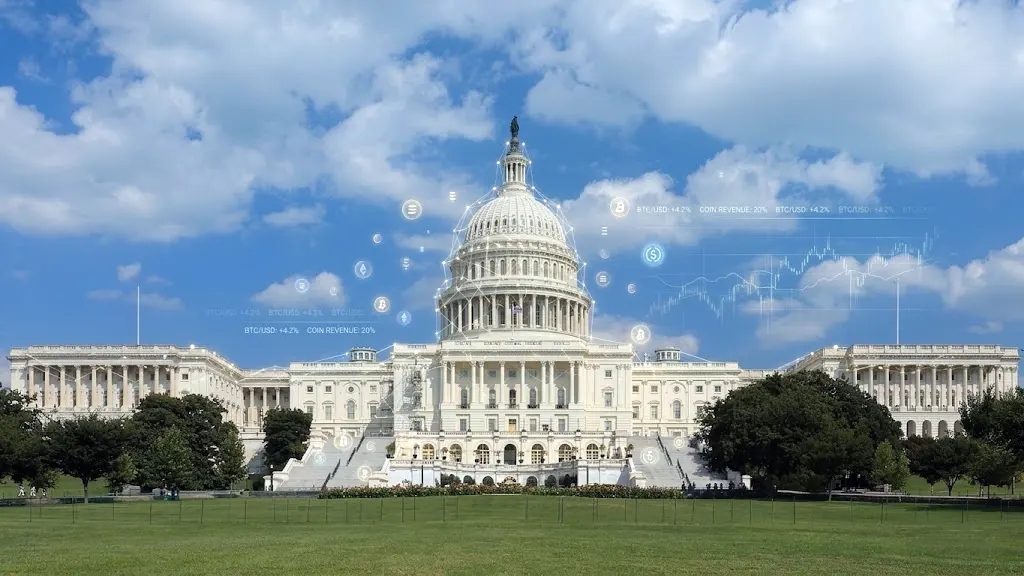
The Line Between “Savings” and “Speculation” Is Now the Whole Battle
For months, Washington has been working toward what many hoped would be a landmark moment for crypto regulation: the passage of the CLARITY Act. Instead, the effort has stalled over a deceptively simple question:
Should people be allowed to earn interest just for holding digital dollars?
That question has now become the fault line dividing banks, crypto firms, and lawmakers. And as negotiations intensify, the outcome could determine whether stablecoins evolve into a mainstream financial tool or remain a niche product.
At stake is not just regulatory clarity, but control over the future of consumer finance.
The Framework That Was Supposed to End the Chaos
The CLARITY Act formally the Digital Asset Market Clarity Act of 2025 was designed to solve one of crypto’s longest running problems: regulatory confusion.
Its central innovation is a three part classification system that assigns oversight based on how a digital asset actually functions:
- Digital commodities like Bitcoin fall under the Commodity Futures Trading Commission
- Investment contract assets remain under the Securities and Exchange Commission
- Permitted payment stablecoins are overseen by banking regulators like the Federal Reserve and the Office of the Comptroller of the Currency
This structure was meant to end what industry leaders have long criticized as “regulation by enforcement”, a system where companies only learn the rules after being sued.
But just as consensus began to form around this framework, a more politically explosive issue took center stage.
The “Yield War” That Derailed the Bill
The current standoff is not about classification. It is about incentives.
Under earlier legislation, stablecoin issuers like Circle were already banned from paying interest directly to users. But crypto exchanges found a workaround: they began offering rewards programs that effectively mimicked interest often around 4% annually simply for holding stablecoins.
To banks, this crossed a line.
Their argument is straightforward: if a “digital dollar” offers bank like returns without bank like regulation, it creates a powerful incentive for consumers to move their money out of traditional deposits.
The numbers behind that fear are substantial. Industry estimates suggest up to $500 billion could migrate out of the banking system by 2028, with some projections reaching as high as $6.6 trillion in long term “deposit flight.”
That pressure has shaped the latest draft of the CLARITY Act in a decisive way.
The Compromise That Satisfied No One
In an attempt to break the deadlock, Senators Thom Tillis and Angela Alsobrooks introduced a bipartisan compromise. It draws a sharp distinction:
- A total ban on “passive yield” earning rewards simply for holding stablecoins
- A carve out for “activity based rewards” tied to actual usage, such as payments or transfers
On paper, this creates a regulatory boundary between savings and utility. In practice, it has triggered backlash from both sides.
Banks argue the carve out still leaves room for abuse. Crypto firms argue the ban goes too far.
The result is a proposal that resolves the legal question but destabilizes the market it aims to regulate.
Coinbase’s Rebellion Signals a Larger Industry Shift
No company has reacted more forcefully than Coinbase.
Stablecoin related rewards account for roughly $1.35 billion about 20% of its annual revenue. The new language, which prohibits rewards “economically equivalent to bank interest,” directly threatens that business model.
Initially open to compromise, Coinbase has now shifted into full opposition.
Its objections are both technical and strategic:
- The definition of “passive” is too broad, potentially sweeping in staking rewards for other crypto assets
- Eliminating yield would likely trigger a retail exodus, as users move funds back into traditional savings accounts or offshore platforms
The company has also deployed political leverage. As a major donor to crypto aligned campaigns, it is signaling that regulatory decisions will carry electoral consequences especially with midterm elections approaching.
Even President Donald Trump has weighed in, warning that banks should not “hold the CLARITY Act hostage,” highlighting how deeply politicized the issue has become.
When a Loophole Becomes the Entire Market
What makes this fight so consequential is that the “loophole” at its center has effectively become the primary use case for stablecoins in the United States.
For many retail users, stablecoins are not primarily a payment tool. They are a high yield cash alternative, a place to park money with better returns than a traditional savings account.
Remove that incentive, and the logic of holding stablecoins begins to unravel.
This is already visible in market reactions:
- Coinbase shares have fallen sharply amid uncertainty
- Circle, the issuer of USDC, saw a 20% single day valuation drop as investors reassessed future demand
The market is pricing in a simple reality: without yield, stablecoins may lose their gravitational pull.
The Quiet Stakes: Control Over the Future of Money
Beneath the technical debate lies a deeper institutional conflict.
Banks are not just protecting deposits. They are defending their role as the primary intermediaries of consumer finance.
Crypto firms, meanwhile, are pushing a model where value can be stored, transferred, and even yield returns outside the traditional banking system.
The CLARITY Act, in this sense, is not just a regulatory framework. It is a decision about which system gets to scale.
This tension is also reflected in the bill’s broader provisions:
- A ban on a U.S. central bank digital currency, driven by concerns over surveillance
- Protections for decentralized finance activity, limiting regulatory reach
- A framework for managing the government’s growing stockpile of seized Bitcoin
Each of these points signals a government trying to balance innovation with control
without fully committing to either.
A Legislative Clock That May Run Out First
For now, the entire effort hangs on timing.
If the Senate Banking Committee fails to finalize the bill by the end of April, the legislative calendar will likely push the CLARITY Act into the gravitational pull of the 2026 election cycle, where major policy moves tend to stall.
That creates a narrow window for compromise and a growing risk that no agreement will be reached at all.
The Real Outcome May Be Decided Outside Washington
What began as a technical debate over “passive yield” has evolved into something far larger.
It is a test of whether financial innovation can outpace regulatory containment
or whether the existing system will reassert control before that happens.
If lawmakers impose strict limits, stablecoins may retreat into a narrower role as payment tools.
If they fail to act, the current model where digital dollars function like high yield savings accounts could continue to expand, pulling capital away from traditional banks.
Either way, the decision will ripple far beyond crypto.
Because at its core, this is no longer just about digital assets. It is about who gets to define the next version of money.