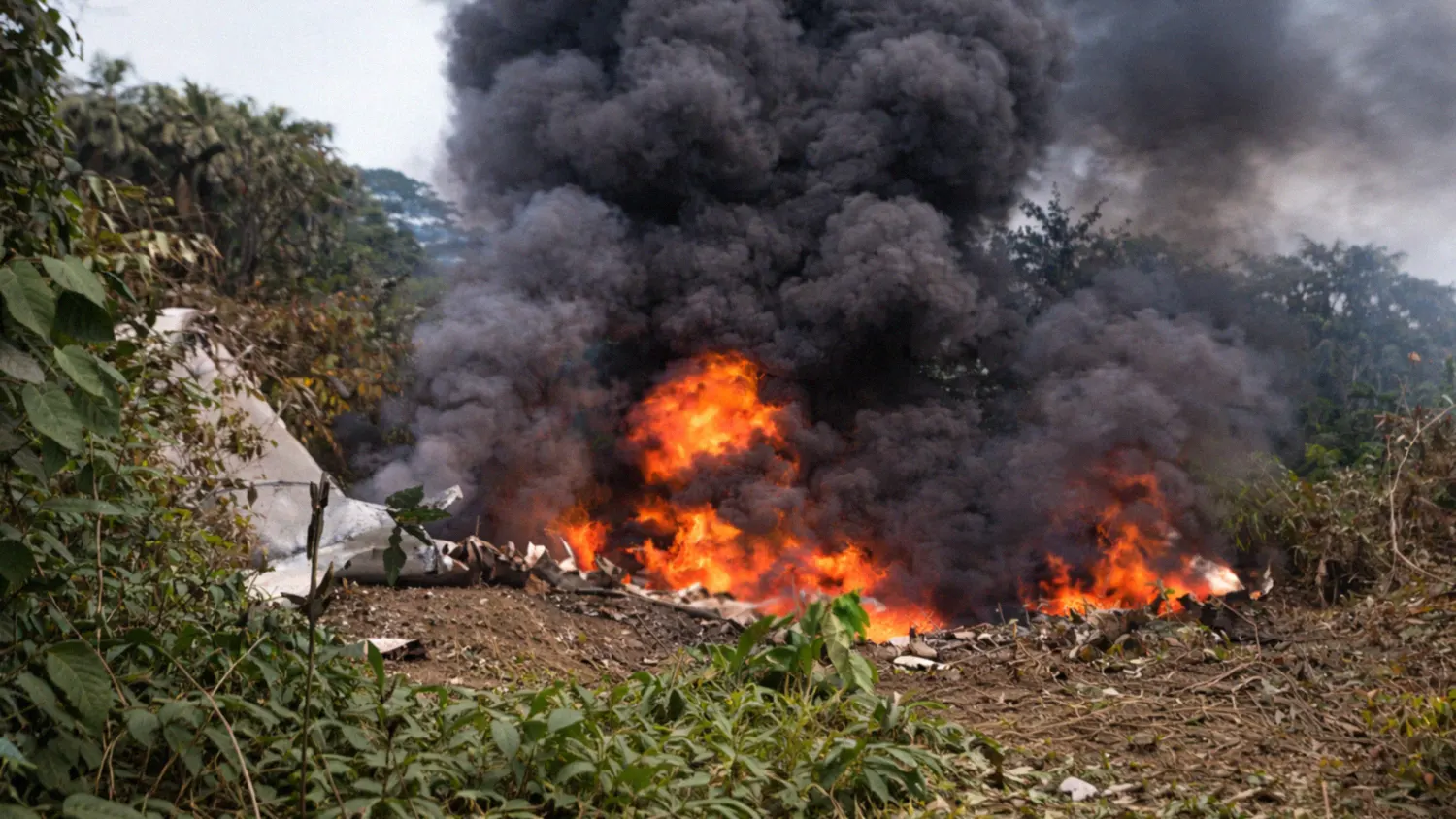
The crash of a Colombian Air Force Lockheed C-130 Hercules has rapidly become the deadliest aviation accident in the history of the Colombian Air Force, leaving a nation in shock and raising urgent questions about military aviation safety, operational risks, and modernization.
A Routine Mission Turns Catastrophic
On the morning of March 23, 2026, the aircraft identified as FAC1016 departed from Caucayá Airport in Puerto Leguízamo, deep in Colombia’s southern Amazon region.
Its destination was Tres de Mayo Airport in Puerto Asís, a short but strategically vital route used for troop rotations where roads are unreliable or unsafe.
This was not an unusual flight. On board were over 120 personnel, primarily members of the elite 27th Jungle Brigade, tasked with counter insurgency and border security operations.
Yet within moments of takeoff, something went terribly wrong.
Witnesses described the aircraft flying unusually low, struggling to gain altitude. Seconds later, it disappeared into dense jungle roughly 1.5 to 2 kilometers from the runway, followed by a massive explosion and a towering column of black smoke.
The “Fatal Climb” and Fireball Impact
Early evidence points to a catastrophic failure during the aircraft’s initial climb phase one of the most critical moments in any flight.
Firefighter reports indicate the plane may have clipped a tree with one wing, possibly after already struggling for lift. That impact appears to have destabilized the aircraft, sending it crashing into the jungle canopy.
But the devastation did not end there.
Because the aircraft was transporting combat ready troops, it carried significant quantities of ammunition, including grenades and small arms rounds. Upon impact, these munitions detonated, triggering secondary explosions that created a fireball effect.
This had two immediate consequences:
- The aircraft was rapidly engulfed in flames
- Rescue efforts were delayed, as explosions made it too dangerous to approach
As a result, what might have been a survivable crash for some became far more deadly.
Casualties, Survivors, and a Remarkable Rescue
The human toll is staggering:
- Total on board: Approximately 125–128 people
- Confirmed dead: At least 66
- Survivors: Around 57–59
- Critically injured: At least 14
- Missing: 4 personnel still unaccounted for
Among the fallen were six Air Force crew members, including the pilot, Lieutenant Colonel Juan Pablo Amadro Pinilla.
A Grassroots Rescue Effort
Beyond the immediate devastation, one of the most striking aspects of this tragedy is the extraordinary response by local residents.
With no road access to the crash site, civilians used motorcycles as improvised ambulances, navigating narrow jungle paths to transport injured soldiers to two small local clinics.
This rapid, community driven response likely saved dozens of lives before military reinforcements and specialized medical aircraft arrived.
Survivors were later airlifted to Bogotá, where hospital planes equipped with 74 beds continue to treat the wounded.
Amid the tragedy, there are also stories of resilience including reports of one soldier emerging from the wreckage completely unharmed, a rare and remarkable outcome.
What Caused the Crash? Key Questions Under Investigation
As investigators analyze the flight data recorders, three critical factors are emerging:
1. Possible Engine or Power Failure
The C-130 Hercules is designed to remain airborne even if one engine fails. The aircraft’s rapid loss of altitude suggests a more severe issue, such as multi engine failure or a critical systems malfunction.
2. Weight and Environmental Conditions
The aircraft was heavily loaded with:
- Over 120 personnel
- Full combat gear
- Significant ammunition
Combined with high heat and humidity in the Amazon, these factors may have reduced engine performance and lift capacity, raising concerns about weight and balance limits.
3. Runway or Initial Impact Factors
Reports indicate the aircraft may have experienced a scrape or instability near the runway, followed by the fatal wing strike against a tree suggesting the emergency began almost immediately after takeoff.
What Has Been Ruled Out
Authorities have moved quickly to dismiss certain possibilities:
- No evidence of an attack by armed groups, despite the region’s history of conflict
- The aircraft was officially deemed “airworthy”, with a major overhaul completed as recently as 2023
These findings narrow the focus to mechanical, operational, or loading related causes.
A National Debate Over Aging Military Equipment
Beyond the technical investigation, the crash has ignited a political firestorm.
President Gustavo Petro has openly criticized what he describes as “bureaucratic negligence” delaying military modernization. He warned that officials failing to advance fleet renewal efforts “must be removed.”
The aircraft itself adds fuel to the debate:
- Built in 1984
- Donated by the United States in 2020
- Recently overhauled (2021–2023)
While upgrades extended its service life, critics argue that reliance on aging airframes poses unacceptable risks especially during high-stakes operations in challenging environments.
Why This Tragedy Matters
To understand the scale of this disaster, it’s important to recognize its broader implications.
This was not just an aviation accident, it was the loss of dozens of trained personnel from an elite military unit, impacting operational readiness and morale.
Moreover, it highlights a critical tension faced by many nations:
How do you balance operational demands with the risks of aging equipment and limited resources ?
What Comes Next
Search teams continue combing the crash site for the missing, while investigators work to reconstruct the final moments of the flight.
In the coming weeks, attention will focus on:
- Black box analysis results
- Maintenance and loading records
- Operational decision making before takeoff
Each finding will be crucial not only for accountability, but for preventing future tragedies.
A Defining Moment
Ultimately, this disaster may become a turning point for Colombia’s military aviation policy.
Beyond the immediate grief, it raises urgent, unavoidable questions about safety, preparedness, and modernization. The answers will determine whether this tragedy remains an isolated catastrophe or becomes the catalyst for meaningful change.