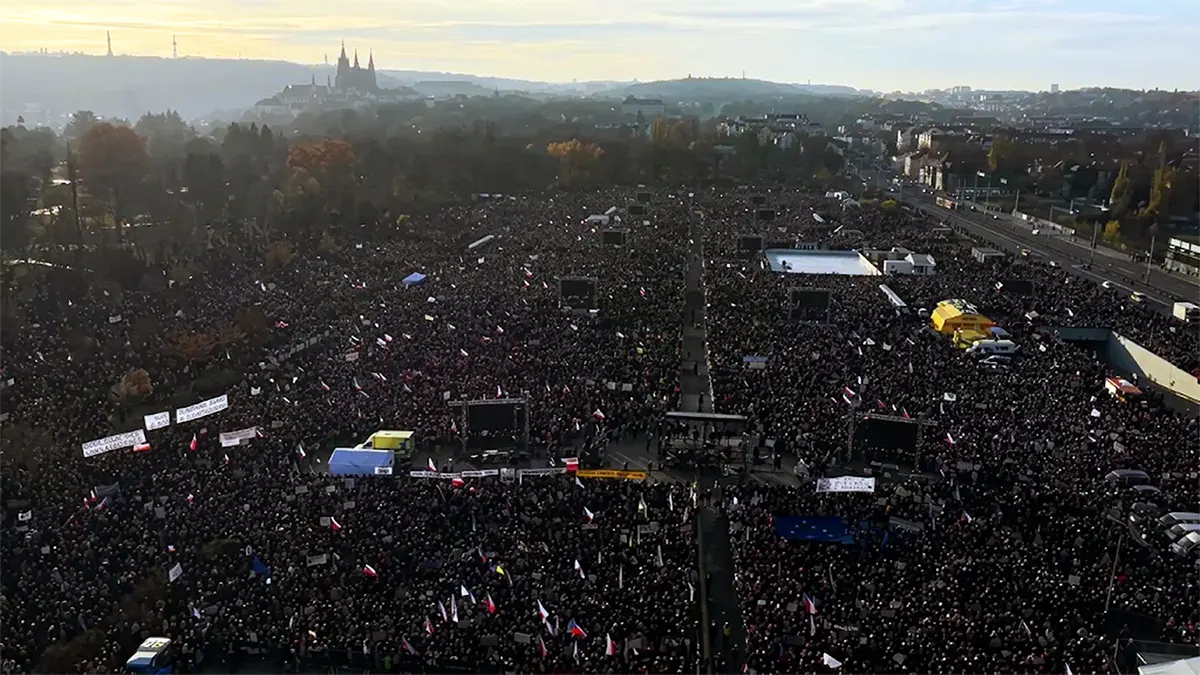
The massive demonstration in Prague has put the Czech government’s proposed media reforms under intense scrutiny, with protesters warning that moving public broadcasters to state-budget funding could undermine their independence.
Beyond the size of the crowd, the dispute raises a much bigger question: Can a government change the way public media is funded without giving politicians greater influence over the news?
The confrontation between Prime Minister Andrej Babiš’s coalition and the country’s pro-democracy movement is now becoming a major test of public trust, institutional independence, and the limits of parliamentary power.
A Historic Crowd Returns to Prague’s Letná Plain
Organized by Milion chvilek pro demokracii (Million Moments for Democracy), the November 15 rally brought together people from across the Czech Republic. Students, journalists, cultural figures, healthcare workers, church representatives, athletes, and ordinary citizens joined the demonstration.
Organizers estimated that between 350,000 and 450,000 people attended. The figure would make it the largest demonstration in the independent Czech Republic since its establishment in 1993, surpassing the huge anti-government rallies held at Letná in 2019.
The location also carried considerable historical significance. Letná Plain was one of the main gathering places during the 1989 Velvet Revolution, when mass demonstrations helped bring an end to communist rule in Czechoslovakia.
For many protesters, returning to the same location was a reminder that defending democratic institutions requires continued public participation.
The demonstration remained peaceful, with no major disturbances reported. However, its message extended well beyond opposition to a single piece of legislation.
Protesters also demanded that Tomio Okamura, leader of the far-right Freedom and Direct Democracy (SPD) party, step down as speaker of the Chamber of Deputies. They further called for SPD to lose control of the Defense Ministry, expressing concerns about the party’s political positions and its approach to national security.
Speakers also criticized the government’s handling of justice, healthcare, culture, and environmental policy.
Why the Public Media Funding Bill Sparked Such Anger
At the center of the controversy is a proposed law that would abolish the mandatory television and radio license fees currently paid by Czech households and businesses.
Under the existing system, Czech Television (ČT) and Czech Radio (ČRo) receive funding directly through these fees. The broadcasters operate as public-service institutions, with a financing structure designed to provide a degree of independence from the government of the day.
The proposed legislation would replace this arrangement with direct funding from the national state budget.
The government argues that the existing fee system is outdated and places an unnecessary financial burden on households and small businesses. However, critics say the proposed replacement could create a dangerous financial relationship between political authorities and public broadcasters.
The central concern is not who legally owns the broadcasters. Both institutions are already public-service organizations. Instead, the dispute concerns who controls the money that keeps them operating.
How the Current and Proposed Funding Systems Differ
| Feature | Current system | Proposed system |
|---|---|---|
| Funding source | Mandatory household and business fees | National state budget |
| Funding control | Direct broadcaster revenue | Annual political budget process |
| Financial security | Relatively predictable income | Dependent on budget allocations |
| Main concern | Cost to households | Potential political influence |
Under the proposed model, Parliament and the government would have a more direct role in determining how much money the broadcasters receive through the annual budget process.
Critics argue that this could expose newsrooms to political pressure, particularly if their funding can be reduced or delayed after reporting that challenges the government.
The 15% Funding Cut Behind the Media Independence Debate
The controversy has become even more serious because the proposal reportedly involves an immediate 15% reduction in public media funding.
According to the figures cited in the debate, Czech Television could lose approximately 1 billion Czech koruna, while Czech Radio could face a reduction of around 350 million koruna.
Together, the broadcasters would lose approximately 1.35 billion koruna annually.
That is not simply an administrative change. A reduction of this size could affect staffing, investigative journalism, regional reporting, cultural programming, and other public-service activities.
For protesters, the combination of reduced funding and annual state-budget dependence creates the greatest concern.
They argue that broadcasters could face two forms of pressure at once: fewer financial resources and greater dependence on politicians for future funding.
This is why opponents frequently describe the proposal as a form of media capture through financial control.
What Does Media Capture Actually Mean?
In political science, media capture describes a situation in which political or economic interests gain significant influence over news organizations without necessarily taking formal ownership of them.
Unlike traditional censorship, media capture does not always involve banning journalists, shutting down television stations, or directly controlling every news report.
Instead, influence can develop through financial pressure, political appointments, regulatory decisions, and ownership changes.
The process can be gradual, making it harder to identify when independent media begins losing its ability to scrutinize those in power.
Several mechanisms are commonly associated with this process:
- Financial pressure: Governments make public broadcasters increasingly dependent on annual budget decisions.
- Leadership changes: Political authorities alter oversight structures or appointment rules, potentially allowing loyalists to take influential positions.
- State advertising: Public advertising budgets are directed toward supportive private media outlets, disadvantaging critical competitors.
- Friendly ownership: Business figures with political connections acquire struggling independent media organizations.
These mechanisms do not automatically mean that every government-funded broadcaster is politically controlled. The important distinction is whether the funding arrangement includes strong legal protections against political interference.
Why Protesters Keep Comparing the Czech Republic to Hungary and Slovakia
The Czech debate has attracted international attention partly because of developments in other Central European countries.
Hungary, Poland, and Slovakia are frequently mentioned by media freedom organizations and protesters as examples of how political influence over public broadcasting can develop.
In Hungary, Prime Minister Viktor Orbán’s government consolidated public broadcasting under a centralized structure and strengthened political influence over media oversight. State advertising and business ownership networks also contributed to the expansion of government-aligned media.
The result has been a media environment in which government-friendly outlets enjoy significant influence.
Poland experienced a different but related controversy under the Law and Justice (PiS) government between 2015 and 2023. Changes to public broadcasting appointments gave the government greater influence over television and radio leadership, prompting accusations that public television had become a partisan communication platform.
In Slovakia, Robert Fico’s government replaced the existing public broadcaster RTVS with a new institution, STVR, in 2024. The restructuring triggered criticism from journalists, opposition politicians, and international press freedom organizations.
These examples explain why Czech protesters are particularly sensitive to changes in public media governance.
However, there is an important distinction: changing a broadcaster’s funding model does not automatically produce the same outcome as the media reforms implemented in Hungary or Slovakia.
The specific legal safeguards, appointment procedures, budget protections, and political environment matter.
That is precisely what critics want the Czech government to address before the proposed law advances.
Why the Government Says the Reform Is Necessary
Prime Minister Andrej Babiš and his coalition reject accusations that they are attempting to control public broadcasting.
Their position is that the proposed reform concerns the financing system, not editorial independence.
The government argues that mandatory television and radio fees have become outdated and unfair, particularly for households and smaller businesses.
It also points to other European countries that have moved away from traditional household license fees toward tax-based funding.
From the government’s perspective, public media can remain independent even when financed through the state budget, provided the funding arrangement is properly designed.
Babiš has also defended the proposal as a fulfillment of the coalition’s political commitments.
The prime minister has rejected the protesters’ demands and indicated that the government will proceed with abolishing the fees.
In response to the November 15 demonstration, he said he respected people’s right to protest but disagreed with the reasons behind the rally.
Coalition representatives, including Okamura, also questioned the political neutrality of the organizers.
The Real Difference Is the Protection of Funding
There is an important point in the government’s argument: state-budget financing is not inherently incompatible with independent public broadcasting.
Several European countries use tax-based funding arrangements.
However, critics argue that the effectiveness of such systems depends on the protections surrounding them.
A funding model can be designed to prevent politicians from arbitrarily reducing budgets or using financial decisions to punish critical journalism.
For example, multi-year funding commitments, independent allocation mechanisms, transparent formulas, and inflation adjustments can reduce political discretion.
The concern surrounding the Czech proposal is that critics believe these protections are insufficient.
The European Federation of Journalists and other media freedom advocates have warned that predictable and independent funding is essential to protecting public-service broadcasting.
The argument, therefore, is not simply about whether taxpayers or households should pay. It is about whether the government should have greater discretion over the financial survival of public broadcasters.
The 4:36 A.M. Parliamentary Vote Became a Symbol of the Protest
Another major source of public anger concerns how the legislation entered the parliamentary process.
In October, the governing coalition advanced the proposed reform through its preliminary reading during an overnight parliamentary session.
The vote took place at 4:36 a.m., after the governing majority restricted the time available for opposition lawmakers to speak.
More than 60 opposition members were reportedly prevented from delivering their planned speeches.
The unusual timing quickly became a symbol of what critics described as an attempt to push through important legislation without sufficient public debate.
The protest organizers subsequently adopted the slogan “Never Again 4:36”, linking the parliamentary procedure to their wider concerns about transparency and democratic accountability.
The issue is significant because public media legislation affects more than the broadcasters themselves. It concerns the information available to citizens and the ability of journalists to scrutinize those exercising political power.
For protesters, the way the bill was advanced reinforced their belief that the government was unwilling to engage in meaningful consultation.
Babiš Rejects the Protesters’ Demands
Despite the enormous turnout, Babiš has shown little willingness to change course.
On November 16, the prime minister rejected the demands presented by Milion chvilek before departing from Prague’s Kbely Airport for an official visit to Israel.
Asked whether he would consider removing Okamura as parliamentary speaker or taking the Defense Ministry away from SPD, Babiš responded: “I won’t consider them.”
His position reflects the political difficulty facing the government. Accepting the protesters’ demands could be interpreted as a retreat under public pressure, while ignoring them risks deepening public dissatisfaction.
The prime minister has also continued defending the media reform, arguing that abolishing the license fees is part of the government’s program rather than an attempt to bring public broadcasters under political control.
However, the size of the demonstration makes the political consequences harder to dismiss.
Why Babiš Cannot Easily Back Down
The prime minister faces competing pressures from his supporters, coalition partners, and the wider public.
First, abolishing television and radio fees is an important coalition commitment. Abandoning the proposal could create tensions with SPD, whose leader Tomio Okamura has strongly supported the reform.
Second, Babiš’s ANO movement has a broader voter base than its more ideological coalition partners. Some ANO supporters value public television and radio and may be uncomfortable with changes that could weaken their independence.
Third, the November demonstration could help opposition groups and civic organizations maintain momentum ahead of future elections.
The government therefore faces a difficult political calculation: pushing ahead could intensify public opposition, but withdrawing the proposal could undermine coalition unity.
A possible compromise would be to preserve the abolition of household license fees while introducing stronger legal protections for broadcaster funding.
That could include automatic inflation adjustments, predictable multi-year allocations, and safeguards preventing political authorities from arbitrarily reducing budgets.
Such a compromise would allow the government to claim it had fulfilled its campaign promise while addressing some of the concerns raised by journalists and protesters.
However, whether the coalition is willing to accept meaningful safeguards remains uncertain.
Can the Government Pass the Bill Despite Public Opposition?
The demonstration has created significant political pressure, but it does not automatically stop the legislative process.
The proposal has already passed its preliminary reading in the Chamber of Deputies. It must still proceed through the remaining parliamentary stages before becoming law.
The governing coalition has a parliamentary majority, giving it a clear advantage in the legislative battle.
Opposition parties, meanwhile, have promised to use parliamentary procedures to slow the bill’s progress. Their strategy could involve extended speeches, procedural challenges, and attempts to force changes during committee discussions.
The Senate and President Petr Pavel could also oppose the legislation.
However, the Czech parliamentary system gives the Chamber of Deputies the ability to override a Senate rejection or presidential veto if the required constitutional majority is secured.
This means that public opposition and institutional resistance could delay the bill without necessarily preventing its passage.
The government’s ability to maintain coalition unity will ultimately be more important than the protest alone.
European Union Rules Add Another Layer of Pressure
The dispute is not limited to domestic politics.
The Czech Republic is also subject to the European Union’s European Media Freedom Act (EMFA), which establishes safeguards for independent media and public-service broadcasters.
Under Article 5, EU member states must ensure that public-service media receive adequate, sustainable, and predictable financial resources to fulfill their responsibilities.
The legislation also addresses safeguards against political interference in the management and editorial independence of public broadcasters.
The European Broadcasting Union (EBU) has previously raised concerns about the Czech government’s proposed funding changes, emphasizing that stable and independent financing is essential to protecting editorial freedom.
This does not mean that the EU automatically prohibits governments from financing public broadcasters through national budgets. The regulation recognizes that member states can choose their own funding arrangements.
The central question is whether those arrangements provide sufficient protection against political interference and guarantee the financial resources broadcasters need to perform their public-service role.
If the Czech legislation fails to meet those standards, it could face scrutiny under EU law.
December 2 Could Become the Next Major Test
The November 15 demonstration may be over, but the organizers are already preparing their next move.
Milion chvilek chairman Mikuláš Minář has invited the government coalition to participate in a public debate at Prague’s Švandovo divadlo on December 2, 2026.
The proposed discussion is intended to bring government representatives together with experts, public figures, and citizens to address the controversial media funding reform.
The organization has also announced a nationwide warning action scheduled for 4:36 p.m. on the same day.
The timing is deliberate. It refers to the 4:36 a.m. parliamentary vote in October that became the central symbol of the movement’s criticism.
The organizers want the government to withdraw the proposed legislation, engage in meaningful public dialogue, and provide stronger guarantees for public media independence.
Whether government representatives accept the invitation remains an important question.
A refusal could reinforce the protesters’ argument that the coalition is unwilling to engage with public concerns. A public debate, meanwhile, could provide an opportunity to explain the government’s position and discuss possible safeguards.
The coming weeks will therefore be important in determining whether the dispute moves toward compromise or further confrontation.
What the Prague Protest Means for Czech Democracy
The demonstration at Letná Plain was extraordinary not only because of its size but also because of the issues that brought people together.
Hundreds of thousands of citizens gathered to defend institutions they believe are essential to a functioning democracy.
At the same time, the government maintains that it has a democratic mandate to implement its election commitments, including abolishing television and radio license fees.
This creates a familiar tension in representative democracies: an elected government has the authority to implement its policies, but that authority operates alongside institutional safeguards, public accountability, and the right of citizens to challenge government decisions.
The protesters cannot automatically dictate government policy simply because they gathered in large numbers. Equally, winning an election does not remove the government’s responsibility to protect independent institutions and follow democratic standards.
The real test will be whether the final legislation can guarantee public broadcasters sufficient financial stability and genuine editorial independence.
For now, the proposed reform remains under parliamentary consideration, and the government has given no indication that it intends to abandon its central objective.
The next major developments will likely come from parliamentary negotiations, the December 2 public mobilization, and the government’s response to growing pressure from journalists, civil society, and European media organizations.
The question facing the Czech Republic is no longer simply whether television and radio license fees should exist. It is whether the country can change how public media is funded without weakening the independence that makes public broadcasting valuable in the first place.