
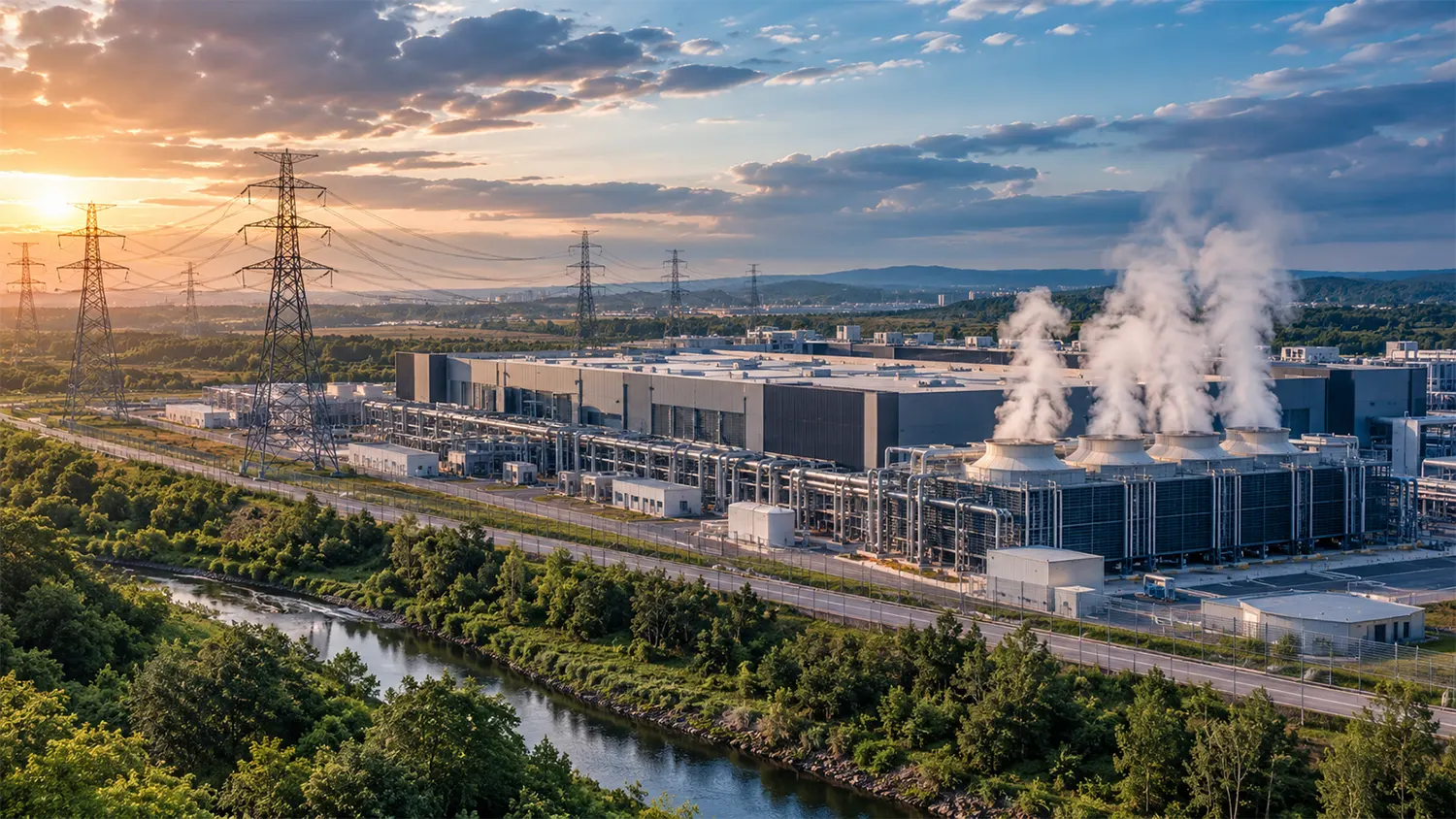
Artificial intelligence is transforming the way people work, communicate, and access information. From chatbots and image generators to automated business systems, AI is rapidly becoming part of everyday life. Behind this digital revolution, however, lies a growing network of physical infrastructure that requires enormous amounts of electricity, water, land, and raw materials.
At the center of this expansion are data centers, the facilities that house the powerful computers responsible for training and operating AI systems. Although cloud computing and AI services may appear to exist entirely online, their operations depend on thousands of physical servers running around the clock.
As demand for generative AI grows, technology companies are racing to build larger and more powerful facilities. This expansion is creating new environmental challenges, particularly in regions where electricity grids, water supplies, and other resources are already under pressure.
The issue goes beyond how much electricity AI consumes. It also raises questions about where that electricity comes from, how servers are cooled, what happens to outdated hardware, and whether the infrastructure being built today could lock communities into decades of additional pollution.
The AI revolution may be digital, but its environmental costs are increasingly physical.
AI’s Growing Appetite for Electricity Is Putting Power Grids Under Pressure
The rapid expansion of AI has made electricity consumption one of the biggest environmental concerns surrounding data centers.
Unlike ordinary office buildings, large data centers operate continuously. Their servers process enormous volumes of information, often requiring thousands of high-performance processors to work simultaneously. AI systems place particularly heavy demands on this infrastructure because training and running advanced models require substantial computing power.
According to the International Energy Agency (IEA), global data center electricity consumption reached approximately 415 terawatt-hours (TWh) in 2024, equivalent to around 1.5% of worldwide electricity consumption.
That figure is expected to grow considerably.
The IEA’s 2026 outlook estimates that global data center electricity consumption reached approximately 485 TWh in 2025. Under its central projection, demand could approach 950 TWh by 2030, nearly doubling within five years. That would represent electricity consumption comparable to that of a major industrialized country.
AI is a major driver of this growth, although conventional cloud computing, streaming, online services, and other digital activities also contribute.
Why AI Data Centers Need So Much Power
AI servers use specialized processors, particularly graphics processing units (GPUs), designed to perform large numbers of calculations simultaneously.
These processors are powerful but energy-intensive. When thousands operate together in a single facility, their combined electricity requirements can reach levels comparable to those of large industrial operations.
The challenge is that data centers need reliable electricity 24 hours a day, seven days a week. Even a short interruption can disrupt services, damage equipment, or affect businesses that depend on continuous computing access.
Solar and wind energy can supply substantial amounts of clean electricity, but their output changes with weather conditions and time of day. Without sufficient storage, grid connections, or other dependable power sources, they cannot independently guarantee uninterrupted electricity at every moment.
As a result, natural gas and other conventional power sources remain part of the energy mix supporting data center expansion.
The IEA expects renewable energy to supply a substantial share of additional electricity demand, but it also projects growth in natural gas generation. Nuclear power is expected to contribute as well, particularly as technology companies seek reliable low-carbon electricity.
Local Communities Feel the Pressure First
Although data centers account for a relatively small share of global electricity consumption, their impact can be much greater in areas where facilities are concentrated.
Northern Virginia, for example, has become one of the world’s largest data center markets. Ireland has also experienced rapid growth in the sector.
In Ireland, data centers accounted for 22% of national electricity consumption in 2024, up from just 5% in 2015. The country’s electricity regulator has projected that this share could rise further as already contracted facilities come online.
When large facilities connect to an already strained electricity network, utilities may need to invest in additional power plants, substations, and transmission lines.
These infrastructure upgrades can create financial pressure, particularly when the costs are passed on to electricity customers.
In some regions, the immediate demand has also encouraged utilities to extend the operation of existing fossil fuel power plants or consider additional natural gas capacity.
This creates a difficult situation: the expansion of supposedly futuristic technology can increase dependence on some of the oldest sources of energy.
The Hidden Water Cost of Keeping AI Servers Cool
Electricity is only part of the environmental challenge. Data centers also require substantial cooling systems to prevent their servers from overheating.
High-performance AI processors generate considerable heat, particularly when operating at full capacity. Without effective cooling, temperatures can rise to levels that reduce performance, damage equipment, or cause system failures.
To manage this heat, many traditional data centers use cooling towers, chillers, and other systems that consume electricity and, in some cases, large quantities of freshwater.
Why Cooling Systems Consume Freshwater
One common cooling method relies on evaporation.
Water absorbs heat from the facility and is released into the atmosphere as vapor. This process helps lower temperatures, but the evaporated water must be replaced with fresh supplies.
At large facilities, daily consumption can reach substantial levels, potentially competing with the needs of nearby households, agriculture, and local industries.
The problem becomes more serious when data centers are constructed in regions already experiencing water shortages.
Parts of Arizona, Texas, Spain, and other water-stressed areas have become attractive locations for data center development because of available land, infrastructure, or favorable business conditions.
However, a facility that requires additional freshwater during an already hot and dry summer can place considerable pressure on local water resources.
There is also a less visible part of the problem. Power plants supplying electricity to data centers may consume water for their own cooling processes. Semiconductor manufacturing also requires large amounts of highly purified water.
This means the water footprint of AI extends beyond the cooling equipment inside individual data centers.
Why Data Centers Cannot Simply Use Seawater
With freshwater becoming an increasingly sensitive resource, using seawater for cooling may appear to be an obvious alternative, particularly for facilities located near coastlines.
However, seawater cannot simply be pumped into conventional cooling equipment without specialized engineering.
Its high salt content can cause corrosion, mineral deposits, and damage to ordinary metal pipes and heat exchangers. Direct contact with sensitive server components would also create serious equipment risks.
That does not mean seawater is unsuitable for data center cooling altogether.
Some systems use seawater as an external cooling source, transferring heat through specialized heat exchangers while keeping the salty water separate from the internal cooling circuit.
This approach can reduce reliance on freshwater, although it requires suitable coastal infrastructure, corrosion-resistant materials, and careful management of environmental impacts.
Desalination is another possibility, but converting seawater into freshwater requires additional infrastructure and energy.
For many facilities, the more practical solution is to reduce freshwater consumption through improved cooling technology and alternative water supplies.
Waste Heat Could Become Another Environmental Concern
The electricity consumed by data centers does not simply disappear. Almost all of it eventually becomes heat that must be removed from the facility.
This creates another environmental challenge as increasingly large computing facilities are built close to residential neighborhoods and urban areas.
Large facilities release substantial amounts of warm air through their cooling systems. Depending on their size, location, surrounding buildings, and atmospheric conditions, this waste heat may contribute to localized temperature changes.
Research into the thermal effects of large data center clusters is still developing. The precise impact varies between locations, and findings should not be generalized to every facility.
Nevertheless, the issue deserves attention, particularly as data center campuses become larger and more concentrated.
Waste heat is not necessarily an unavoidable environmental loss. Some facilities can capture and reuse it to provide heating for nearby buildings, industrial processes, or district heating networks.
The challenge is making these systems economically practical and ensuring that suitable users are located close enough to benefit from the recovered heat.
The Environmental Cost of AI Hardware Goes Beyond Electricity
The environmental footprint of AI does not begin when a data center switches on. It starts much earlier, during the extraction of raw materials, manufacturing of computer components, and construction of the facilities themselves.
Modern AI infrastructure depends on specialized processors, memory systems, storage devices, cooling equipment, and complex networking hardware.
Producing these components requires energy, water, and materials from global supply chains.
Mining and Manufacturing Put Pressure on Natural Resources
Advanced semiconductor manufacturing depends on materials such as silicon, copper, and various specialized metals.
Extracting and processing these resources can cause environmental damage, including land disturbance, water pollution, and greenhouse gas emissions.
Chip manufacturing is also particularly demanding. Semiconductor fabrication facilities require carefully controlled environments and highly purified water to prevent contamination during production.
Beyond the chips themselves, building large data center campuses requires enormous quantities of concrete, steel, and other construction materials.
These activities generate embodied carbon emissions: greenhouse gas emissions associated with manufacturing, transporting, and constructing the infrastructure before it even begins operating.
This is an important distinction because a company may purchase renewable electricity to operate its data center while still relying on carbon-intensive supply chains to manufacture its servers and construct its buildings.
The Growing Problem of Electronic Waste
AI hardware also creates a waste management challenge.
Technology companies continuously seek faster and more efficient processors to remain competitive. As newer generations of AI chips become available, older equipment may be replaced even when it remains functional.
This creates a growing stream of discarded servers, circuit boards, storage devices, and other electronic components.
A 2024 study published in Nature Computational Science estimated that generative AI could produce a cumulative 1.2 million to 5 million tonnes of electronic waste between 2020 and 2030, depending on how quickly the technology expands and how long equipment remains in use. Nature
However, these projections remain uncertain. A 2026 reassessment argued that earlier estimates may have overstated future waste because they assumed shorter server lifespans than some operators actually experience.
The revised research estimated that AI servers could generate approximately 131,000 to 225,000 tonnes of electronic waste annually by 2030.
Regardless of which projection proves more accurate, the underlying challenge remains: discarded AI hardware contains valuable materials that require proper recovery and recycling.
Without effective recycling systems, electronic waste can become a serious environmental and public health problem, particularly in countries where waste processing infrastructure is limited.
Why AI Could Make Climate Change Harder to Fight
The environmental consequences of data center expansion extend beyond their direct electricity and water consumption.
One of the biggest concerns is that the infrastructure being built to support AI today could create long-term dependence on fossil fuels.
New Gas Power Plants Could Lock In Decades of Emissions
Electricity grids cannot always expand quickly enough to accommodate the sudden arrival of massive data center projects.
Building transmission lines, upgrading substations, and developing new renewable energy facilities can take years.
Some developers and utilities therefore consider dedicated natural gas generation to secure a more immediate and reliable electricity supply.
The problem is that power plants are long-term investments. Once built, they are generally expected to operate for many years.
This creates the risk of fossil fuel lock-in: infrastructure constructed to support today’s AI boom could continue producing greenhouse gas emissions long after computing technology becomes more energy-efficient.
The IEA estimates that indirect carbon dioxide emissions from data center electricity consumption were approximately 180 million tonnes in 2024, equivalent to around 0.5% of global combustion-related CO₂ emissions.
Although that share is relatively small, the agency expects these emissions to grow significantly over the coming decade.
The Carbon Footprint of Building Data Centers
Another important issue is the carbon emissions associated with manufacturing and construction.
A data center’s operational emissions are only part of its environmental footprint.
Manufacturing AI processors, producing servers, transporting equipment, and constructing large facilities all generate emissions.
Concrete and steel are particularly important because they are among the most carbon-intensive materials used in modern construction.
Semiconductor production adds another layer of complexity through energy-intensive manufacturing processes and the use of specialized industrial gases.
This means renewable electricity alone cannot eliminate the entire environmental footprint of an AI data center.
Reducing its overall impact also requires cleaner manufacturing, longer equipment lifespans, more efficient construction, and responsible material sourcing.
AI Efficiency Does Not Automatically Mean Lower Emissions
There is another complication: improvements in technology do not always translate into lower overall resource consumption.
As AI chips become more efficient, running AI systems can become cheaper.
That lower cost may encourage businesses and consumers to use AI more frequently and across more applications.
This is known as the rebound effect.
For example, an AI model that becomes cheaper to operate may be integrated into more software products, business processes, and online services. Although each individual task requires less energy, the total number of tasks can increase enough to offset some of the efficiency gains.
AI also has a complicated relationship with the fossil fuel industry.
Energy companies already use AI to improve exploration, production, maintenance, and operational efficiency in oil and gas operations.
At the same time, AI can help optimize electricity grids, improve renewable energy forecasting, and identify opportunities to reduce industrial energy consumption.
The IEA recognizes both sides of this equation. Its assessment suggests that AI could help reduce emissions through existing applications, but those potential benefits depend on widespread adoption and effective implementation.
AI is therefore neither automatically good nor automatically bad for the climate. Its overall impact depends on how the technology is powered, deployed, and regulated.
How Technology Companies Are Trying to Reduce the Environmental Impact
Growing scrutiny from governments, environmental organizations, and local communities has pushed technology companies to reconsider how they design and operate data centers.
Several approaches are emerging, although their effectiveness depends on how they are implemented.
1. Moving Toward Nuclear and Renewable Energy
Major technology companies are increasingly seeking long-term electricity agreements with renewable energy developers and nuclear power operators.
Solar and wind projects can supply substantial amounts of clean electricity, particularly when combined with battery storage and reliable grid connections.
Nuclear energy offers another option because it can generate electricity continuously without producing direct carbon dioxide emissions during operation.
Companies such as Microsoft, Google, and Amazon have explored or pursued agreements involving nuclear power, renewable electricity, and other low-carbon energy sources.
However, simply purchasing renewable energy certificates or signing electricity agreements does not necessarily mean a data center is powered by clean energy at every hour.
The more meaningful approach involves supporting additional clean electricity generation that can meet growing demand rather than relying exclusively on existing renewable capacity.
2. Replacing Traditional Cooling With Liquid Cooling
Traditional air-cooling systems become increasingly challenging as AI servers generate more heat in smaller spaces.
To address this, operators are adopting liquid cooling technologies.
One approach, known as direct-to-chip liquid cooling, circulates coolant through cold plates attached directly to processors. This allows heat to be transferred more efficiently than relying exclusively on fans and chilled air.
Another option is immersion cooling, where servers or specific components are placed inside specially designed dielectric fluids that absorb heat.
These technologies can improve cooling efficiency and support higher computing densities.
Some facilities are also adopting closed-loop systems that continuously circulate cooling fluid rather than repeatedly consuming freshwater through evaporation.
However, the water savings depend on the overall cooling design. A closed-loop system does not automatically eliminate water consumption if the facility still relies on evaporative cooling elsewhere.
3. Using Recycled Water Instead of Drinking Water
Another strategy is to reduce competition with local communities by replacing potable water with alternative sources.
These include:
- Recycled wastewater treated for industrial applications.
- Greywater from household and commercial activities.
- Reclaimed water from municipal treatment facilities.
- Other suitable non-potable industrial water supplies.
This approach can reduce pressure on drinking water supplies, particularly in areas experiencing water scarcity.
However, recycled water must meet appropriate quality standards to prevent mineral deposits, biological growth, and corrosion in cooling equipment.
4. Improving Energy Efficiency Across Data Centers
Technology companies are also working to improve the efficiency of their entire computing infrastructure.
One commonly used measurement is Power Usage Effectiveness (PUE).
PUE compares the total electricity consumed by a data center with the electricity used directly by its IT equipment. A lower figure indicates that less energy is being spent on supporting infrastructure such as cooling, lighting, and power distribution.
Singapore, for example, has introduced a Green Data Centre Roadmap designed to support the growth of digital infrastructure while improving energy efficiency.
The initiative aims to bring data centers toward a PUE of 1.3 or lower over the next decade, alongside greater adoption of liquid cooling and low-carbon energy.
Other efficiency measures include improving server utilization, extending hardware lifespans, and recovering waste heat for other applications.
Governments Are Starting to Put Environmental Limits on Data Center Expansion
As the environmental and infrastructure costs become more visible, governments are increasingly recognizing that data center development cannot be treated solely as a technology or investment issue.
Electricity availability, water security, emissions, and community interests are becoming important considerations in planning new facilities.
However, there is no single international regulatory framework governing the environmental impact of data centers. Different countries are adopting different approaches based on their infrastructure and economic priorities.
Europe: Mandatory Environmental Reporting
The European Union has introduced reporting requirements under its Energy Efficiency Directive.
Under Delegated Regulation (EU) 2024/1364, data centers with an installed IT power demand of at least 500 kilowatts (kW) must report key performance indicators.
These include electricity consumption, renewable energy use, water consumption, cooling efficiency, and waste heat reuse.
The information is collected through a European database to improve transparency and help policymakers assess the environmental performance of data centers.
This approach is important because governments cannot effectively regulate environmental impacts without reliable information about how much energy and water facilities actually consume.
Ireland has also introduced stricter conditions for new data center connections.
In December 2025, the Commission for Regulation of Utilities published a new policy requiring qualifying new facilities to provide generation or storage capacity matching their requested maximum electricity import capacity.
Operators must also meet at least 80% of their annual electricity demand through additional renewable energy projects in Ireland, with a six-year period to develop the required renewable generation.
United States: Protecting Electricity Customers and Local Communities
In the United States, environmental and infrastructure concerns have increasingly become part of state and local political debates.
Virginia, one of the world’s largest data center markets, has faced questions about electricity costs, grid expansion, and the financial burden placed on residential customers.
Other states have considered stronger regulations, including environmental assessments, electricity rate protections, and restrictions on new construction.
New York took a particularly significant step in July 2026, when Governor Kathy Hochul announced a one-year moratorium on new hyperscale data centers through an executive action.
The measure was intended to provide time to examine the environmental and infrastructure consequences of large data center developments while developing stronger protections for electricity customers and host communities.
These developments illustrate a growing debate in the United States: how to support AI competitiveness without allowing the costs of expansion to fall disproportionately on local communities.
Asia-Pacific: Balancing Digital Growth With Limited Resources
Asia-Pacific is becoming an increasingly important region for data center investment.
Singapore, Malaysia, and Indonesia are among the markets attracting interest from international technology companies seeking to expand their computing infrastructure.
However, the region faces particular challenges involving land availability, electricity supply, water security, and tropical temperatures.
Singapore offers an example of how governments can connect data center expansion with efficiency requirements.
Its Green Data Centre Roadmap aims to increase available computing capacity while encouraging more efficient infrastructure and greater use of green energy.
China has also pursued a strategy known as Eastern Data, Western Computing, which encourages the development of computing infrastructure in western regions with access to energy resources, rather than concentrating all facilities in major eastern population centers.
For Southeast Asia, the environmental implications are particularly important.
Malaysia’s Johor region and Indonesia’s Batam and Jakarta areas have attracted growing interest from data center developers.
However, investment growth also raises questions about whether local electricity networks, water supplies, and supporting infrastructure can accommodate additional demand without creating pressure on existing communities.
For Indonesia in particular, the challenge is to ensure that the expansion of digital infrastructure is accompanied by responsible energy planning, sustainable water management, and transparent environmental assessments.
Can the AI Industry Grow Without Increasing Environmental Damage?
The rapid expansion of AI presents a difficult question for governments, technology companies, and society.
On one hand, artificial intelligence offers significant opportunities. It can improve industrial efficiency, help researchers develop new materials, optimize electricity networks, and support the integration of renewable energy.
On the other hand, the infrastructure required to deliver these benefits consumes resources and generates emissions.
The challenge is not simply to build more efficient data centers. It is to ensure that improvements in computing technology translate into meaningful reductions in the industry’s total environmental footprint.
That requires several changes to happen together.
Technology companies need to invest in additional low-carbon electricity generation, rather than relying on fossil fuel infrastructure to meet immediate demand. They must also improve cooling efficiency, reduce freshwater consumption, extend hardware lifespans, and invest in responsible electronic waste management.
Governments, meanwhile, need stronger environmental reporting requirements and planning systems that account for the combined impact of multiple facilities in the same region.
Local communities should also have access to reliable information about proposed projects, including their expected electricity demand, water consumption, environmental risks, and infrastructure costs.
Ultimately, the sustainability of AI will depend not only on how intelligent its technology becomes, but also on how responsibly the infrastructure behind it is developed.
The digital economy cannot remain environmentally invisible simply because its products exist on screens.
As AI becomes more deeply integrated into everyday life, the energy, water, land, and materials required to support it will become increasingly important public concerns.
The AI revolution is still expanding. Whether it becomes a driver of cleaner innovation or another source of environmental pressure will depend largely on the decisions being made today.