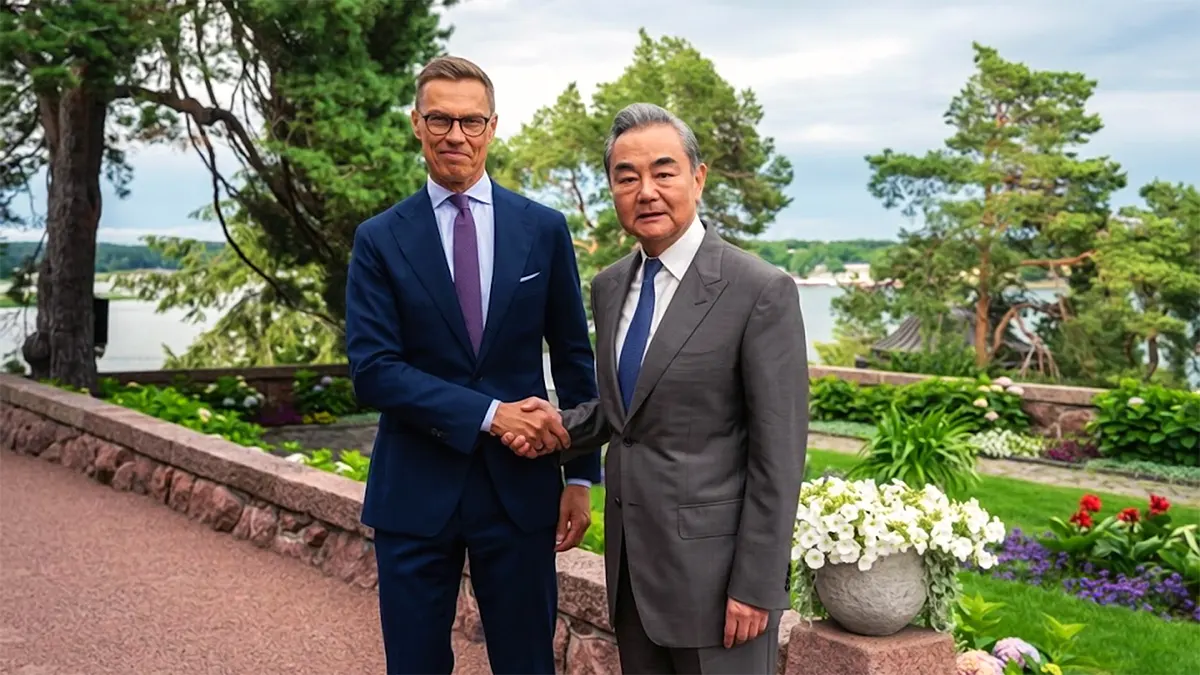
China and Finland reaffirmed their commitment to expanding cooperation in green technology, artificial intelligence (AI), and scientific innovation during Chinese Foreign Minister Wang Yi’s official visit to Finland, even as both sides exchanged views on European security and growing trade tensions between China and the European Union.
The high-level meetings, held in Helsinki and Turku, brought together Wang Yi, Finnish President Alexander Stubb, and Foreign Minister Elina Valtonen. While economic collaboration dominated the agenda, discussions also touched on sensitive geopolitical issues, including Russia’s war in Ukraine, EU-China trade relations, and stability in the Middle East.
The visit formed part of Wang’s broader diplomatic tour of Nordic countries, highlighting Beijing’s efforts to maintain dialogue with European partners despite an increasingly complex international landscape.
Green Technology and AI Lead Bilateral Agenda
A major outcome of the meetings was both countries’ shared interest in strengthening cooperation in future-oriented industries.
Finland and China agreed that sectors such as clean energy, artificial intelligence, and scientific research offer opportunities to expand economic ties while avoiding areas that carry greater political or security risks.
For Finland, the focus aligns with its global reputation in sustainability and technological innovation. China, meanwhile, continues to pursue large-scale investments in low-carbon development, creating potential opportunities for deeper commercial partnerships.
Officials also discussed implementing the China-Finland Joint Action Plan, which aims to increase trade and investment while building on Finland’s expertise in sustainable development.
During the talks, Foreign Minister Elina Valtonen referenced Chinese President Xi Jinping’s environmental philosophy that “lucid waters and lush mountains are invaluable assets,” signaling Finland’s interest in participating in China’s expanding green economy.
Ukraine and European Security Remain Central Issues
Although economic cooperation dominated much of the discussion, Finland made it clear that European security remains a top priority.
President Alexander Stubb and Foreign Minister Elina Valtonen raised concerns about Russia’s invasion of Ukraine, emphasizing that the conflict continues to undermine stability across Europe.
Finnish leaders encouraged China to play a constructive role in addressing international security challenges, arguing that progress on global peace is essential for maintaining healthy relations between China and Europe.
The leaders also exchanged views on the ongoing situation in the Middle East, reflecting broader concerns over regional stability.
Trade Frictions Between China and the EU Surface
Trade relations between Brussels and Beijing also featured prominently during the meetings.
Wang Yi reiterated China’s preference for dialogue, but cautioned that trade and investment consultation mechanisms should not become tools for unilateral pressure.
The Chinese foreign minister also encouraged Finland to play a constructive role within the European Union to help maintain what he described as “sound and steady” EU-China relations.
In response, Valtonen reaffirmed Finland’s support for constructive and rules-based negotiations, saying trade disputes should be resolved through meaningful dialogue rather than escalating into broader economic conflicts.
Finland’s Strategy: Cooperation Without Compromising Security
Finland’s approach toward China reflects what many European policymakers describe as “de-risking” rather than “decoupling.”
Instead of cutting economic ties with China, Finland continues to support cooperation in sectors considered low risk, including green technology, forestry innovation, digital solutions, and artificial intelligence.
At the same time, Helsinki maintains strict safeguards around critical infrastructure, telecommunications, and strategic technologies, particularly following its accession to NATO and its closer alignment with European security policies after 2022.
This approach allows Finland to protect national security while preserving valuable economic opportunities.
Balancing Economic Interests With NATO Commitments
Finland’s position is often viewed as a pragmatic balancing act, but officials stress that the country is not attempting to sit between competing geopolitical blocs.
On security matters, Finland remains firmly aligned with NATO and the European Union, particularly regarding Russia’s actions in Ukraine.
However, Finnish leaders also recognize China’s importance as one of the world’s largest trading partners.
Rather than pursuing full economic separation, Finland seeks to maintain cooperation in sectors where mutual benefits can be achieved without creating strategic vulnerabilities.
This strategy enables Helsinki to support European security objectives while continuing dialogue with Beijing on issues such as climate change, innovation, and sustainable economic development.
Diplomatic Signals Point to Continued Dialogue
The meetings also reaffirmed Finland’s longstanding adherence to the One-China policy, a cornerstone of diplomatic relations between the two countries.
President Stubb additionally acknowledged China’s global development, security, civilization, and governance initiatives as significant contributions to international dialogue, while emphasizing that continued engagement should be guided by mutual respect and practical cooperation.
Despite ongoing geopolitical challenges, both sides signaled that keeping communication channels open remains essential for managing differences and expanding cooperation where common interests exist.