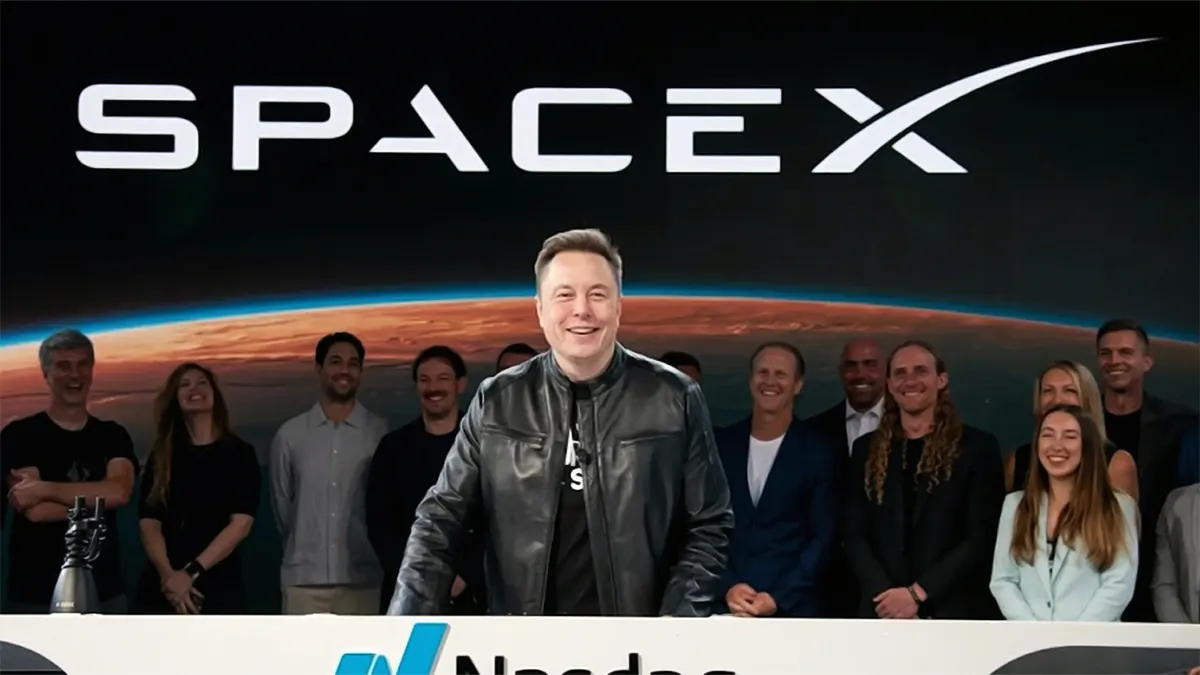
On Friday, June 12, 2026, Wall Street witnessed something it had never seen before. SpaceX, the rocket company Elon Musk kept private for 24 years finally rang the opening bell at the Nasdaq MarketSite in Times Square, and the numbers that followed were genuinely difficult to comprehend.
By the time the closing bell rang, Musk had crossed a threshold no human being had ever reached: a personal net worth of over $1 trillion.
$75 Billion Raised in a Single Day And It Still Wasn’t Enough to Stop the Surge
SpaceX hit the Nasdaq under the ticker SPCX at $135 per share, selling 555.6 million shares and raising $75 billion in one shot, the largest IPO in human history, easily eclipsing Saudi Aramco’s $29.4 billion record from 2019.
To put that gap in perspective: the difference between what SpaceX raised and what Aramco raised is, by itself, larger than Aramco’s entire record-setting offering.
But the offering price was just the starting gun.
The stock opened at $150, surged through the day, and briefly crossed $168 per share pushing the company’s total valuation past the $2 trillion mark intraday. By the closing bell, SPCX settled at $160.95, locking in a market cap of roughly $1.97 trillion on day one.
| Metric | Detail |
|---|---|
| IPO Price | $135 per share |
| Capital Raised | $75 billion |
| Opening Price | $150 per share |
| Day 1 Peak | ~$168/share (briefly above $2T) |
| Day 1 Close | $160.95 (~$1.97T market cap) |
How Musk Crossed $1 Trillion in a Single Trading Session
Before the listing, Musk’s net worth hovered around $813 billion already the largest in history, built largely on his Tesla stake (around $260 billion) and private holdings in ventures like xAI, Neuralink, and The Boring Company.
The problem, from a wealth-tracking standpoint, was that SpaceX was private. Index trackers and wealth calculators had to value his 42% stake conservatively, essentially discounting it because there was no live market price.
The IPO changed that instantly.
At the offering price of $135, Musk’s holdings jumped to over $690 billion in SpaceX alone, pushing his total net worth right to the edge of the trillion-dollar mark. The math was simple: the stock only needed to hold above $140 to push him over the line.
It didn’t just hold above $140. It ran to nearly $161.
By the closing bell, Musk’s estimated net worth stood at $1.14 trillion, a figure that now exceeds the entire annual GDP of countries like Saudi Arabia, the Netherlands, or Turkey.
The wealth surge didn’t stop with Musk. The massive valuation spike turned an estimated 4,400 current and former SpaceX employees into paper millionaires overnight.
The Index Wars: Why Nasdaq and Russell Rewrote Their Own Rules
The SpaceX IPO didn’t just break wealth records, it broke the plumbing of passive investing.
Traditionally, index inclusion rules exist to protect everyday investors. A “seasoning” period forces newly public companies to trade for months before index funds are required to hold them, giving markets time to stabilize wild opening-day prices. For a company the size of SpaceX, though, waiting months meant trillions of dollars of the U.S. economy would be invisible to index funds that are supposed to mirror it.
Index providers responded but not in the same way.
Nasdaq moved fast. Effective May 1, 2026, it introduced new “Fast Entry” rules specifically designed for ultra mega cap IPOs. Any new listing ranking in the Top 40 by market cap roughly anything above $100 billion can skip the seasoning period entirely and enter the Nasdaq-100 just 15 trading days after debut.
Nasdaq also quietly eliminated its 10% minimum public float requirement for mega-caps, replacing it with a weighting multiplier of up to 3x the actual float. This mattered enormously for SpaceX, because Musk is only floating less than 5% of the company publicly which would have disqualified it under the old rules.
FTSE Russell moved even faster. Its updated rules, effective May 26, 2026, allow mega-cap IPOs to qualify for the Russell 1000 just five trading days after going public, down from the previous standard of waiting for quarterly reconstitution.
Why the S&P 500 Is Making SpaceX Wait And It Has Three Good Reasons
While Nasdaq and Russell opened the floodgates, S&P Dow Jones Indices is holding the line. Don’t expect to see SPCX in the S&P 500 anytime soon.
First, the 12-month seasoning rule. The S&P 500 mandates that any newly public company must trade for at least 12 consecutive months before it can even be reviewed for inclusion. The committee wants to see how the stock performs through multiple earnings cycles not just opening-day retail euphoria.
Second, the profitability requirement. Unlike Nasdaq or Russell, the S&P 500 requires companies to be genuinely profitable under GAAP accounting standards. Specifically, the sum of the most recent four consecutive quarters of earnings must be positive. SpaceX generated $18.7 billion in revenue in 2025 but its aggressive spending on Starship development and planetary projects produced a net loss of $4.9 billion. Until that flips to sustained profit, the S&P 500 door stays closed.
Third, the human element. The Nasdaq-100 and Russell 1000 are rule-based, formulaic indexes hit the metrics, get in automatically. The S&P 500 is governed by a live Index Committee that meets regularly and weighs corporate governance. With Elon Musk controlling roughly 84.4% of SpaceX’s voting power, the committee will almost certainly take its time assessing the concentration risk before opening that door.
Retirement Accounts Are Now “Forced Buyers” And Not Everyone Is Happy About It
Because of the accelerated Nasdaq and Russell rule changes, institutional index funds tracking those benchmarks will be forced to buy billions of dollars of SPCX within days whether fund managers want to or not.
That’s triggering fierce backlash.
U.S. Senator Elizabeth Warren and pension comptrollers from New York, Illinois, and Maryland have publicly criticized both Nasdaq and FTSE Russell, arguing that rushing a volatile, low-float, unseasoned stock into benchmarks effectively turns everyday retirement accounts into forced buyers with no say in the matter. When your 401(k) tracks the Nasdaq-100, it has to own whatever the Nasdaq-100 owns.
Wall Street Isn’t Just Buying a Rocket Company, It’s Buying Three Massive Businesses at Once
The $2 trillion question everyone is asking: how do you justify that valuation?
The answer is that investors aren’t pricing SpaceX as a rocket company. They’re pricing it as three separate, massive growth engines rolled into a single ticker.
The core infrastructure play is SpaceX’s near-total monopoly on getting things into orbit. Over the past three years, SpaceX has been responsible for more than 80% of all mass launched into orbit globally. Wall Street views Falcon 9 and the rapidly scaling Starship program as the exclusive “railroad tracks” of the space economy, the infrastructure every competitor and customer fundamentally depends on.
The recurring revenue engine is Starlink, which has scaled past 10 million global subscribers and is now entering its monetization phase evidenced by the plan price increases implemented in May 2026. Investors are valuing it like a high-margin global telecom monopoly with zero regional infrastructure limitations, because that’s essentially what it is.
The exponential upside bet is the xAI and X merger, formally completed in February 2026. This legally fused Musk’s AI venture and X’s technology stack directly into SpaceX, creating something analysts struggle to categorize. The Grok AI model feeds continuously on X’s real-time data firehose. In 2025 alone, $12.7 billion of SpaceX’s capital expenditure went into AI infrastructure, primarily funding the Colossus data center in Memphis currently the largest coherent AI training cluster on Earth. Bulls see a closed-loop future where xAI’s models optimize rocket telemetry, manage Starlink’s satellite routing, and power future robotics, all on a private data network with no equal.
The Bear Case Isn’t Going Away Quietly
Not everyone is celebrating. Institutional critics argue that folding xAI into SpaceX was a defensive move to obscure heavy AI losses. The AI segment alone burned through $6.4 billion in operating losses in 2025, dragging the entire company into the red.
The skeptic’s argument: instead of buying a clean, focused aerospace leader, public investors are being asked to bankroll an incredibly expensive, speculative AI arms race that happens to have rockets attached.
Whether that concern gets priced in or dismissed over the coming months will define whether SPCX’s historic first-day pop holds up, or becomes the opening chapter of a very different kind of story.