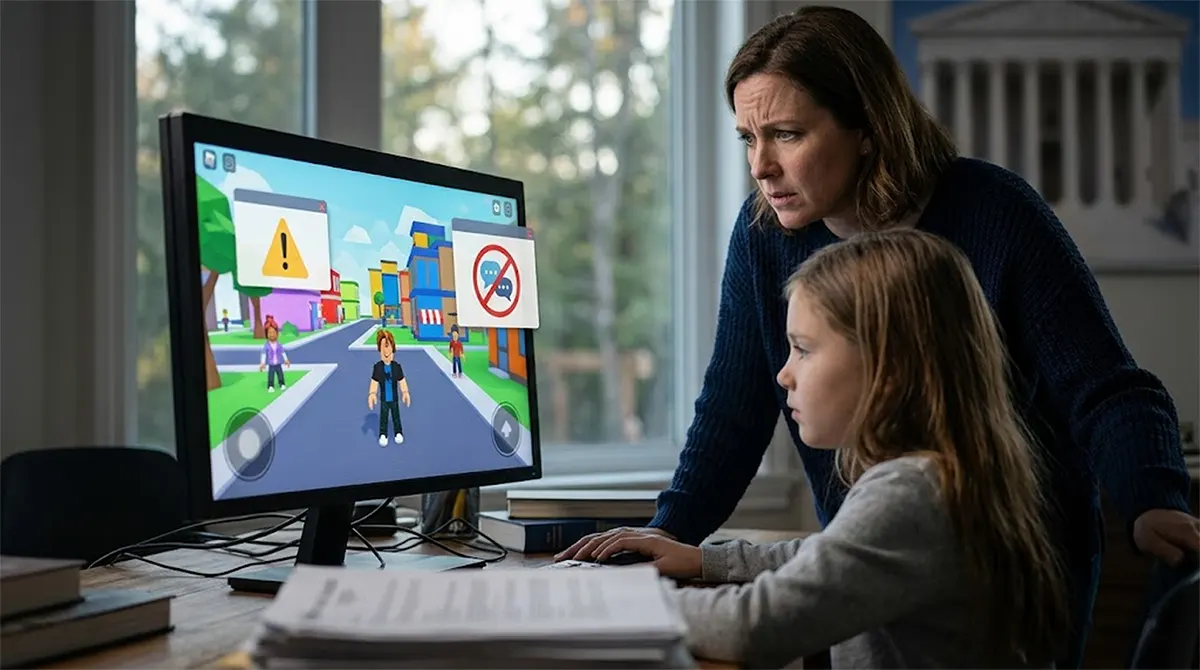
For years, Roblox sold parents a simple, reassuring idea: a creative, colorful, family-friendly world where kids could build, play, and explore safely. Hundreds of millions of families believed them. The numbers were extraordinary over 70 million daily players, many of them children under 13, logging in from bedrooms around the world.
The problem is that the reality inside that virtual playground looked very different from the marketing. And now, governments, courts, and devastated families are making sure the bill comes due.
The Legal Avalanche That Forced Roblox to Act
Roblox didn’t overhaul its platform because leadership suddenly grew a conscience. It overhauled because the legal and financial pressure became impossible to ignore.
Several U.S. states went on the offensive, suing Roblox over broken safety systems and misleading parents about the true risk to children. Nevada reached a $12 million settlement. Alabama followed with $12.2 million, and West Virginia with $11 million. Texas, Indiana, and Nebraska have active ongoing lawsuits still working through the courts.
The Los Angeles County Counsel filed what may be the most scathing lawsuit of all, one that didn’t mince words. The filing accused Roblox of designing its platform so that children become, in its exact framing, “easy prey for pedophiles.” The county sued for public nuisance and false advertising, arguing that Roblox’s moderation and age-verification systems had been fundamentally broken for years while the company kept assuring parents everything was fine.
Beyond government action, mass tort law firms consolidated over 100 individual civil lawsuits from families across the country. These cases document real-world horrors: children groomed through unmoderated in-game chat, exposed to sexually explicit user-generated content, and lured off-platform to apps like Discord where predators escalated the abuse. One law firm filing describes a 15 year old boy from Texas who took his own life after being blackmailed by a predator he met on Roblox.
The core accusation across all of this litigation is the same: Roblox knowingly chose not to implement strict age verification or heavy chat restrictions for years because doing so would have slowed user growth. Critics argue the company chose stock valuations over children’s safety and the lawsuits are the receipt.
The Numbers Behind the Crisis
Because Roblox treats internal data like a corporate secret, the full picture only emerged through federal investigations and court records. What came out was staggering.
By law, tech companies must report suspected child sexual exploitation to the National Center for Missing and Exploited Children (NCMEC). A U.S. Senate Judiciary Committee investigation found that Roblox filed over 65,000 such reports in a single year and federal authorities publicly criticised the company because many of those reports were missing critical data like geographic location, making it nearly impossible for police to act on them.
Criminal records show that at least 30 people have been arrested and prosecuted in the U.S. for abducting or sexually abusing children they first contacted on Roblox. In several cases, predators used the promise of free Robux or rare in-game items to convince children as young as 11 to sneak out of their homes to meet them.
Perhaps most alarming is the discovery of organised grooming networks not lone bad actors, but coordinated groups like the cyber network known as “764” or “CVLT” that deliberately used Roblox as their primary recruiting ground. These groups created friendly-looking avatars, joined popular children’s games, and systematically targeted vulnerable kids before using emotional manipulation or blackmail to push them onto Discord or Snapchat, where the abuse escalated.
When a company generates 65,000 internal red flags in a single year and still faces hundreds of lawsuits from parents, the argument that this is a fringe problem collapses entirely. At Roblox’s scale over 70 million daily players even a fraction of a percent of bad actors translates to tens of thousands of children at risk every single day.
What Roblox Actually Changed (And What It Couldn’t Fix)
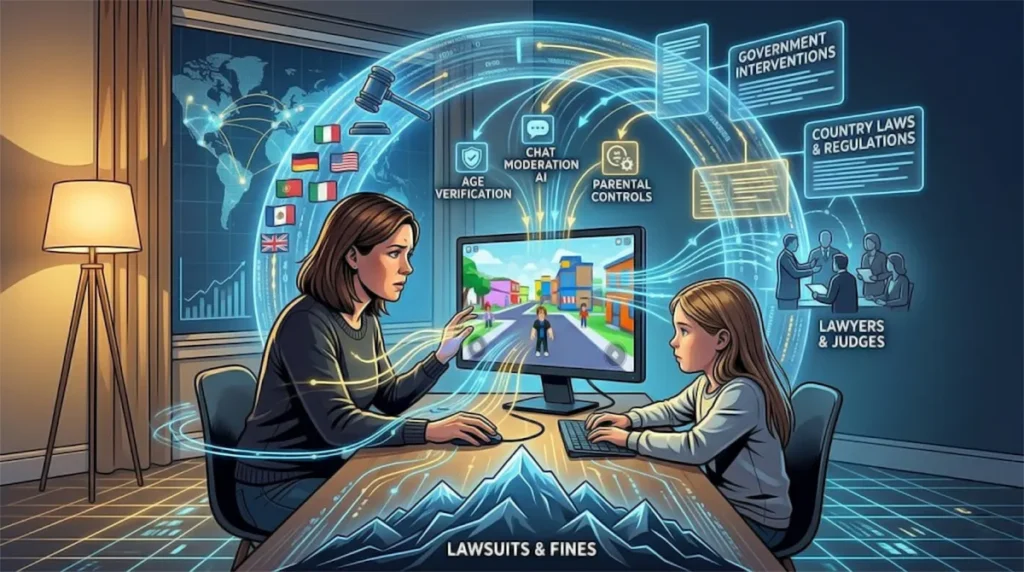
Under overwhelming legal pressure, Roblox made structural changes that are genuinely significant even if they arrived years too late.
The biggest loophole for years was embarrassingly simple: children could just lie about their birth year when signing up, and predators could do the same to pose as minors. Roblox closed this with AI-powered facial age estimation, users must now take a live selfie to access chat features or age-restricted spaces. An algorithm estimates their age range in real time.
For the youngest users, Roblox Kids (ages 5–8) now has all text chat and direct messaging disabled by default. Nobody can talk to them, and they cannot talk to anyone, unless a parent manually enables it. For the 9–15 bracket, chat is restricted to the same age group or verified “Trusted Friends.”
One of the most legally damning revelations in the lawsuits was that Roblox had been using end to end encryption on private messages which sounds privacy-friendly but meant that neither parents nor law enforcement could see what predators were sending to children. As part of the settlements, that encryption was removed for minor accounts, allowing real-time scanning for grooming behaviour.
Roblox also banned users under 16 from accessing entire categories of games, specifically social hangouts (virtual lounges with no gameplay objective) and free-form drawing games (shared digital whiteboards), which predators had used to isolate and corner children.
The consensus among child safety experts is that these changes genuinely raised the floor, the platform is meaningfully harder to exploit than it was even two years ago. But the problem has never been purely technical. Predators adapt. Experts report that bad actors have already shifted tactics, using encoded language and rapid trust-building to migrate children to other platforms within the first two minutes of contact. The new systems are a stronger shield, but not an invisible wall.
Countries That Simply Pulled the Plug
While some governments pushed Roblox to reform, others decided they were done waiting entirely.
Egypt and Algeria issued permanent nationwide bans. Algerian officials explicitly stated that large numbers of children under ten were being exposed to sexual harassment, fraud, and scams on the platform. Turkey imposed a full national block over severe child exploitation risks. Iraq banned it after government safety studies concluded the open communication features left young people dangerously exposed. Qatar and Oman followed after large-scale campaigns from worried parents and advocacy groups.
China has had Roblox blocked for years. A heavily moderated partnership with Tencent attempted a local launch but was shut down shortly after. Russia and North Korea maintain permanent blocks.
Other countries chose intervention over outright bans. Indonesia and New Zealand imposed partial restrictions, particularly blocking younger users from open-world social spaces. Australia and the UK dragged Roblox executives into regulatory meetings, the UK’s Online Safety Act now gives the government power to fine Roblox up to 10% of global revenue and, more significantly, to criminally prosecute tech executives if they willfully ignore child exploitation on their platforms. The Netherlands and Belgium banned specific monetization mechanics entirely, rendering certain popular games unplayable without developer changes.
The scale of this global response sends an unmistakable signal: when a platform grows so large it can no longer police itself, some governments are willing to cut off access entirely rather than wait for voluntary reform.
The CEO Who Pitched Roblox as a Dating App
If there’s one moment that crystallised public fury at Roblox’s leadership, it was CEO David Baszucki publicly suggesting that Roblox could serve as a great online dating platform to help lonely adults connect on an app where roughly 40% of daily active users are under 13.
On a major tech podcast, Baszucki framed adult virtual dating as a solution to a “loneliness epidemic,” arguing it would be restricted to ID-verified, 21-plus sections of the platform. Safety experts immediately dismantled the logic.
The analogy that went viral: “a love hotel next to a kindergarten.” Even a walled-off adult section concentrates millions of romance-seeking adults onto a children’s ecosystem. Given that teenagers routinely bypass Roblox’s age gates using older siblings’ IDs or system bugs, adding an explicit incentive like virtual dating rooms only increases the pressure on those already-flawed barriers.
When asked on the same podcast about predators targeting children on Roblox, Baszucki said the company viewed the problem “not necessarily just as a problem, but an opportunity as well.” The backlash was swift and wide across the gaming and child safety communities.
From a pure stock-market perspective, the logic is grimly rational. Roblox has a structural problem: kids grow up. Players who join at age eight often leave by 14 or 15, moving on to Fortnite, Call of Duty, or traditional social media. Baszucki is trying to sell Wall Street on the idea that Roblox is a metaverse for all ages not a children’s toy with a ceiling. The problem is that you cannot casually mix a digital sandbox for primary schoolers with a social discovery network for adults without creating exactly the kind of security nightmare that is already the subject of 100-plus lawsuits.
Doing Just Enough Not to Lose in Court
The deeper frustration shared by child safety advocates, government officials, and digital well-being researchers is the persistent sense that Roblox is doing the minimum required to survive legally, not the maximum required to protect children.
For years, Roblox’s standard defence against criticism was pointing parents toward its parental controls dashboard. Researchers like Jonathan Haidt, author of The Anxious Generation, filed formal FTC complaints arguing this was a classic corporate deflection. By saying “Here are the tools, you manage it,” Roblox avoided having to redesign the platform to be safe by default. The controls were often confusing for busy parents to navigate, while the game itself was engineered to be as engaging and addictive as possible for children.
More damaging still: state legislators revealed that Roblox has actively lobbied against digital safety bills, including the App Store Accountability Act legislation that would require honest age ratings and transparency about dangers inside apps. Accurate warnings would frighten parents away, drop download numbers, and hurt investor confidence. So Roblox fought the warnings.
Community trust took another hit when reports surfaced that Roblox banned a prominent creator who had been actively tracking and exposing paedophiles on the platform. Rather than partnering with community members willing to help clean up the virtual streets, the company appeared more concerned with the bad publicity and went after the whistleblower.
Implementing absolute safety measures, mandatory legal ID verification for every account, shutting down open social spaces entirely would devastate Roblox’s player base and tank its stock price. So many experts believe the company will continue operating the same way most large tech platforms do: doing enough to stop the next lawsuit, while keeping the platform as open and addictive as possible to protect the bottom line.
What Governments Are Doing And What They Can’t Replace
The era of letting tech companies self-regulate is, at least officially, over. The UK’s Online Safety Act, the EU’s Digital Services Act, and state-level laws across the U.S. are all moving in the same direction: make platforms safe by default, or face criminal consequences not just fines.
California’s Age-Appropriate Design Code bans addictive features and dark patterns targeting minors. States including Utah, Arkansas, Texas, and Louisiana now require platforms to verify user ages and obtain explicit parental consent before allowing minors to create accounts.
But government regulation moves slowly. Technology and human behaviour move fast. Every time a law bans a specific feature, developers find a workaround, or predators adjust their approach. Laws can raise the floor of the platform. They cannot replace a parent who talks regularly with their child about who they’re playing with online, keeps gaming devices in common family areas, and knows what grooming warning signs look like.
The systems are better than they were. The problem hasn’t been solved. And for parents of children on Roblox or any large online platform, the most important moderation tool still lives outside the app entirely.