Ever since news of the U.S.-Iran peace framework broke, one number has dominated the headlines, the outrage cycles, and the comment sections: $300 billion. Critics are calling it a “Marshall Plan for Iran.” Supporters say it’s the key to regional stability. And everyone seems to have a different answer for where the money is actually coming from.
Here’s the truth and it’s more complicated, and more interesting, than either side is letting on.
First, Let’s Kill the Biggest Myth
The claim spreading fastest on social media is that the United States government is handing Iran $300 billion in direct aid. This is false.
Both President Trump and Vice President JD Vance have explicitly stated that not a single dollar of this comes from U.S. taxpayers or the federal government. Trump went further, posting on social media to call the idea of a direct U.S. government payout “fake news.” Speaking at the G7 in France, he was blunt: “We’re not putting up 10 cents… We do not have a fund.”
So if the U.S. government isn’t writing the check, what exactly is the $300 billion?
It’s a Private Investment Fund And the Money Is Already Partly Committed
The Reconstruction and Development Fund, as it’s tentatively named in the peace framework, is structured entirely as a private-sector investment vehicle. Think of it less like foreign aid and more like a massive commercial venture capital pool, one aimed at rebuilding a country sitting on the world’s second-largest natural gas reserves and fourth-largest oil reserves.
Here’s where the money is expected to come from:
Private corporations are leading the charge. According to details leaked from the negotiations, more than half of the $300 billion roughly $150 billion or more has already been quietly committed by multinational corporations. These are energy conglomerates, logistics firms, and industrial manufacturers from Asia, Europe, South America, and Africa. The draw isn’t charity. Iran has a population of 92 million people and decades of untapped commercial potential that sanctions locked away. For global companies in mining, petrochemicals, and infrastructure, a sanctions-free Iran is one of the biggest commercial opportunities in a generation.
Gulf Arab states are expected to fill in the rest. Vice President Vance specifically pointed to a “Gulf Coast coalition” meaning wealthy oil-rich nations like Saudi Arabia and the UAE as the primary regional backers. The concept is straightforward: these neighbors provide credit lines and commercial loans to rebuild Iran’s infrastructure, buying regional stability in the process.
So Why Is Everyone Confused?
Because the political reality is messier than the legal text.
While the Memorandum of Understanding says the U.S. will “work with regional partners” to develop this fund, the immediate backlash from both parties in Congress forced a rapid reframe. Critics compared it to a “Marshall Plan while hardliners are still in power,” and Trump responded by distancing Washington from any organizing role, framing it as simply “allowing the rest of the world to invest if Iran behaves.”
The Gulf states themselves are also far from enthusiastic. During the recent conflict, Iranian-backed proxies fired missiles at Gulf energy facilities and disrupted regional trade by closing the Strait of Hormuz. These nations aren’t rushing to funnel billions into a regional rival without ironclad proof that Iran has permanently dismantled its nuclear and proxy programs.
The result is a fund that exists on paper, has significant private corporate interest behind it, but lacks confirmed government commitments from the exact parties the U.S. framework had in mind.
One Thing That Is Airtight: The Military Can’t Touch This Money
Given the backlash, the framework has been built with strict guardrails to prevent a single dollar from reaching the Iranian military or weapons programs.
The money never goes to the Iranian government. Instead of transferring funds to Tehran’s treasury, private companies from the U.S., Gulf states, Asia, and Europe would directly finance and build the projects themselves bypassing government hands entirely.
Access is locked behind performance metrics. Vice President Vance was explicit: the fund stays frozen until Iran fully dismantles its nuclear weapons program, eliminates its enriched uranium stockpiles, and ends proxy attacks in the region. The $300 billion is a carrot at the end of a very long stick, not an upfront payment.
The investment is also legally restricted to civilian and commercial sectors only:
| Sector | What Gets Built |
|---|---|
| Energy & Oil | Refineries, natural gas extraction, petrochemical plants |
| Heavy Industry | Steel complexes, industrial manufacturing zones |
| Transportation | Commercial airports, roads, rail networks |
| Logistics & Trade | Port upgrades, maritime infrastructure |
No defense contracts. No military procurement. No blank checks to the government.
Why $300 Billion? Because That’s Literally the Damage Bill
The number wasn’t pulled out of thin air. It matches, almost exactly, what international analysts and Iranian officials estimate the conflict actually destroyed.
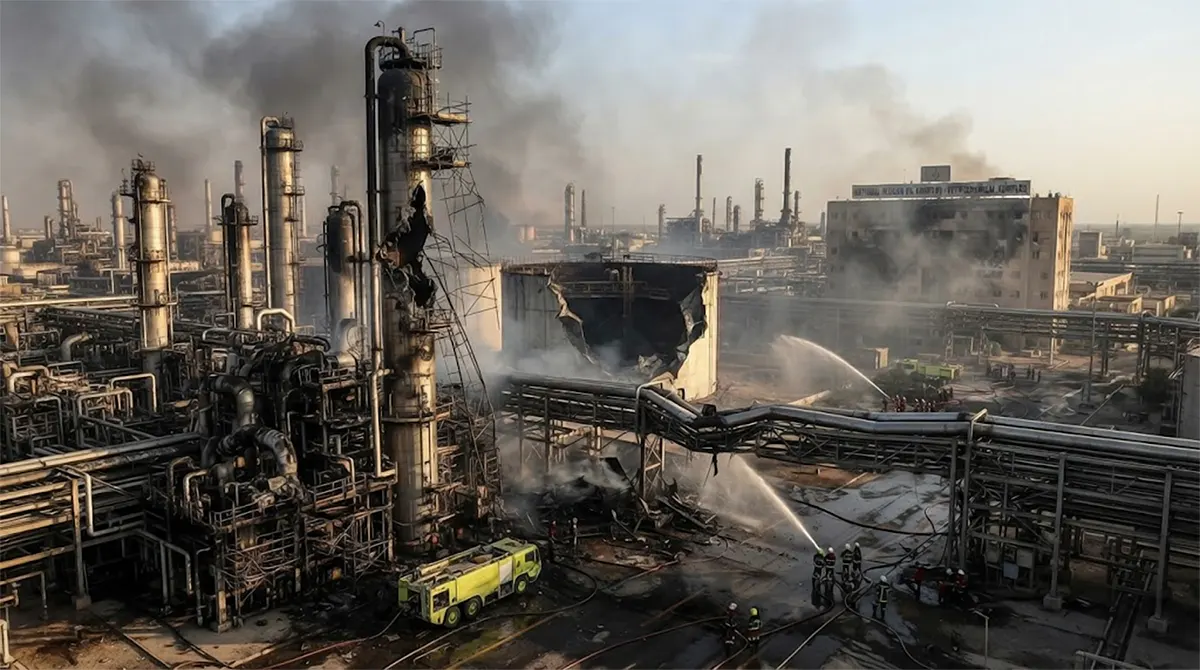
The scale of destruction inside Iran is staggering. Financial estimates from both Iranian officials and international think tanks put the total cost of damage and economic loss between $150 billion and $300 billion. A United Nations humanitarian report tracked over 149,000 civilian and industrial infrastructure units damaged during the heaviest weeks of airstrikes.
The hardest-hit sectors paint a clear picture of what went wrong and what needs to be fixed:
The energy sector took the worst of it. Major hubs like Mahshahr and the South Pars gas fields were repeatedly struck, knocking out roughly 85% of Iran’s oil and gas export capacity. That sector alone sustained an estimated $30 to $50 billion in direct damage. Refineries added another $15 to $25 billion. The Mobarakeh Steel Complex, one of the region’s largest was crippled, wiping out nearly 70% of Iran’s steel production capacity.
Transportation was systematically dismantled. Fifteen major airports and several critical shipping ports were damaged or disrupted. Over 50 transit routes including highways, mountain tunnels, and rail bridges — were targeted. At least 400 water infrastructure sites and multiple power grids were knocked offline.
Civilian neighborhoods didn’t escape. Of the 149,000+ damaged structures, the Iranian Red Crescent reported that over 123,000 were residential homes with 51,000 in Tehran alone. The conflict also impacted 1,726 educational facilities and 245 healthcare sites. More than 500 telecommunications and digital infrastructure sites were hit, causing widespread blackouts and roughly $335 million in IT sector damage alone.
Put all of that together, and $300 billion isn’t a political gesture. It’s the estimated price tag to rebuild what was destroyed.
How Long Will Rebuilding Actually Take?
Shorter than you might think and significantly faster than Ukraine.
The key difference is the nature of the conflict. Ukraine has endured a grinding, multi-year ground war that leveled entire cities block by block, requiring total municipal reconstruction. Iran’s conflict lasted roughly three and a half months, concentrated in targeted airstrikes on specific industrial and military sites. The surrounding geography roads, neighborhoods, civilian networks remained largely intact.
That structural difference shapes a very different recovery timeline:
In the first weeks to months, the immediate global priority is getting energy flowing again. Iran can technically start selling its stored crude oil almost immediately, since the U.S. Treasury issued waivers under the peace framework. Clearing the Strait of Hormuz of undersea mines and naval blockade remnants with over 500 stranded ships waiting will take one to two months, but maritime experts expect it to be stable before the end of the year.
Over one to three years, the deeper reconstruction work kicks in. Repairing localized missile damage to refineries, steel plants, and electrical grids is estimated to take around 12 to 18 months. The real bottleneck isn’t money, it’s specialized equipment. Some heavily damaged facilities require massive industrial turbines that only about three companies globally manufacture. For the most complex energy infrastructure, that parts backlog could stretch reconstruction to a maximum of five years.
The “black gold” incentive speeds everything up. Foreign corporations have a powerful financial reason to deploy engineers to Iran fast: the moment a refinery or drilling site is repaired, it immediately pumps oil into global markets and starts generating returns. The payoff is essentially instant, which means private investors are highly motivated to move quickly.
Analysts project that Iran’s commercial shipping lanes start recovering within weeks, basic trade normalizes within months, and the core of its damaged infrastructure is rebuilt within one to three years, a timeline that stands in sharp contrast to Ukraine’s still-unresolved reconstruction picture.
The Bottom Line
The $300 billion figure is real, but it’s been badly misrepresented. It’s not a government handout. It’s not American taxpayer money. It’s a conditional, private-sector investment framework backed by multinational corporations eager to access Iran’s massive untapped markets, and potentially by Gulf state neighbors seeking long-term regional stability.
The fund stays locked until Iran proves, verifiably, that it has dismantled its nuclear program and ended its regional proxy operations. If Iran doesn’t deliver, the money doesn’t move. If it does, some of the world’s largest energy and infrastructure companies are ready to move in fast not out of charity, but because the commercial opportunity is enormous.
Whether the deal survives its fragile 60-day window is another question entirely. But if it does, the rebuilding of Iran won’t look like a slow, painful reconstruction. It’ll look like a gold rush.