In the largest single night drone barrage of the war so far, Ukraine struck deep into Russian territory, hitting a major oil refinery outside Ryazan, a naval base on the Caspian Sea, a military airfield, and dozens of other strategic sites, all in one coordinated overnight operation.
- 355 Ukrainian drones intercepted by Russia in 24 hours
- 23+ Separate military & economic targets hit
- 17M Tons of crude oil processed annually at Ryazan refinery
- 100km Distance toxic smoke plume traveled into neighboring regions
A Direct Answer to Kyiv’s Deadliest Night
The operation did not come without warning. After Russia’s 30-hour missile barrage killed 24 civilians in Kyiv including three children, Ukrainian President Volodymyr Zelenskyy publicly instructed Ukraine’s special services to design what he called a “severe format of response” to Russia’s terrorist tactics. This was it.
Ukraine’s Unmanned Systems Forces, commanded by Robert Brovdi, orchestrated the overnight campaign, targeting at least 23 separate military and economic facilities across Russia and occupied territory in a single, sustained operation.
The Ryazan Refinery Strike and the “Oil Rain” Nobody Expected
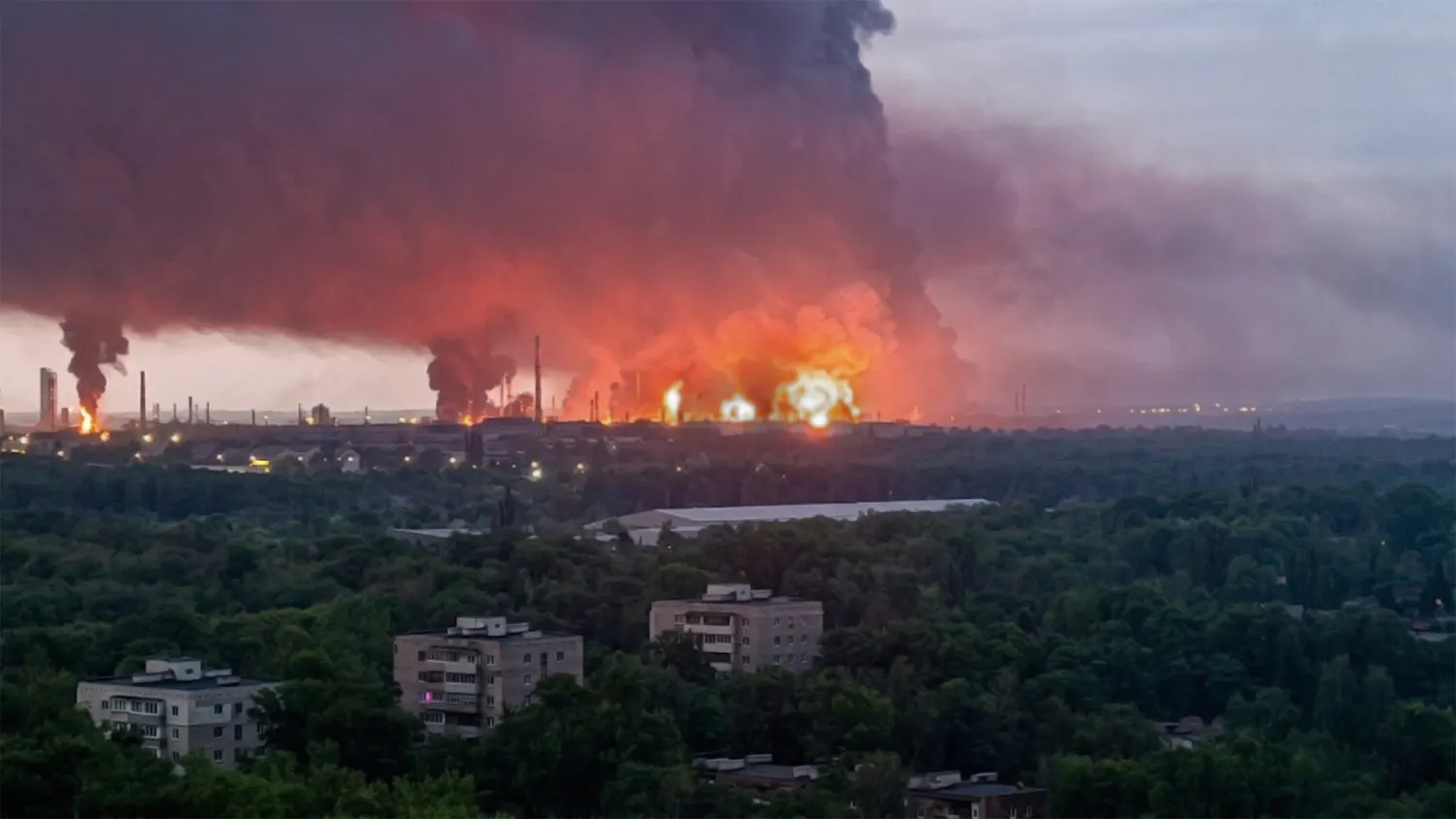
The crown jewel of the operation and the strike drawing the most international attention was the direct hit on the Rosneft-operated Ryazan Oil Refinery, located roughly 185 kilometers southeast of Moscow. The facility is one of Russia’s largest fuel processing plants, handling approximately 17 million tons of crude oil every year.
Multiple drone impacts caused a catastrophic fire that sent massive columns of toxic black smoke more than 100 kilometers into neighboring regions. But it was what happened closer to the ground that stunned residents: a phenomenon they are now calling “oil rain.”
When large petroleum fires reach extreme temperatures, they atomize unrefined fuel and soot into the air. As that plume cools and mixes with atmospheric moisture above the city, it condenses and falls back down. In Ryazan’s Oktyabrsky District, that meant a greasy, sticky black film settling over cars, windows, and building facades across the neighborhood.
Ryazan Region Governor Pavel Malkov confirmed that four people were killed, including a child, and 12 others were injured. Debris from off target drones damaged two high rise residential apartment buildings near the industrial sector, blowing out facades and starting secondary fires.
A City Brought to a Standstill
Governor Malkov officially declared a State of Emergency across the region, unlocking emergency funds and mobilizing civil defense units for cleanup and decontamination. Schools, kindergartens, and public institutions in affected districts were shut down. All mass gatherings and outdoor events were cancelled.
Residents were urged to stay indoors, close their windows, and avoid touching the black residue coating their streets. Specialized municipal crews were deployed to wash down public infrastructure, a task complicated by the fact that removing petroleum-based film from buildings and thousands of private vehicles requires industrial chemical detergents, not ordinary cleaning equipment.
This is not the first time this kind of environmental fallout has occurred. Similar “black rain” events were previously reported following Ukrainian drone strikes on refineries in Tuapse and Perm, establishing what analysts are calling a growing environmental pattern tied to Ukraine’s strategy of targeting deep tier industrial infrastructure.
Beyond Ryazan: How Far Ukraine’s Drones Actually Reached
The Ryazan strike was the most visible, but the broader scope of the operation tells an equally striking story about how far Ukraine’s domestic drone program has come.
| Target | What was hit | Location / Notes |
|---|---|---|
| Kaspiysk Naval Base | A small Russian missile ship and a naval minesweeper were damaged | Caspian Sea, 1,000km+ away, a deep strike into an area previously considered beyond Ukraine’s reach. |
| Yeysk Military Airfield | A Beriev Be-200 amphibious aircraft and a Kamov Ka-27 anti-submarine helicopter were confirmed destroyed | Krasnodar Krai at the Navy’s 859th Naval Aviation Training Center. |
| Crimea | A Pantsir-S1 surface-to-air missile system was destroyed. A cargo ship carrying ammunition was struck | At the port of Berdyansk. |
| Luhansk Oblast | The 427th “Rarog” Brigade eliminated a Russian Tor-M2 air defense system. The 414th “Magyar’s Birds” Brigade destroyed a military training center and temporary deployment point. | Eastern Ukraine |
Russia’s Defense Ministry claimed it intercepted and destroyed 355 Ukrainian drones in a 24-hour period, a figure that, if accurate, actually underscores the unprecedented scale of what Ukraine launched. Interception counts only mean something when the attacking side doesn’t have enough drones to overwhelm the defense. Ukraine clearly did.
Draining Both the Tank and the Treasury
Ukraine’s strategy here is not random. By pairing catastrophic economic sabotage disrupting a refinery that processes 17 million tons of crude annually with precision military destruction of rare naval aircraft and air defense systems, Ukraine is executing a two pronged squeeze on Russia’s war machine.
The Ryazan refinery directly supplies fuel that feeds Russian military logistics. Destroying it, even temporarily, creates downstream fuel shortages at a time when Russia is already under pressure from Western sanctions. Every Pantsir or Tor-M2 system knocked out is one fewer layer of air defense protecting the next Russian advance.
“Ukraine is proving that its long-range domestic drone industry can stretch Russian air defenses to their absolute breaking point.”
— Ukrainian military analysts, on the scale of the operation
The operation also carries a psychological dimension that cannot be separated from the military one. Ryazan is not a front-line city. It sits less than 200 kilometers from Moscow. When residents there wake up to black rain falling on their cars and schools are shut down indefinitely, the war which Russian state media has spent years framing as a distant “special military operation” becomes impossible to ignore at home.