On November 1, 2024, a concrete canopy at a railway station in Novi Sad collapsed without warning, killing 16 people. It was the kind of disaster that, in a country with functioning institutional accountability, would trigger investigations, prosecutions, and reforms. In Serbia, it triggered something else entirely: the largest sustained protest movement the country has seen since the fall of Slobodan Milošević in 2000.
Eighteen months later, that movement isn’t dying down. It’s growing.
From Vigils to 180,000 People in the Streets
It started quietly. Grief-stricken citizens stood in silent vigils under the motto “Serbia, stand still.” The public blamed the collapse on corruption, cost-cutting, and a total lack of oversight in construction contracts, contracts awarded, without competitive tender, to opaque state-linked firms and Chinese companies.
The silence didn’t last. By early 2025, the vigils had become demonstrations, the demonstrations had become a movement, and the movement had a face: university students. The pressure they generated was enough to force then-Prime Minister Miloš Vučević to resign in January 2025, a remarkable outcome for a street movement in a country where the ruling party has controlled the levers of power for over a decade.
But the resignation didn’t end anything. It was the beginning.
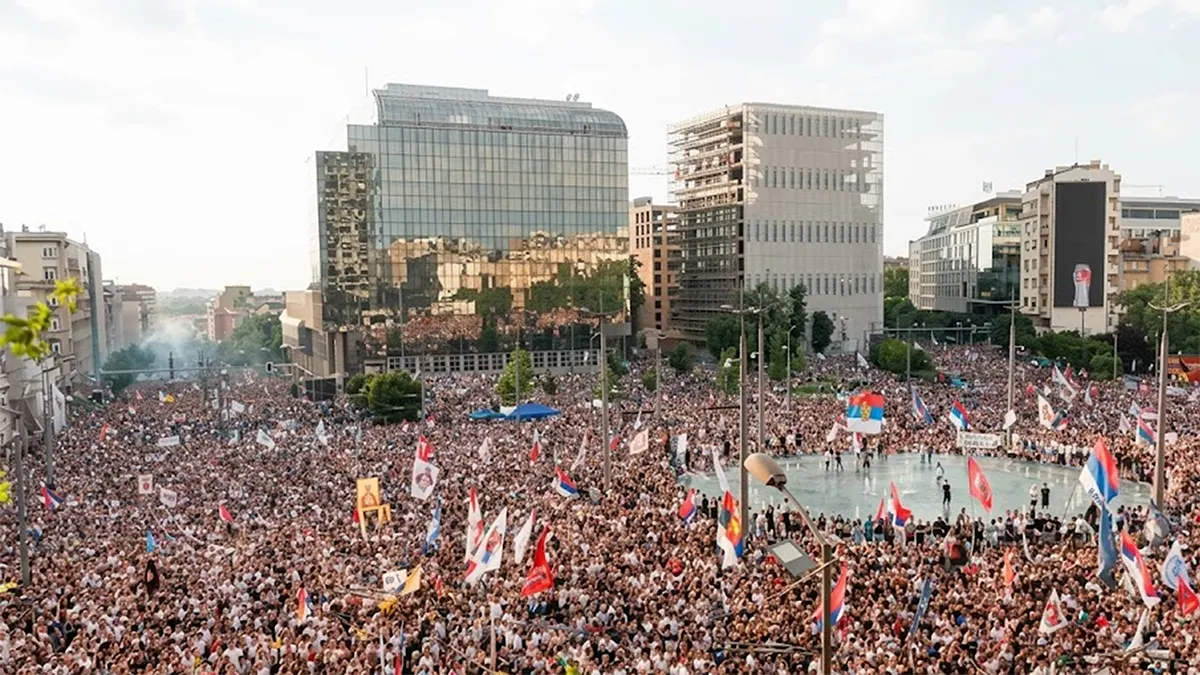
This past Saturday, May 23, 2026, tens of thousands converged on Belgrade’s Slavija Square under the banner “Students Win” (Studenti pobeđuju). Non-governmental monitors estimated the crowd at 180,000 to 190,000 people. The government’s Interior Ministry claimed 34,300 attended. The gap between those two numbers tells you almost everything you need to know about how this conflict is being managed by both sides.
The State Made Sure Getting There Was Hard
Before a single protester reached Slavija Square, the Serbian state had already made its position clear. The state-run railway company cancelled all trains into and out of Belgrade on Saturday, a deliberate attempt to choke off turnout from the rest of the country.
It didn’t work. Columns of citizens organised carpools, private buses, and any alternative transport they could find to reach the capital. The cancelled trains became their own story evidence, for many Serbs, of exactly the kind of institutional bad faith the movement has been protesting since the beginning.
What the Students Are Actually Demanding Now
The movement that started with grief over 16 deaths in Novi Sad has grown into something considerably larger. Student leaders have broadened their platform into a direct challenge to the political system itself:
Early parliamentary elections to strip the current government of its mandate. Strict anti-corruption laws and independent investigations into state infrastructure spending, the same contracts that opposition voices blame for the Novi Sad collapse. And a 20% increase in the higher education budget, a demand that roots the movement in the everyday material reality of the students leading it.
This is no longer just a protest about a roof. It’s a movement demanding a different kind of country.
Peaceful by Day, Volatile by Night
The daytime rally at Slavija Square was tightly controlled. Student marshals maintained internal security corridors, and the main program passed without serious incident. That’s become a consistent feature of this movement, the students themselves go to considerable lengths to keep their demonstrations peaceful and visually coherent.
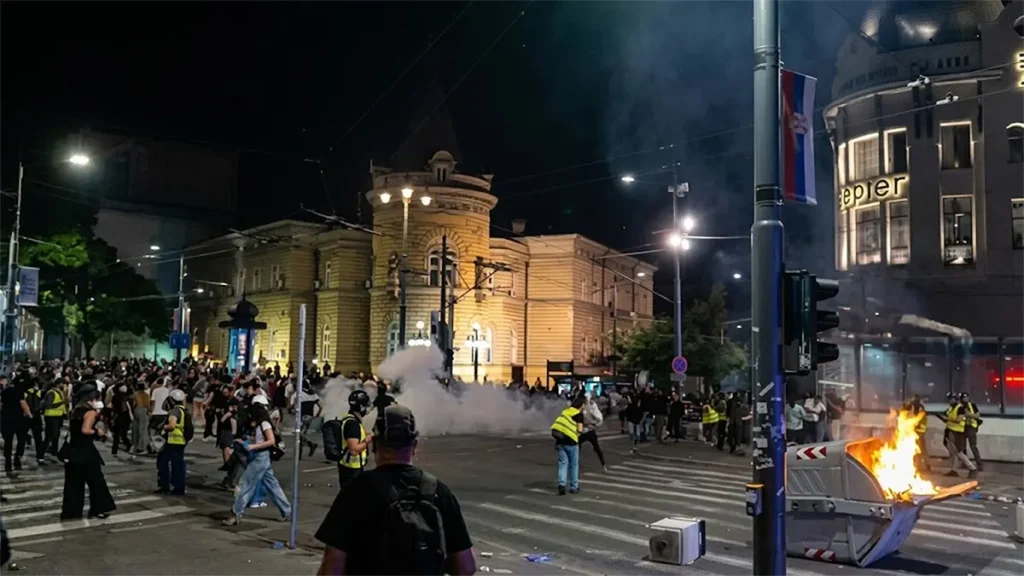
What happens after dark is a different story. Late Saturday evening, clashes erupted near the presidential building and Pioneer Park, where pro-government loyalists have maintained a permanent counter-camp since March 2025. This camp funded and organised by ruling-party supporters functions as a physical buffer around the presidency, a literal wall of bodies and banners designed to keep protesters away from the seat of power.
After the main program ended, masked groups arrived and began hurling rocks, bottles, and flares at police lines. Riot police responded with pepper spray, tear gas, and stun grenades. Student leaders have consistently and publicly warned that these masked provocateurs are organised instigators sent specifically to generate violent images that the government can use to reframe a democratic movement as a public order crisis. European observers have noted the same pattern repeating across multiple rallies.
Where Was President Vučić? Beijing.
While the streets of Belgrade were filling, President Aleksandar Vučić was thousands of miles away, visiting the Great Wall and signing new infrastructure and artificial intelligence deals with Chinese President Xi Jinping. He posted a video on Instagram condemning the protests, claiming demonstrators had “shown their violent nature” and asserting that the state would function strictly under the law.
State media echoed him, framing the 180,000-person civic gathering as either fringe violence or a foreign-backed nationalist plot.
That split-screen image, a president in Beijing deepening ties with China while his country’s youth flood the streets demanding accountability is not incidental. It is, in many ways, the central contradiction of Vučić’s entire political project.
The EU Just Froze €1.5 Billion. Here’s the Mechanism.
The European Union didn’t freeze Serbia’s funding because of the protests themselves. It did so because the protests exposed something the EU had been watching with increasing alarm: a government systematically dismantling the institutional safeguards it had promised to build.
The money in question 1.58 billion euros is Serbia’s allocated share of the EU Growth Plan for the Western Balkans, a 6 billion euro initiative designed to accelerate the region’s economic integration and eventual EU membership. The catch, built into the program from the start, is conditionality: funds are only released when recipient countries hit measurable rule of law milestones, protect press freedom, fight corruption, and maintain democratic standards.
Serbia received its first baseline tranche 56.5 million euros in January, before the situation deteriorated. Everything else is now frozen indefinitely.
The formal legal trigger wasn’t the tear gas or the cancelled trains. It was a judicial reform pushed through parliament with no consultation of independent judges, prosecutors, or the EU. Designed, critics argue, to shield senior government officials from the anti-corruption investigations the Novi Sad movement was demanding, the new laws gave state-appointed court presidents direct leverage over sitting judges and stripped away protections that kept prosecutors independent from political pressure. The Council of Europe’s Venice Commission, the bloc’s legal advisory body condemned the reforms outright.
EU Enlargement Commissioner Marta Kos made the decision and the reasoning plain: payments are paused until Serbia restores judicial independence. She also addressed the broader pattern election irregularities flagged by international monitors, the crackdown on peaceful protesters, the tear gas and stun grenades as part of a consistent picture of democratic backsliding.
“You Cannot Sit on Two Chairs”
That line delivered by Commissioner Kos cuts to the heart of what the EU is really trying to force. Serbia has been a formal EU candidate for over a decade. It has also, throughout that decade, maintained close ties with the Kremlin, refused to join Western sanctions against Russia, and pursued a string of opaque, non-competitive infrastructure contracts with Chinese firms, the very contracts at the centre of the Novi Sad collapse allegations.
Vučić has spent years taking EU development money while looking East for political alliances, treating Brussels and Beijing as parallel sources of leverage rather than mutually exclusive commitments. The €1.5 billion freeze is the EU’s clearest signal yet that this balancing act has a limit.
With Vučić hinting that early parliamentary elections could come between September and November this year, the student movement is already thinking beyond the street. The task they’ve set themselves now is to convert 18 months of protest energy into an electoral force capable of challenging a ruling party that has shaped Serbian politics, its courts, its media, its contracts in its own image for over a decade.
The roof in Novi Sad fell in November 2024. What it started is still very much standing.