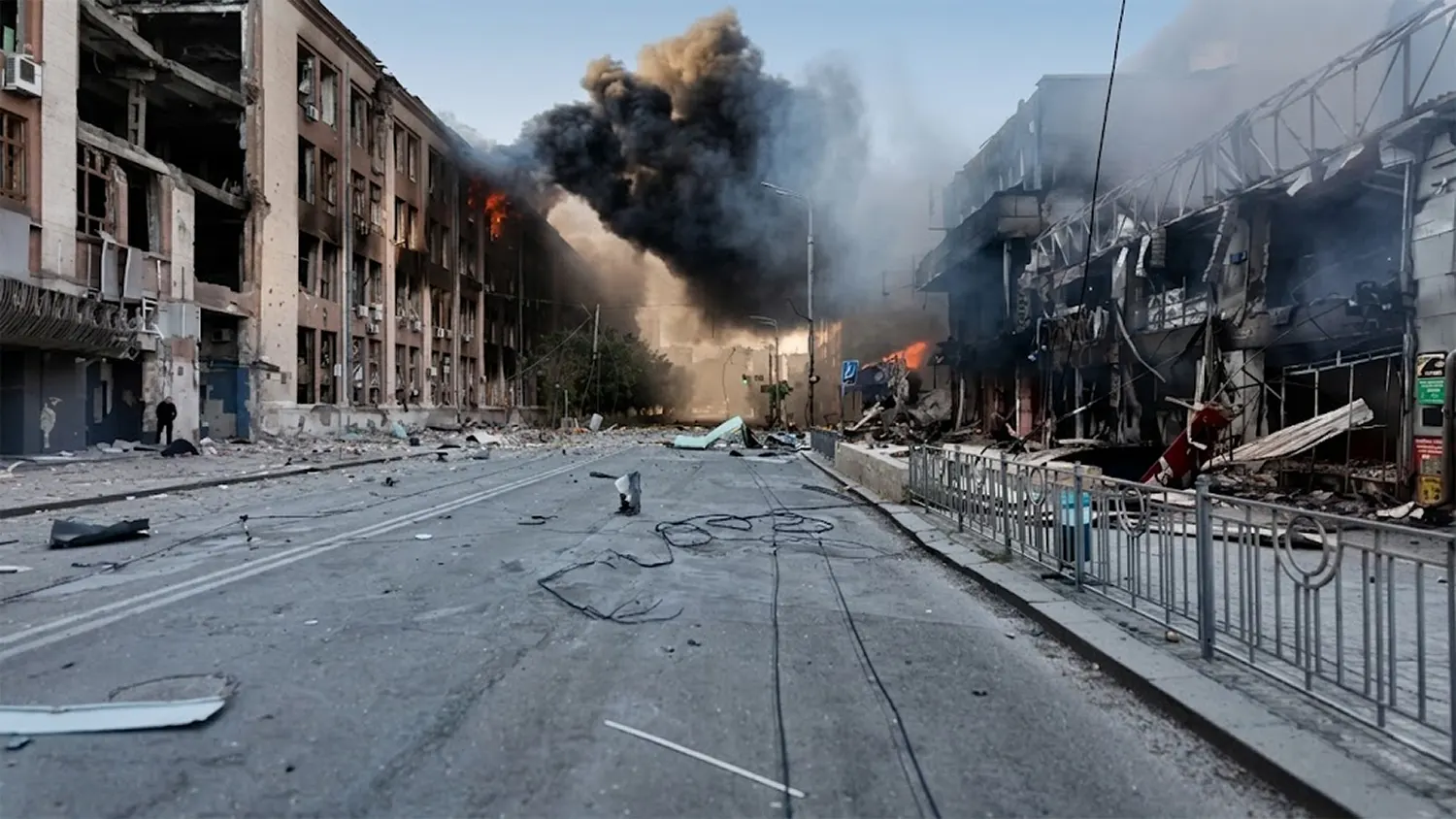
After a weekend of devastating strikes on the Ukrainian capital, Moscow issued a stark evacuation warning to every diplomat and foreign national in the city. The response from Europe, the UN, and Ukraine itself was swift and unified: we’re not going anywhere.
The ultimatum that alarmed every embassy in Kyiv
Russia’s Foreign Ministry didn’t just hint at what was coming, it issued a formal, explicit warning: all foreign nationals, diplomats, and representatives of international organizations should leave Kyiv “as soon as possible.” Residents were told to stay away from any military, administrative, or government infrastructure inside the capital.
The language was deliberate and pointed. Moscow announced it was beginning a campaign of “systematic and sustained strikes” targeting Ukrainian command posts, decision-making centers, and military-industrial facilities with a particular focus on drone production and development sites. The warning wasn’t vague. It was a public notification that Kyiv was about to become a sustained target.
What triggered the announcement, according to Moscow, was the Ukrainian strike on a vocational school and student dormitory in Russian-occupied Luhansk, an incident that has been covered in full by this publication. Ukraine maintains the building housed an elite Russian drone command unit, not students. That dispute remains unresolved. But Russia’s response to it is now very much in motion.
The phone call that set off alarm bells in Western capitals
The ultimatum wasn’t delivered through a press release alone. Russian Foreign Minister Sergei Lavrov used a direct phone call with U.S. Secretary of State Marco Rubio to personally tell Washington to pull its diplomatic staff out of Kyiv because strikes were imminent.
Rubio confirmed the call publicly while speaking to reporters during an official visit to India. He noted that Russia hadn’t targeted just the Americans they had, in his words, “sent a notice to all the embassies” in the capital simultaneously. It was a coordinated diplomatic warning, not a private back-channel message.
On the question of whether the U.S. would mediate an end to the war, Rubio reaffirmed Washington’s readiness to do so but pointedly acknowledged that there are currently no active or scheduled peace talks between the U.S. and Ukraine. The diplomatic channel is open in principle; in practice, it is not moving.
“Every time you see these big strikes from one side or the other, it’s a reminder of why this is a terrible war… and it needs to come to an end.”
— U.S. Secretary of State Marco Rubio
Ukraine’s foreign minister called it exactly what it is
Ukrainian Foreign Minister Andrii Sybiha did not mince words. He publicly labeled Lavrov’s warning to Rubio a “brazen provocation” and an act of total arrogance arguing that Russia was essentially telling the most powerful country in the world, to its face, that it intends to ignore the entire peace process and strike Kyiv anyway.
“How brazen it is to directly inform the leading country, the most powerful country in the world, that you disregard its peace efforts, ignore the entire peace process and will strike Kyiv.”
— Andrii Sybiha, Ukrainian Foreign Minister
Rather than urging calm or caution, Sybiha turned the pressure outward calling on the U.S. and European allies to send a “firm and harsh signal” back to Moscow that these strikes are completely unacceptable. Ukraine’s official position is that complying with the evacuation order, even partially, would hand Russia a propaganda victory and validate the intimidation campaign.
Europe didn’t just refuse to leave, it pushed back harder
The European Union’s response was coordinated, defiant, and remarkably fast. Rather than quietly reviewing security protocols, Brussels went on the offensive.
The EU’s diplomatic service summoned Russia’s chargé d’affaires in Brussels. EU foreign policy spokesperson Anitta Hipper publicly called the threat to foreign citizens and diplomatic personnel an “unacceptable escalation” and demanded that Moscow stop targeting civilians. The head of the EU mission in Kyiv, Katarina Mathernova, went further describing the Kremlin’s announcement as a “masterpiece of hypocrisy” and confirming flatly that the 27-nation bloc is not moving.
Individual member states escalated in parallel. Germany, Norway, the Netherlands, and Sweden all summoned Russian ambassadors to hand over formal protests. Sweden notably linked the Kyiv threats to a broader pattern of Russian provocations, including fabricated claims of airspace violations in the Nordic-Baltic region framing this as part of a wider destabilization strategy rather than an isolated incident.
Moscow’s embassies in Europe rejected all complaints, maintaining that the planned strikes are purely “surgical” responses aimed at military infrastructure. That framing satisfied no one.
How every major actor is positioned right now
| Russia | Ukraine | European Union |
| Announcing “systematic strikes” on Kyiv’s command centers and drone facilities. Lavrov personally warned Washington to evacuate. | Calling it blackmail. Foreign Minister Sybiha urging allies to hold firm and send a “firm and harsh signal” to Moscow. | Summoned Russia’s envoy in Brussels. Refusing to evacuate. Called the warning “unacceptable escalation” and a “masterpiece of hypocrisy.” |
| United States | United Nations | |
| Rubio confirmed the Lavrov call. No evacuation ordered. Reaffirmed readiness to mediate but no active talks are scheduled. | Secretary-General Guterres expressed “profound concern.” UN humanitarian staff staying in Kyiv with adjusted security protocols. |
The UN warned of something bigger than the strikes themselves
UN Secretary-General António Guterres didn’t frame his response around the specific buildings Russia intends to hit. He framed it around what a sustained bombing campaign of this nature does to the possibility of peace.
Guterres warned that carrying out systematic strikes on Kyiv will drastically escalate the conflict, trigger widespread civilian suffering, and severely hinder any remaining backdoor peace efforts. The UN also reiterated that targeting administrative centers and infrastructure in densely populated areas violates international humanitarian law, a condemnation that now applies to a campaign Russia has announced in advance, openly, and by name.
UN humanitarian agencies and essential personnel operating inside Ukraine have not begun a mass pullout from the capital. Like their European counterparts, they have adjusted security protocols and stayed.
What Russia is actually trying to accomplish
The evacuation warning is doing several things simultaneously, and not all of them are about bombs. By publicly announcing the strikes in advance and routing the message through direct diplomatic channels including a personal call to the U.S. Secretary of State, Moscow is applying maximum psychological pressure on Western governments while maintaining the appearance of a power that follows its own rules and answers to no one.
The unified refusal to evacuate, from the EU, the UN, and Ukraine’s own government, is itself a strategic counter-move. Every embassy that stays is a signal that the international community is not prepared to be coerced out of Kyiv. Every ambassador summoned in European capitals is a formal record that Russia issued threats against diplomatic personnel, a designation with serious implications under international law.
The strikes, if and when they come, will be the next chapter. But this standoff Russia’s ultimatum met with a coordinated wall of refusal is already a confrontation in its own right, playing out in real time across diplomatic channels, press conferences, and summoned ambassadors from Brussels to Stockholm.
Nobody is leaving