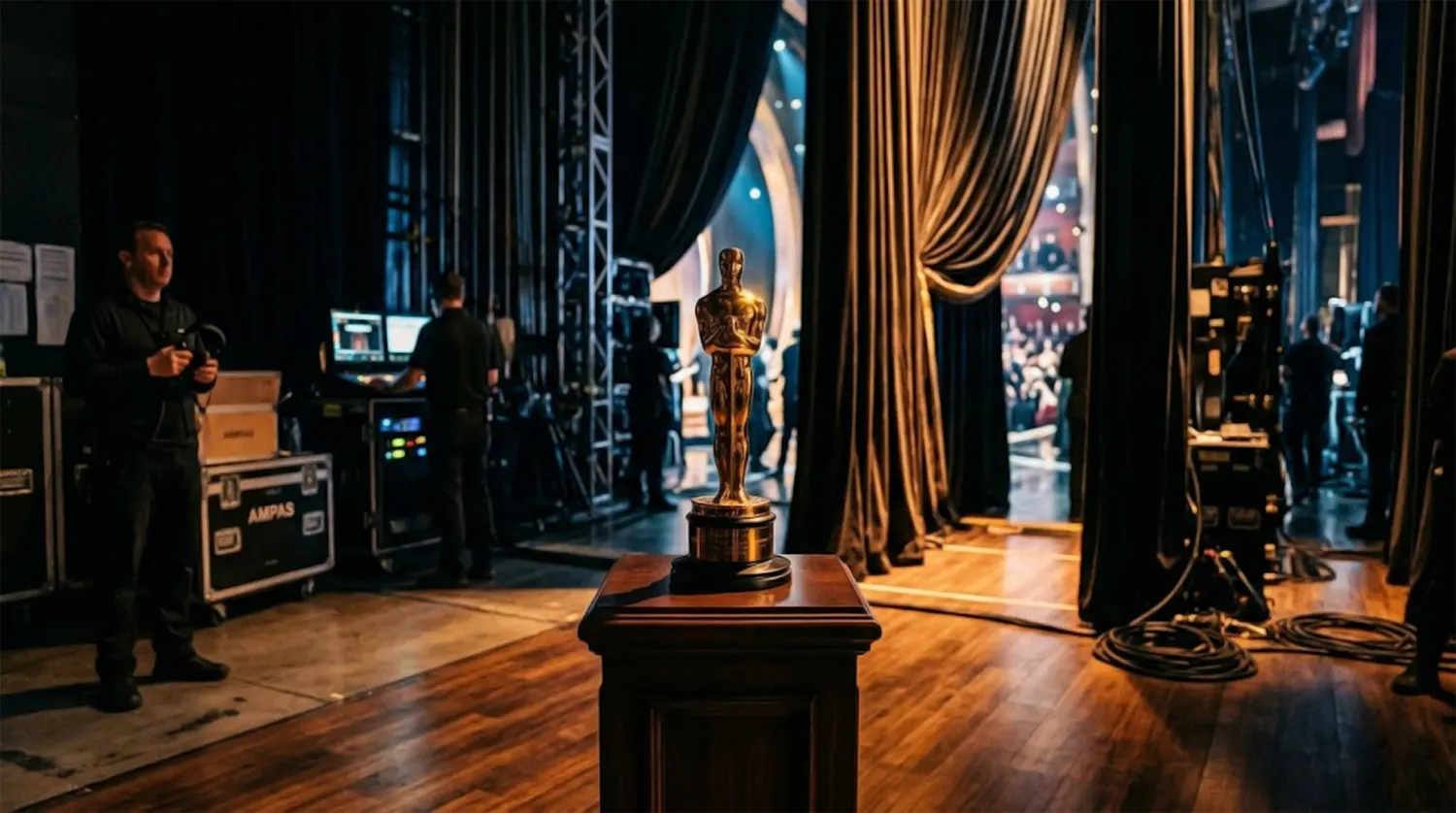
The Academy of Motion Picture Arts and Sciences has drawn a clear line on artificial intelligence, ruling that Oscars will remain reserved for human creators. The updated rules, announced in May 2026, require “demonstrable human authorship” in acting and writing categories. It is the clearest signal yet that Hollywood’s top institution wants to protect what it calls the “human spirit” of filmmaking.
That decision did not emerge in isolation. For years, AI has hovered over the industry as both a tool and a threat. But the real pressure came from rapid technological advances and recent controversies, forcing the Academy to act before the boundaries blurred beyond recognition.
One flashpoint involved the AI-assisted recreation of Val Kilmer in a recent film, raising questions about consent and authenticity. Another came with the rise of fully digital performers like “Tilly Norwood,” which challenged the very definition of acting. Together, these cases made one issue unavoidable: who or what deserves credit for a performance?
But the real shift came when the Academy formalized its answer. Under the new rules, only human performed roles with explicit consent can qualify for acting awards. Fully synthetic characters, deepfakes, or AI-generated avatars are explicitly banned from nomination.
Hollywood draws a firm boundary between human performance and machine creation
The same principle now extends to writing. Screenplays must be “human authored,” excluding scripts generated by chatbots or large language models. While AI tools can still assist with research or editing, they cannot be the source of narrative, dialogue, or character development.
That distinction reflects a deeper concern. The Academy is not banning AI outright, it still allows its use in visual effects or sound design but it is drawing a line at creative ownership, ensuring that awards recognize human decision making rather than algorithmic output.
To enforce this, the Academy has introduced a new layer of oversight. Filmmakers must now provide detailed disclosures of AI usage, and the organization reserves the right to audit submissions if questions arise. This marks a shift from trust-based evaluation to active verification of authorship.
That raises a second question: how do you prove a performance or script is truly human?
Inside the Academy’s new “digital forensics” system
The answer lies in what industry insiders are calling a “digital transparency log.” Studios must submit documentation outlining where and how AI tools were used during production. This includes voice modification, script assistance, and synthetic elements, along with evidence that humans remained in control.
If concerns persist, the Academy can escalate the review. It has introduced forensic audits conducted by technical specialists, who analyze raw footage, audio tracks, and project files to detect signs of AI manipulation. The burden of proof now falls on filmmakers if their work appears suspicious.
The penalties are significant. Films found to have misrepresented their use of AI can be disqualified or barred from future submissions. This adds real consequences to what might otherwise be a symbolic rule.
What makes this even more urgent is the legal backdrop. In the United States and other jurisdictions, fully AI generated works cannot currently be copyrighted. Awarding such work would risk elevating content that lacks legal ownership, undermining the entire system of artistic recognition.
A controversy that exposed the gray zone between “performance” and “product”
The urgency of these rules was underscored by a recent Oscars controversy involving Adrien Brody. His 2025 award-winning performance sparked debate after it was revealed that AI tools were used to refine his accent in post production.
Supporters argued the technology functioned like digital makeup, preserving emotional authenticity while correcting technical flaws. Critics countered that an accent is part of the performance itself, and altering it blurred the line between acting and editing.
The Academy’s new rules attempt to resolve that ambiguity. AI-assisted enhancements such as voice smoothing or de-aging are still allowed for now. But fully synthetic performances, or those lacking clear human authorship, are no longer eligible for recognition.
This distinction highlights the Academy’s broader philosophy: AI can assist the craft, but it cannot replace the creator. The “soul” of a performance must remain human, even if technology shapes its presentation.
Why writers and the paper trail behind them are now central to the debate
The same logic applies to screenwriting, where the Academy is placing new emphasis on process. Writers must be able to demonstrate a clear development history, including drafts, revisions, and production notes that show how a script evolved over time.
In practice, this is not a new burden for professionals. Screenwriting already involves extensive documentation, from union registrations to version histories in tools like Final Draft. These records form a “paper trail” that proves human authorship, something AI-generated content struggles to replicate.
Studios may also be required to provide emails, brainstorming notes, and early drafts if a screenplay’s origins are questioned. The goal is to confirm that the work reflects human creativity, collaboration, and revision, not a single prompt-generated output.
That level of scrutiny reflects a broader industry shift. Following the 2023 labor strikes, writers and actors demanded safeguards against AI replacing their roles. The Academy’s rules now codify those concerns into the awards system itself.
A new era where technology is welcome but authorship is protected
Taken together, these changes signal a recalibration rather than a rejection of technology. Hollywood is not turning away from AI; it is redefining where AI fits. The tools remain valuable, but the recognition remains human.
For filmmakers, this creates a new balancing act. Innovation is still encouraged, but it must be paired with transparency, accountability, and clear human leadership. For audiences, it offers reassurance that the performances and stories honored at the Oscars still reflect lived experience.
And as the industry continues to evolve, the Academy’s stance suggests a broader truth: in an era of increasingly powerful machines, the value of human creativity is not diminishing it is being more carefully defined than ever before.