Madrid doesn’t do things quietly. Over the course of a single weekend, tens of thousands of Spaniards poured into the streets of the capital, twice over two entirely separate crises that have been simmering for months. On Saturday, it was about corruption and a Prime Minister many want gone. On Sunday, it was about rent prices and a generation being priced out of their own city. Different causes, different crowds, but the same message: people have had enough.
A March Called “Dignity” and the Scandals Behind It
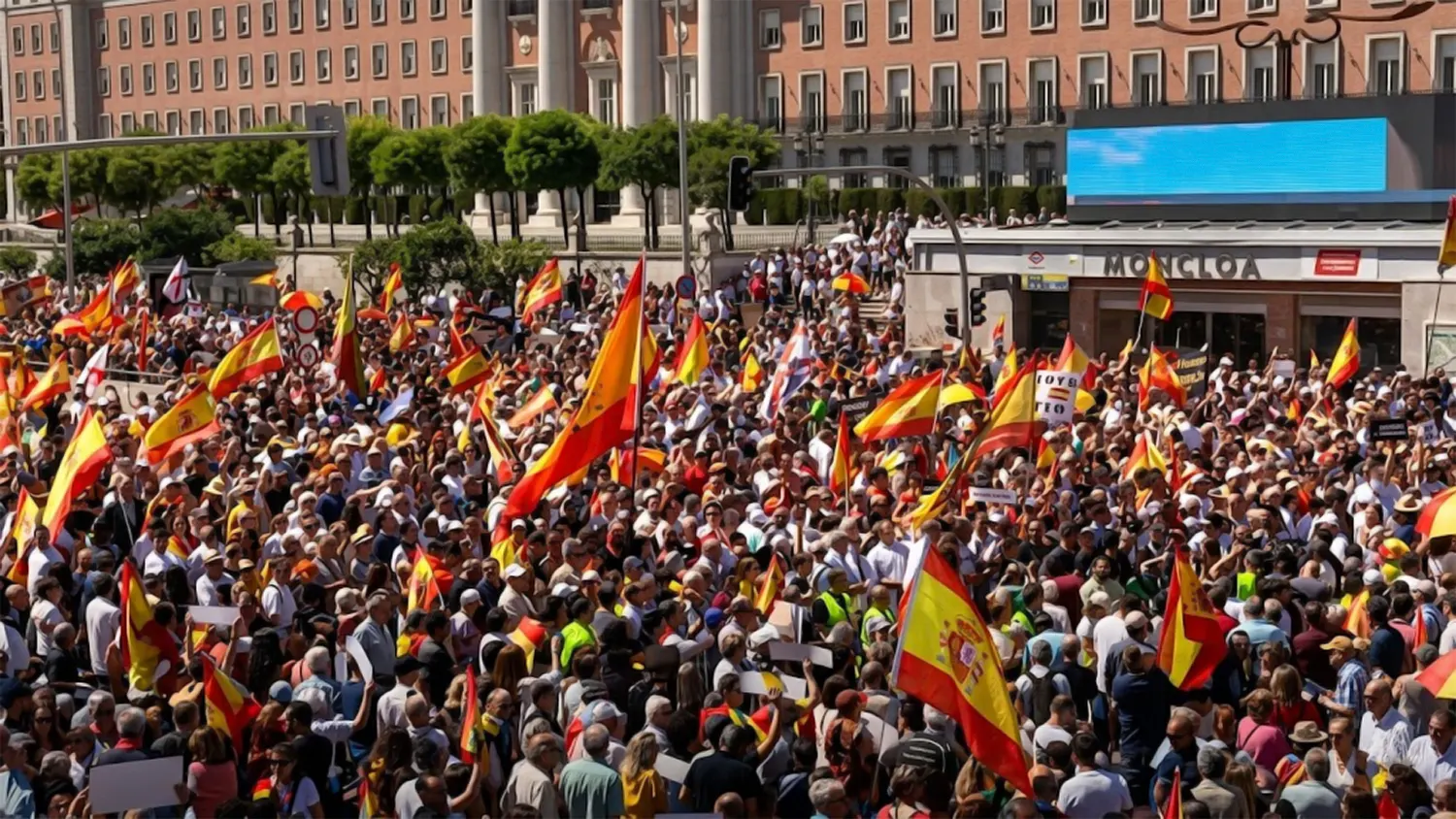
The Saturday protest had a name, the “Dignity Parade” and a very specific target: Socialist Prime Minister Pedro Sánchez. Organised by a coalition of over 150 civic associations under the banner of Sociedad Civil Española, and backed loudly by both the mainstream conservative opposition party PP (Popular Party) and the far-right Vox, the march wound through central Madrid and ended near the Prime Minister’s official residence at Plaza Moncloa.
Attendance figures told the usual politically charged story. Local government officials put the crowd at around 40,000. Organisers claimed up to 120,000. The truth, as always, is probably somewhere in between but regardless of the exact number, the images were striking. Protesters carried red and gold Spanish flags and banners reading: “Corruption has a price. No more impunity. Resignation and elections now.”
The march was largely peaceful. Near Moncloa, however, a small group that pushed toward the Prime Minister’s residence was met by riot police resulting in a handful of minor injuries and arrests.
Not One Scandal, But a Whole Circle Under Investigation
What makes the opposition’s anger so potent isn’t a single allegation, it’s the accumulation. Over the past two years, judicial investigations have crept closer and closer to Sánchez’s inner circle, touching his wife, his brother, a former top minister, and even a former Prime Minister. Here’s where each case actually stands:
Begoña Gómez (the wife) has been under formal investigation for over two years over alleged influence peddling tied to her private business dealings. The case has bounced around the courts prosecutors tried to close it for lack of evidence, and an upper court recently threw out an attempt to fast track her to a jury trial as “premature.” But the judge has refused to drop it entirely, meaning the probe stays open.
David Sánchez (the brother) has been formally charged with influence peddling. The investigation phase is complete, and he is scheduled to stand trial later this year.
José Luis Ábalos (former Transport Minister) just completed a high profile criminal trial for allegedly taking kickbacks on public contracts for face masks during the COVID-19 pandemic. He’s currently awaiting the verdict.
José Luis Rodríguez Zapatero (former PM, close ally) is the newest addition. A Spanish high court judge has just placed him under formal investigation over an alleged emergency airline bailout case involving Venezuelan connections. He’s been summoned to testify as a suspect on June 2, 2026.
One important caveat: none of these individuals have been convicted of anything. Under Spanish law, they remain legally innocent. The protests aren’t responding to guilty verdicts, they’re responding to the sheer weight of so many investigations circling the same political family at the same time.
Sánchez’s Playbook: Defiance, Dismissal, and “Lawfare”
Prime Minister Sánchez has a well worn response to all of this, and he deployed it again. He has consistently framed the corruption investigations not as legitimate legal proceedings, but as a coordinated smear campaign orchestrated by far-right groups and hostile media outlets.
His administration’s line rests on a specific word: lawfare, the idea that political opponents are weaponising the judiciary to destabilise a democratically elected minority government that they couldn’t defeat at the ballot box. Sánchez has pointed out that the original complaint against his wife was filed by Manos Limpias, a fringe far-right group, and argues the cases have been built on media reports rather than hard evidence.
He has flatly refused to resign. Earlier in his tenure, he publicly flirted with stepping down over the attacks on his wife and then chose to stay, framing it as refusing to let his opponents win. That same defiant posture was on display this weekend. Despite tens of thousands gathered near his front door, Sánchez has pledged to carry on governing.
The opposition sees this differently. To them, the sheer number of people under investigation within one Prime Minister’s orbit isn’t a coincidence, it’s evidence of a systemic culture of impunity. To Sánchez’s supporters, those investigations are the political attack itself.
Both interpretations are entirely predictable. What’s less predictable is how Spanish courts will eventually rule.
The Second March: Housing, and a Generation Running Out of Options
By Sunday, the protest landscape shifted completely. A separate, massive demonstration reportedly even larger than Saturday’s filled the streets over Spain’s deepening housing affordability crisis, a problem that has been building for years and has now become one of the most urgent political issues in the country.
The grievances are straightforward: rents have surged far beyond what ordinary salaries can support, particularly in major cities like Madrid and Barcelona. Young Spaniards, in particular, face a situation where even steady employment doesn’t translate into the ability to rent let alone buy a home. Families and workers across income levels joined the march, reflecting just how broadly the crisis has spread beyond any single demographic.
Two Protests, One Question
It would be easy to look at this weekend and see two unrelated stories. But they share the same underlying frustration: a sense that institutions whether political or economic are failing ordinary people, and that those at the top are insulated from consequences the rest of the country lives with every day.
Whether that frustration translates into real political change depends on what happens next in the courts, in parliament, and eventually, at the ballot box. For now, Madrid has made clear that the pressure isn’t going away.