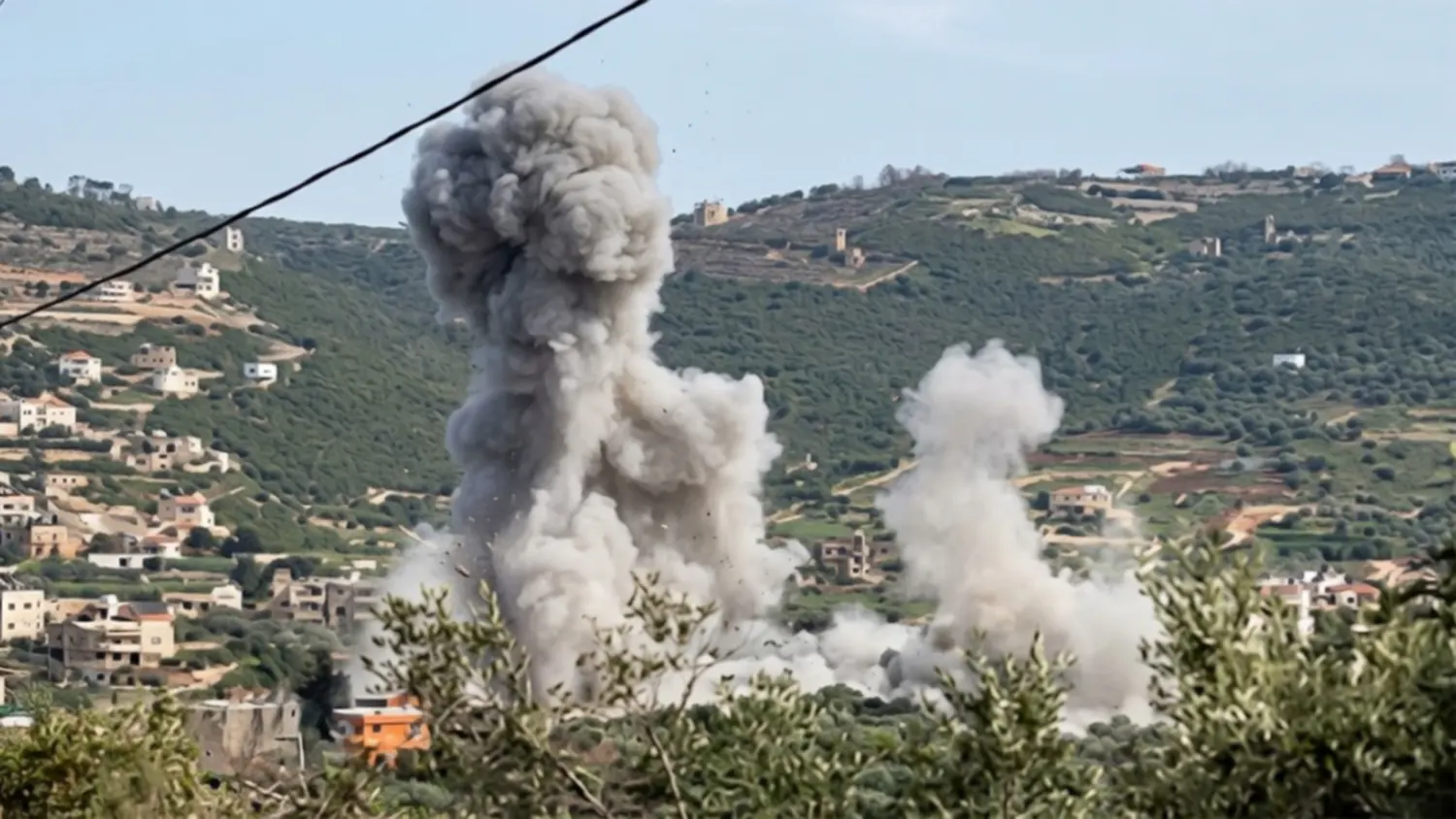
U.S. President Donald Trump extended the Israel–Lebanon ceasefire on April 24, 2026, but within hours, airstrikes, rocket fire, and civilian casualties underscored a stark reality: the truce exists on paper, not on the ground.
That gap is why this moment matters. A ceasefire that fails in practice risks rapid escalation, while regional stakes from Iran talks to global energy markets continue to rise. What happens in the next few days may shape far more than Lebanon’s southern border.
But the real shift becomes clear when looking at the past 24 hours, where diplomacy and military action have moved in opposite directions.
When a ceasefire holds politically but fractures militarily
The contradiction is immediate. Israeli airstrikes continued overnight into April 25, targeting what Israel says were Hezbollah rocket launchers and infrastructure in southern Lebanon.
Those strikes followed a trigger event. Hezbollah fired rockets toward northern Israel just before the extension was finalized, framing it as a defensive response to earlier Israeli actions. Israel, in turn, described its strikes as necessary to neutralize immediate threats.
The result is a familiar pattern. Each side justifies escalation as defense, even as the ceasefire formally remains in place.
That pattern becomes more consequential when measured in human cost.
Casualties are rising despite the diplomatic pause. At least six people were killed in Israeli strikes on April 24, according to Lebanon’s Health Ministry, with fatalities reported in Bint Jbeil, Wadi al-Hujair, and Touline.
Israel disputes that framing. The military maintains that those killed in Bint Jbeil were Hezbollah operatives, not civilians, and therefore legitimate targets under its rules of engagement.
This disagreement is not new, but it is critical. How casualties are defined shapes international response, and deepens mistrust between the parties involved.
And beyond casualties, the fighting has not remained confined to airstrikes alone.
On the ground, the ceasefire looks increasingly fragile. Active clashes continue in southern towns, particularly in Bint Jbeil, where Israeli forces report direct engagements with Hezbollah fighters.
At the same time, Israel has warned civilians not to return south of the Litani River, effectively maintaining a forward defense zone despite the truce.
In practical terms, this creates a paradox. Civilians are displaced as if war is ongoing, while leaders describe the situation as a controlled pause.
That disconnect leads directly to the next pressure point: diplomacy itself.
A widening gap between Washington’s optimism and battlefield reality
In Washington, the ceasefire is framed as progress. The Trump administration describes the extension as a “bridge” to a broader agreement, tied in part to ongoing U.S.–Iran negotiations.
But regional actors see it differently. Israeli Prime Minister Benjamin Netanyahu has made clear that the truce does not limit military action, insisting on “freedom of action” against Hezbollah threats.
Hezbollah, meanwhile, rejects the premise entirely. The group has labeled the talks a “free concession”, signaling no formal commitment to the U.S. brokered framework.
These positions are not just different, they are structurally incompatible. And that tension explains why the ceasefire struggles to hold.
What makes this even more urgent is the strategic logic driving each side’s decisions.
Israel’s position is rooted in security doctrine. Any Hezbollah presence near the border is treated as an immediate threat, particularly if rocket systems are involved.
Hezbollah operates under a different logic. It views Israeli forces in southern Lebanon as an occupation, and frames rocket fire as defensive resistance.
This creates a self reinforcing cycle. Each action triggers a counteraction, and each counteraction becomes justification for the next strike.
That cycle is not just military, it is also humanitarian.
Civilians trapped in a “gray zone” between war and peace
The human impact is severe and growing. More than 1.2 million Lebanese about 20% of the population remain displaced, unable to return to homes near the southern border.
Critical infrastructure is also under strain. Tebnin Hospital, the last functioning facility in the southern frontline area, is operating under constant threat, with supply routes repeatedly disrupted.
Even aid delivery has become precarious. Key access points like the Qasmiyeh Bridge have been struck multiple times, complicating efforts by humanitarian groups to maintain basic services.
This is the reality of what analysts call a “gray zone.” The war is not fully active, but it has not stopped, and civilians bear the cost of that ambiguity.
And beyond Lebanon itself, the implications are spreading outward.
Why a local ceasefire now carries global consequences
The urgency behind the ceasefire extends far beyond the immediate conflict. Energy markets are increasingly sensitive to instability in the region, particularly given tensions involving Iran.
The International Energy Agency has warned that a prolonged escalation could trigger a major fuel supply disruption, potentially affecting European aviation and global energy security.
At the same time, diplomacy is expanding geographically. U.S. envoys are engaged in parallel discussions involving Iran, linking the Lebanon situation to broader regional negotiations.
This makes Lebanon more than a flashpoint. It has become a testing ground for wider geopolitical strategy, where local violence can have global ripple effects.
Which brings the focus back to the central question: what happens next?
A narrow window where miscalculation could reset the conflict
The next three weeks were meant to create space for de escalation. Instead, they are exposing how fragile that effort is.
On paper, the ceasefire holds. In reality, daily exchanges of fire continue, and both sides are preparing for further escalation even while negotiating.
That contradiction defines the current moment. Diplomacy is buying time, but not resolving the conflict, and each new incident risks collapsing the entire framework.
For now, Lebanon sits in a precarious balance. A truce has been declared, but the conditions for lasting peace remain unresolved and increasingly, under pressure.