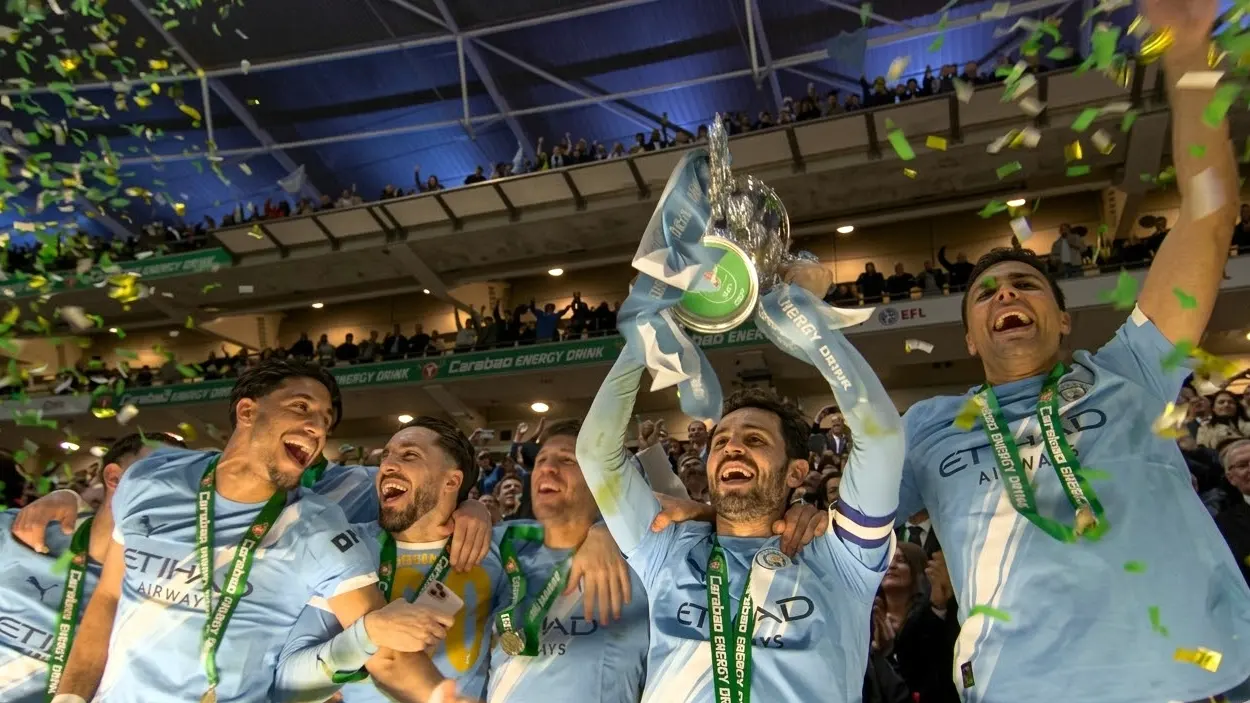
Under the arch of Wembley, finals are often defined by moments fleeting, decisive, and unforgiving. The 2026 Carabao Cup Final delivered exactly that. Manchester City claimed a 2–0 victory over Arsenal, but the scoreline only tells part of a story shaped by an early goalkeeping masterclass and a second-half emergence of a new star.
At its heart, this was a tale of extremes: James Trafford’s brilliance preserving parity under siege, and Nico O’Reilly’s clinical composure punishing Arsenal’s collapse. Between those moments, the tactical control of Pep Guardiola’s side gradually suffocated a vibrant but ultimately wasteful Arsenal performance.
The Opening Siege: Trafford’s Defining Moment (0’–15’)
Arsenal approached the final with urgency, intensity, and clear intent. From the first whistle, they pressed high, forcing City into uncomfortable areas and compressing space in midfield. Structurally, Mikel Arteta’s side deployed an aggressive 4-3-3 press, targeting City’s buildup lanes and disrupting rhythm.
The defining moment came in the 7th minute, a sequence that may well be remembered as the turning point of the final.
The “Trafford Triple Save.”
Starting ahead of Ederson, James Trafford justified his selection in extraordinary fashion. First, he denied Kai Havertz in a one on one with a sharp, low block. Within seconds, Bukayo Saka pounced on the rebound only for Trafford to produce not one, but two reflex saves in rapid succession.
Three saves. Less than ten seconds. A final defining intervention.
Arsenal’s early dominance was reflected in the numbers: 3 shots on target inside 15 minutes, compared to City’s 2 across the entire half. Yet, despite territorial control and attacking fluency, they failed to convert pressure into a lead, a recurring theme that would ultimately define their afternoon.
City, for their part, relied on defensive resilience. Nathan Aké and Abdukodir Khusanov were composed under pressure, gradually stabilizing the defensive line and allowing City to regain structure.
A Tactical Reset: City Regain Control
As the first half progressed, the dynamic shifted subtly but significantly. City began to impose their positional play, stretching Arsenal horizontally and creating central overloads.
By halftime, the game had transitioned from chaos to control.
City’s 63% possession across the match was not merely statistical dominance, it was strategic suffocation. By circulating the ball efficiently and pinning Arsenal deeper, Guardiola’s side reduced the game’s tempo and limited transitional opportunities.
Arsenal, having expended enormous energy early, began to lose compactness. Their press became less coordinated, their defensive distances stretched, and crucially, their ability to regain possession diminished.
The O’Reilly Show: Four Minutes That Defined the Final (60’–64’)
Finals often pivot on mistakes and Arsenal’s unraveling came swiftly and brutally.
60th Minute – 1–0: The Breakthrough
A seemingly routine moment turned catastrophic. A high cross from Rayan Cherki should have been comfortably claimed by Kepa Arrizabalaga. Instead, under minimal pressure, the goalkeeper fumbled the ball, spilling it into the six yard box.
Waiting was Nico O’Reilly.
The 21-year-old academy graduate reacted instinctively, nodding into an empty net. It was a poacher’s finish, but more importantly, it was a moment of composure amid chaos.
64th Minute – 2–0: The Killer Blow
Before Arsenal could regroup, City struck again.
This time, the move was crafted with precision. Matheus Nunes delivered a perfectly weighted cross to the back post. O’Reilly timed his run expertly, rising above the defense to power a header into the top corner.
Two goals. Four minutes. Game over.
In that brief window, O’Reilly transformed from promising prospect to Wembley match winner.
Defensive Lockdown: Control and Frustration (70’–FT)
With a two goal cushion, City shifted into game management mode, a phase they have mastered under Guardiola.
The emphasis turned to control:
- Sustained possession sequences
- Compact defensive structure
- Strategic fouling to disrupt rhythm
Arsenal, by contrast, grew increasingly frustrated. Their 11 fouls and 3 yellow cards reflected a team chasing shadows rather than dictating play.
Yet, even in defeat, they came agonizingly close to reigniting the contest.
Late Drama
- 78th minute: Riccardo Calafiori struck the post with a low drive
- Stoppage time: Gabriel Jesus saw a header crash against the crossbar
On another day, those moments might have changed the narrative. But this was Trafford’s day and City’s.
By the Numbers: Efficiency Over Volume
The final statistics underline the contrast in approaches:
- Score: Arsenal 0–2 Manchester City
- Possession: 37% – 63%
- Shots: 7 – 10
- Shots on Target: 3 – 2
- Yellow Cards: 3 – 1
Arsenal generated more early threat, but City demonstrated superior efficiency and control. They required fewer clear chances and took them ruthlessly.
Records and Milestones: A Historic Afternoon
This final was not just about the result, it was about legacy.
- Pep Guardiola became the most successful manager in League Cup history with 5 titles, surpassing Sir Alex Ferguson, Brian Clough, and José Mourinho
- Nico O’Reilly became the third youngest player to score a brace in a League Cup final (21 years, 1 day), joining elite company including Wayne Rooney
- Manchester City secured their 9th League Cup title, now just one behind Liverpool’s record of 10
These milestones reinforce City’s dominance in domestic cup competitions during the Guardiola era.
Tactical Takeaways: Control, Transition, and Ruthlessness
From an analytical perspective, three key themes emerge:
1. Goalkeeping as a Game State Lever
Trafford’s early interventions preserved equilibrium at a moment when City were vulnerable. Without that sequence, the tactical narrative and possibly the result could have shifted entirely.
2. Midfield Control as Defensive Strategy
City’s second-half dominance was not built on defensive retreat, but on possession as protection. By monopolizing the ball, they minimized Arsenal’s attacking phases.
3. Efficiency in Critical Moments
Arsenal’s failure to convert early dominance contrasted sharply with City’s clinical finishing. Finals reward teams that capitalize on high leverage moments and City executed flawlessly.
A Star Is Born, A Dynasty Reinforced
This Carabao Cup final will be remembered for two defining images: Trafford’s triple save and O’Reilly’s towering headers.
For Manchester City, it is another trophy, another chapter in an era of sustained excellence. For Arsenal, it is a harsh lesson in the unforgiving nature of elite football where dominance without efficiency leads to regret.
But above all, this was the day Nico O’Reilly announced himself on the biggest domestic stage.
And if this performance is any indication, it will not be the last time his name defines a final.