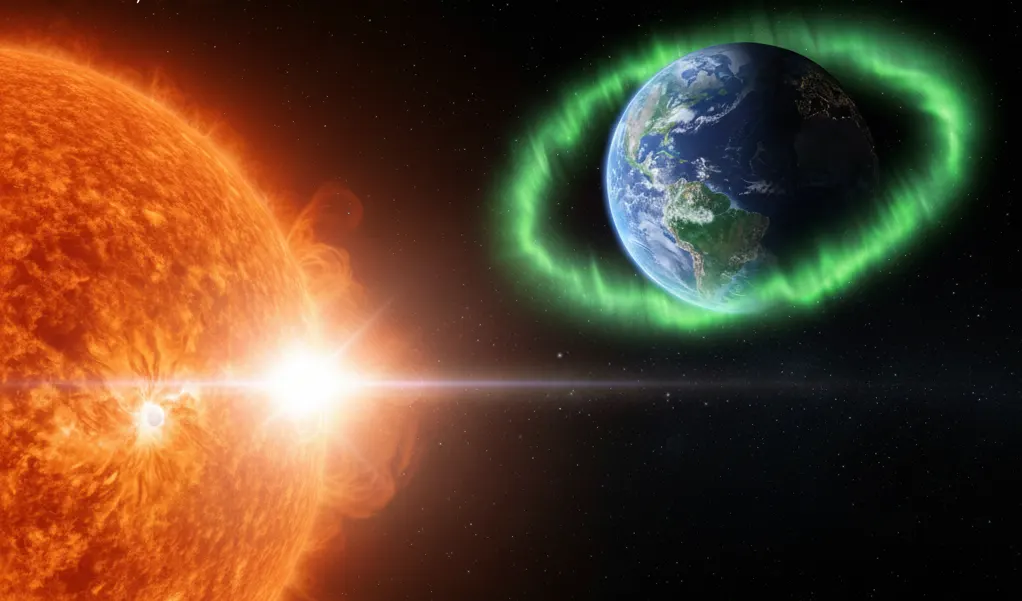
While the world focuses on the icy slopes of the Winter Olympics, a much hotter firestorm is taking place 93 million miles away. In the first week of February 2026, the Sun has entered a state of “Solar Chaos,” unleashing a barrage of X class solar flares that have triggered global radio blackouts and painted the night skies with rare, southward creeping auroras.
According to data from NASA’s Solar Dynamics Observatory (SDO) and NOAA’s Space Weather Prediction Center (SWPC), the Sun emitted a staggering six X class flares in the first four days of February alone. This level of activity marks a significant surge in Solar Cycle 25, proving that while the “peak” may have been predicted for 2025, the Sun’s most violent temper tantrums are happening right now.
The “Monster” Behind the Storm: Sunspot AR4366
The primary culprit for this cosmic fireworks display is a massive, magnetically complex sunspot region designated AR4366. Over the last week, this sunspot ballooned in size, growing to rival the infamous sunspot of the 1859 Carrington Event.
“Region 4366 has grown into a ‘flare factory,’” says Dr. Emma Cain Louden, an astrophysicist monitoring the event. “Its magnetic fields are so twisted and unstable that they are snapping like high tension rubber bands, releasing billions of hydrogen bombs worth of energy into space.”
Timeline of the February Firestorm
- February 1: The X8.3 “Monster” Flare. At 6:57 PM EST, the Sun released an X8.3 flare, the most powerful eruption recorded in 2026 and one of the strongest of the last two decades. It caused an immediate R3 level radio blackout across the South Pacific, eastern Australia, and New Zealand.
- February 2: The Double Punch. Just hours later, two more eruptions an X2.8 and an X1.6 hammered the Earth’s ionosphere, extending communication disruptions for maritime and aviation channels.
- February 4: The X4.2 “Colossal” Eruption. This impulsive flare peaked at 7:13 AM EST, knocking out high frequency radio signals across Africa and Europe. It currently ranks among the top 20 most powerful flares recorded since 1996.
Global Impacts: From Radio Silence to Rare Auroras
While solar flares travel at the speed of light and hit Earth in minutes, the slower moving clouds of plasma known as
Coronal Mass Ejections (CMEs) take days to arrive.
These CMEs are responsible for the stunning visual displays and technical headaches we are seeing this weekend.
Technological Disruptions
The Indian Space Research Organisation (ISRO) and NASA have issued high alert warnings for satellite operators.
The intense radiation from these flares can expand the Earth’s upper atmosphere, creating “drag” on low earth orbit satellites and potentially shortening their lifespans. Shortwave radio enthusiasts and pilots have reported “dead air” below 30 MHz for several hours following each X class event.
The “Year of the Aurora”
The silver lining to this solar chaos is the “Year of the Aurora.” Because these storms are so powerful, the Northern Lights are being pushed far beyond their usual Arctic haunts.
- Northern Hemisphere: Auroras have been captured as far south as Washington, Michigan, Maine, and even parts of the UK and Northern Italy.
- Southern Hemisphere: In a truly rare event, a diffuse aurora was spotted over southern Brazil, made possible by a magnetic weak point known as the South Atlantic Anomaly.
Why 2026 is a Test for Modern Civilization
Solar Cycle 25 was originally predicted to be a “weak” cycle, similar to the one before it. However, 2026 is proving those models wrong. Our increasing reliance on GPS, Starlink satellites, and interconnected power grids makes us more vulnerable to solar weather than at any other point in history.
“In 2026, the question is no longer if a solar storm will occur, but if we are prepared for the limitations they impose,” says space weather forecaster Valdemar Medeiros. “A single Carrington level event today could theoretically disrupt the global internet for weeks.”