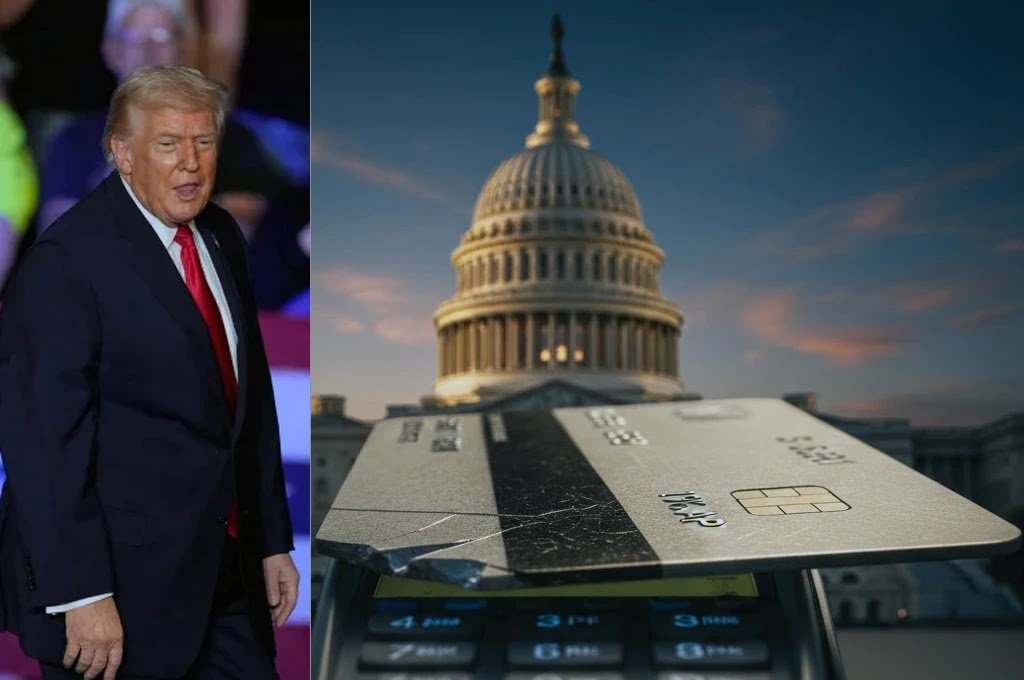
A Populist Demand Turns Into a Capitol Hill Battle
President Donald Trump’s push to cap credit card interest rates at 10% has moved from campaign style pressure to a full scale legislative fight, setting up one of the most consequential consumer finance showdowns in years.
After banks ignored his January 20 deadline to voluntarily lower rates, Trump escalated the issue on January 21 at the World Economic Forum in Davos, urging Congress to act.
Speaking to global executives, he posed the rhetorical question now echoing through Washington:
“Whatever happened to usury ?”
That moment marked the formal launch of a policy clash between the White House and the financial industry over how much profit is too much in the credit economy.
The Proposal at the Center
The effort now revolves around the 10 Percent Credit Card Interest Rate Cap Act (S. 381)
a bill that would impose a one year 10% ceiling on credit card APRs.
Supporters argue the measure would deliver immediate relief:
- Current average APR: ~24%
- Subprime rates: Often above 30%
- Proposed cap: 10%
- Estimated household savings: ~$100 billion annually
The administration contends that soaring rates, combined with record bank margins, are squeezing families trying to rebuild savings and manage everyday expenses.
An Unlikely Political Alliance
The bill has forged an unusual alliance between lawmakers who rarely agree on financial regulation.
Leading sponsors include:
- Sen. Bernie Sanders (I-VT)
- Sen. Josh Hawley (R-MO)
They’ve been joined by senators from the progressive wing and populist conservatives alike
a coalition driven by voter frustration over debt burdens.
Still, leadership resistance is real. The legislation remains stalled in the Senate Banking Committee, with no timeline for a floor vote.
The Banking Industry’s Counterattack
This showdown isn’t happening in a vacuum; it’s the latest front in a widening war over consumer finance rules.
In a January 10 joint statement, the American Bankers Association (ABA) and the Bank Policy Institute (BPI) warned that a 10% cap could force lenders to restrict or close 80% of existing credit card accounts, affecting 175–190 million cardholders.
Their argument centers on “risk pricing.” Banks say:
- Capital costs consume roughly 4%
- Expected losses and defaults add about 6%
- Operational costs push total lending costs higher
At a 10% ceiling, they argue, mainstream lending to higher risk borrowers becomes unsustainable leading to tighter credit standards and fewer approvals.
Executives also warn consumers could turn to far costlier alternatives, including payday lenders with triple digit effective interest rates.
The “Junk Fee” Trade-Off
The rate cap debate also intersects with recent regulatory shifts.
In April 2025, the administration’s Consumer Financial Protection Bureau under Acting Director Russell Vought effectively voided the prior $8 late fee cap, allowing banks to return to fees of $32–$40 per missed payment.
The White House now frames the 10% interest proposal as a corrective trade off:
banks regained fee flexibility, but consumers should see relief on interest costs.
Critics counter that the two policies pull in opposite directions, complicating the “consumer protection” narrative.
What Lawmakers Are Weighing
At its core, the debate pits consumer relief against credit market mechanics:
| Issue | Supporters Say | Opponents Say |
|---|---|---|
| Household impact | Immediate debt relief | Short-term help, long-term exclusion |
| Market function | Limits excessive pricing | Government price controls distort risk |
| Credit access | Eases financial strain | Could cut off lower-income borrowers |
| Economic effect | Frees cash for spending | Risks credit contraction |
Data source: Congressional Record S. 381 / Industry Analysis (Jan 2026)
House Speaker Mike Johnson and other Republicans have said they want to study the potential “secondary effects” before advancing the bill, while financial industry lobbying has intensified.
The Stakes Beyond Rates
This is no longer just a policy proposal, it’s a test of how far governments should go in reshaping consumer credit markets during periods of economic strain.
Supporters view the cap as overdue intervention against predatory pricing.
Opponents see it as a form of price control that could fracture the lending system.
The bill’s fate now rests in Congress, where economic theory, political pressure, and financial system stability are colliding in real time.
Whatever the outcome, the fight signals a broader shift: consumer debt has moved from a household concern to a central battleground in national economic policy.