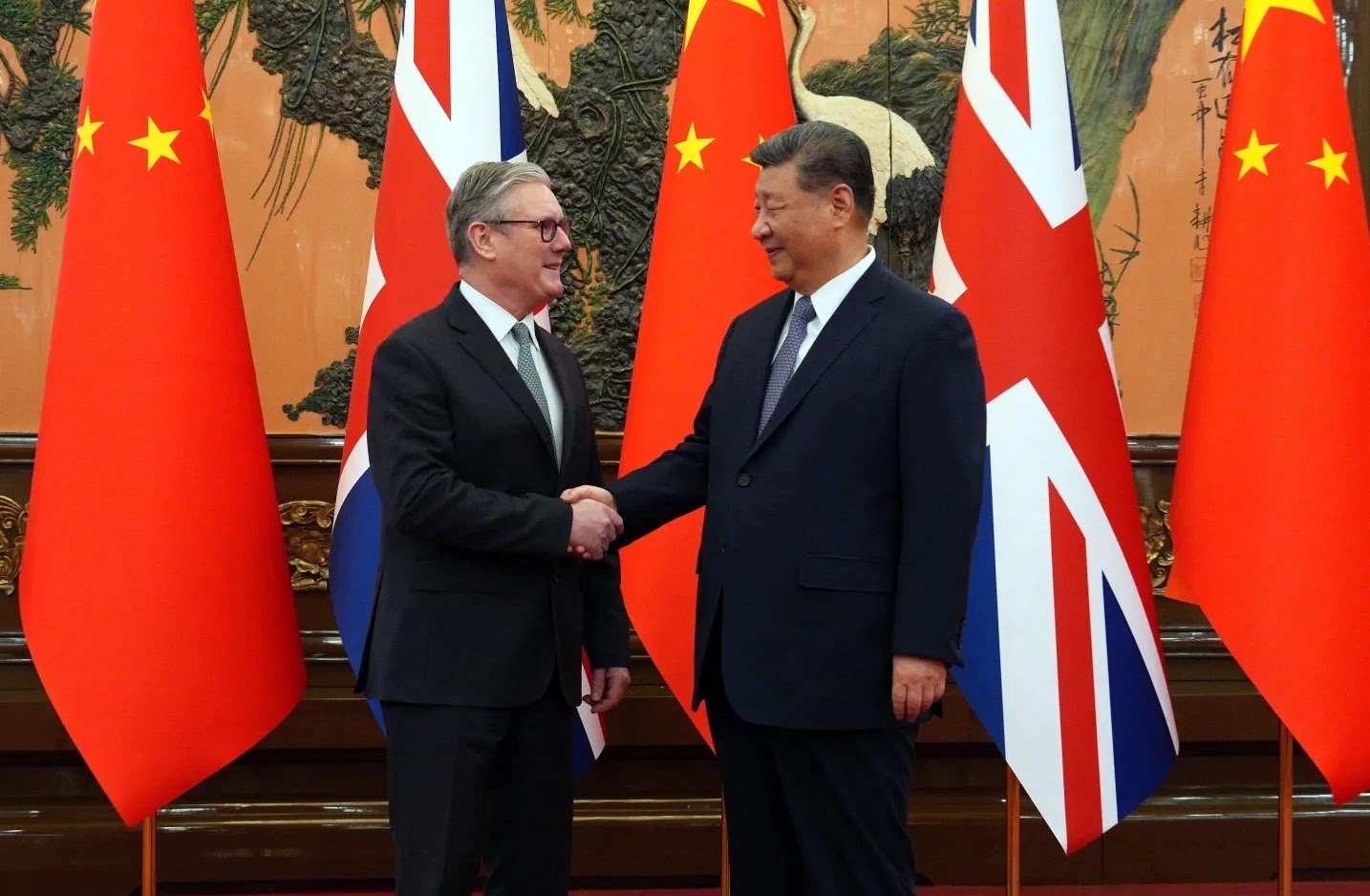
Inside Beijing’s Great Hall of the People, a setting designed to project permanence and power
Keir Starmer opened a meeting that could redefine Britain’s relationship with the world’s second largest economy. At his side: more than 50 executives from finance, pharmaceuticals, and manufacturing. The visual alone delivered the message. London has come to talk business but not at any price.
Starmer’s visit, the first by a British prime minister in eight years, marks what officials are calling a “pragmatic reset”: engagement with guardrails, cooperation without illusions, and diplomacy built around economic necessity rather than strategic romance.
Trade First, But Not Blindly
Starmer’s arrival in Beijing with CEOs from HSBC, GSK, and Jaguar Land Rover in tow underscores a blunt reality: the UK government is betting that steadier trade with China can help revive growth at home.
China remains Britain’s third largest trading partner. The push this week is not for a sweeping free trade agreement, but for targeted access:
- Expanded operating room for British banks in China’s wealth markets
- Faster approvals for UK pharmaceuticals and life sciences firms
- Continued demand for high end British manufacturing exports
The pitch from London is consistency. After years of policy swings between enthusiasm and hostility, British officials are trying to create a predictable commercial environment, one that reassures investors without triggering geopolitical shockwaves.
UK–China Economic Snapshot (Jan 2026)
- Total Annual Trade: ~£103 billion
- UK Goods Deficit: ~£42 billion (partly offset by a services surplus)
- Primary UK Exports: Financial services, pharmaceuticals, automotive
- Migration Link: >60% of small-boat engines used in Channel crossings are Chinese manufactured
A Security Perimeter Around Engagement
If the setting projected ceremony, the security protocols reflected deep mistrust. British delegates were issued temporary phones and laptops, carried signal blocking bags, and were briefed to assume hotel rooms could be monitored, an extraordinary digital defense posture for a modern diplomatic visit.
Starmer has described the approach as “clear-eyed.” Economic engagement is being rebuilt, but espionage risks, cyber threats, and data security remain front and center.
Human Rights as the Litmus Test
During face to face talks, Starmer raised the case of Jimmy Lai, the British citizen and pro democracy publisher imprisoned in Hong Kong. The UK is seeking movement on humanitarian grounds;
Beijing insists the matter is judicial and internal.
For critics at home, this case is the ultimate test of whether “pragmatism” delivers leverage
or simply softens Britain’s stance.
The Migration Deal: A Practical Breakthrough
Amid the strategic tension, the two sides reached a concrete law enforcement agreement aimed at illegal Channel crossings. Instead of focusing solely on boats intercepted at sea, the UK and China will cooperate to disrupt the supply chain of engines and parts before they reach smuggling networks in Europe.
The arrangement includes intelligence sharing, manufacturer engagement, and joint efforts against organized crime groups also linked to synthetic opioid production. For Starmer, it is proof that engagement can produce operational gains on a politically sensitive issue.
Domestic Backlash and the “Mega-Embassy”
Back in London, the reset is controversial. The UK’s recent approval of a massive new Chinese embassy complex has drawn accusations that the government is trading security for access.
Officials argue consolidation actually simplifies monitoring and helped unlock reciprocal expansion of Britain’s diplomatic footprint in Beijing.
Layered onto this is the Chagos Islands dispute. U.S. officials and President Donald Trump personally are reportedly furious over Britain’s plan to transfer sovereignty of the islands to Mauritius, fearing it could create a Chinese surveillance “gap” near the Diego Garcia base. That tension colors Washington’s cool reaction to Starmer’s outreach.
The Trump Contrast: Old Diplomacy vs. New Transactionalism
This summit also unfolds against a shifting U.S. approach. President Trump’s new “Board of Peace” initiative, which operates outside traditional multilateral structures, reflects a more transactional diplomatic model. Britain has declined to join.
Starmer’s Beijing trip follows Canadian Prime Minister Mark Carney’s recent visit to China
a sign that Western allies are hedging as U.S. trade policy grows less predictable. London’s message is that engagement with China is risk management, not realignment.
The Real Test Ahead
The reset is designed to operate in the grey zone: trade without dependency, dialogue without naivety, cooperation alongside containment. It is a model built for a fragmented world.
But its credibility may ultimately rest less on trade volumes than on one unresolved question:
whether quiet diplomacy can produce progress in cases like Jimmy Lai’s.
If not, the word “pragmatic” may begin to sound, to critics, a lot like “appeasement.”