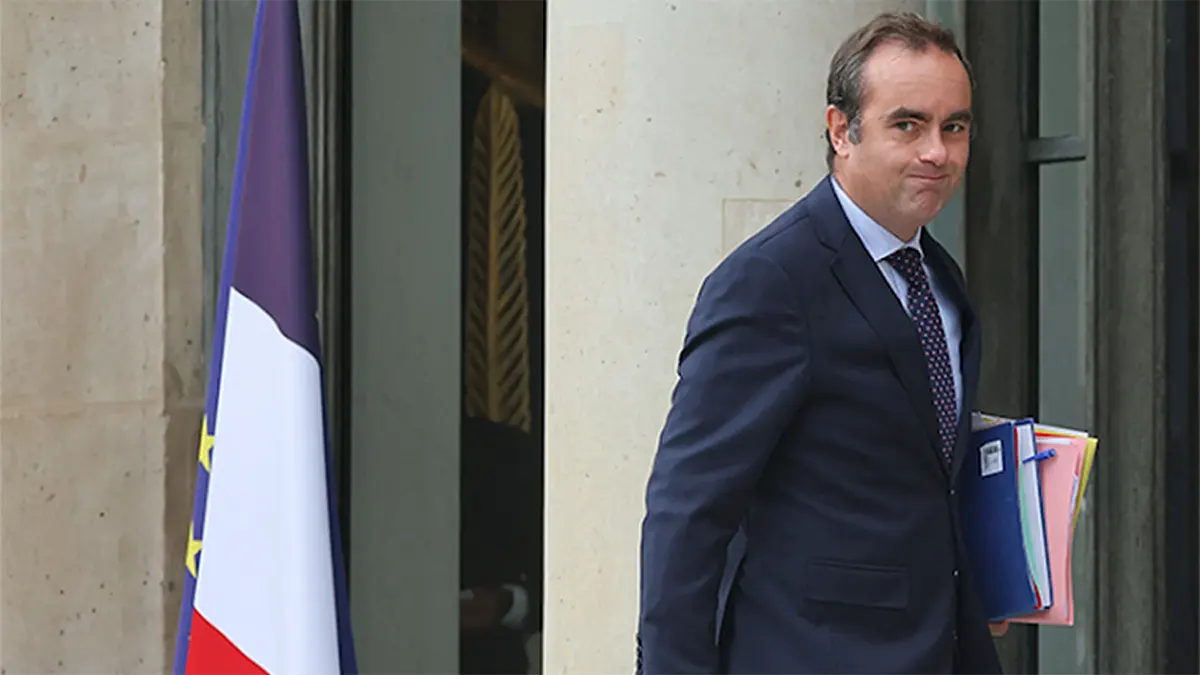
France has been thrown into another political crisis after Prime Minister Sébastien Lecornu resigned on October 6, just 27 days after taking office and only hours after announcing his new cabinet.
President Emmanuel Macron accepted the resignation on Monday morning, ending the shortest premiership in the history of France’s Fifth Republic. Lecornu had been appointed on September 9, following the collapse of François Bayrou’s government.
The resignation came as Lecornu struggled to secure enough support in a deeply divided National Assembly. His government was already facing opposition from both the left and right, while members of the conservative Republicans party also questioned whether the new cabinet represented the political break Lecornu had promised.
Lecornu says the conditions to govern had disappeared
Lecornu said he could no longer continue because the political conditions needed to govern were not in place.
In his resignation statement, he pointed to partisan interests and the approaching 2027 presidential election, arguing that political groups were focused more on their own positions than on finding enough common ground to govern.
He also criticized the lack of compromise across France’s political spectrum.
The problem was not simply opposition from outside the government. Some of Lecornu’s potential allies were also turning against his cabinet almost immediately after it was announced.
That left the prime minister facing the possibility that his government could collapse before it even held its first full cabinet meeting.
The cabinet lasted less than a day
The timing made the crisis particularly extraordinary.
Lecornu announced the first 18 members of his government on Sunday evening, October 5. By Monday morning, he had resigned.
The government therefore existed for only about 14 hours, making it the shortest-lived government of the Fifth Republic and, according to Le Monde, the shortest French government in more than a century.
Lecornu’s own tenure lasted 27 days.
That broke the previous Fifth Republic record held by Michel Barnier, who had remained prime minister for just under three months before his government fell in December 2024.
The extraordinary speed of the collapse highlights just how difficult it has become for Macron to build a functioning government without a stable parliamentary majority.
Conservatives turned on the cabinet almost immediately
One of the biggest problems came from Les Républicains (LR), the center-right party whose parliamentary support Lecornu needed.
LR leader Bruno Retailleau was himself retained as interior minister, but he criticized the cabinet almost immediately after its announcement.
Retailleau said the composition “does not reflect the break promised” by Lecornu and called his party’s strategic committee to discuss the situation.
The controversy centered partly on the return of several familiar figures associated with Macron’s previous governments.
Former Finance Minister Bruno Le Maire was appointed defense minister, while Roland Lescure took over the economy and finance portfolio. Reuters reported that the new cabinet was intended to be a compact 18-member team, with further appointments expected later.
For critics on the right, the appointments looked less like the promised political reset and more like a continuation of Macron’s existing approach.
Both the left and far right were ready to challenge the government
Lecornu was also facing opposition from the two ends of France’s political spectrum.
The National Rally, led by Marine Le Pen, quickly called for Macron to dissolve the National Assembly and hold new legislative elections.
On the left, La France Insoumise also demanded a political reset and renewed its pressure on Macron.
The government’s problem was therefore structural: it did not have a reliable majority and needed cooperation from political groups that had strong reasons to oppose it.
The immediate challenge was especially serious because the government needed to advance the 2026 budget, with France already facing significant fiscal pressure. Reuters reported that securing parliamentary support for the budget was Lecornu’s central task when Macron appointed him.
France’s political crisis has been building for more than a year
Lecornu’s resignation did not happen in isolation.
France’s current political instability intensified after Macron dissolved the National Assembly and called snap legislative elections in 2024. The election produced a fragmented parliament in which no political bloc secured a governing majority.
That made it difficult for successive prime ministers to pass legislation without negotiating with rival parties.
Lecornu was already Macron’s fifth prime minister in two years, according to Reuters reporting on his resignation.
His predecessors Gabriel Attal, Michel Barnier and François Bayrou each faced different versions of the same fundamental problem: how to govern when no single political camp controls the National Assembly.
The resignation therefore represents another symptom of a wider political breakdown rather than simply the failure of one prime minister.
Financial markets immediately reacted to the shock
The political turmoil quickly reached French financial markets.
The CAC 40 fell more than 2% at one point after news of Lecornu’s resignation, before recovering some of the losses. Reuters reported that the index was down 1.85% later in the morning, while shares of major French banks were also under pressure.
French government bond yields also moved higher. The yield on the benchmark 10-year French government bond rose by roughly seven basis points to around 3.58%, while the 30-year yield climbed close to 4.41%.
The reaction reflects a broader concern among investors: political instability makes it harder for France to deal with its already difficult fiscal position.
Markets were particularly sensitive to uncertainty surrounding the government’s ability to agree on a 2026 budget and address the country’s debt and deficit problems.
Macron faces another difficult choice
Lecornu’s resignation put the next move firmly in Macron’s hands.
The president could appoint another prime minister, attempt to build a new parliamentary arrangement, or consider another dissolution of the National Assembly. Each option carries significant political risks.
A new prime minister would still face the same fragmented parliament unless Macron could secure a broader agreement among political parties.
Calling another election could produce a clearer result but it could also deepen the political divisions that caused the current crisis in the first place.
Meanwhile, Macron has continued to reject calls for his own resignation.
By the end of October 6, however, the president had taken an unexpected step: he asked Lecornu to conduct further negotiations for 48 hours in an attempt to find a political platform capable of providing some stability.
That meant the resignation had not immediately brought France to a definitive political endpoint.
The real test is whether France can find a workable majority
Lecornu’s brief tenure has exposed the central problem facing Macron’s presidency.
France does not simply need another prime minister. It needs a governing arrangement capable of surviving parliamentary votes and passing a budget.
That is becoming increasingly difficult as the center, right and left struggle to cooperate and prepare for the 2027 presidential election.
For investors, the concern is fiscal stability. For Macron, it is political authority. And for the parties in parliament, the calculation is increasingly shaped by how they position themselves ahead of the next presidential contest.
Lecornu’s 27-day premiership may therefore be remembered not only as a historical record, but as another warning that France’s political system is struggling to function under its current parliamentary balance.
The immediate crisis on October 6 remained unresolved. Macron had bought himself another 48 hours of negotiations, but the fundamental question remained the same: can France’s deeply divided political forces find enough common ground to govern?