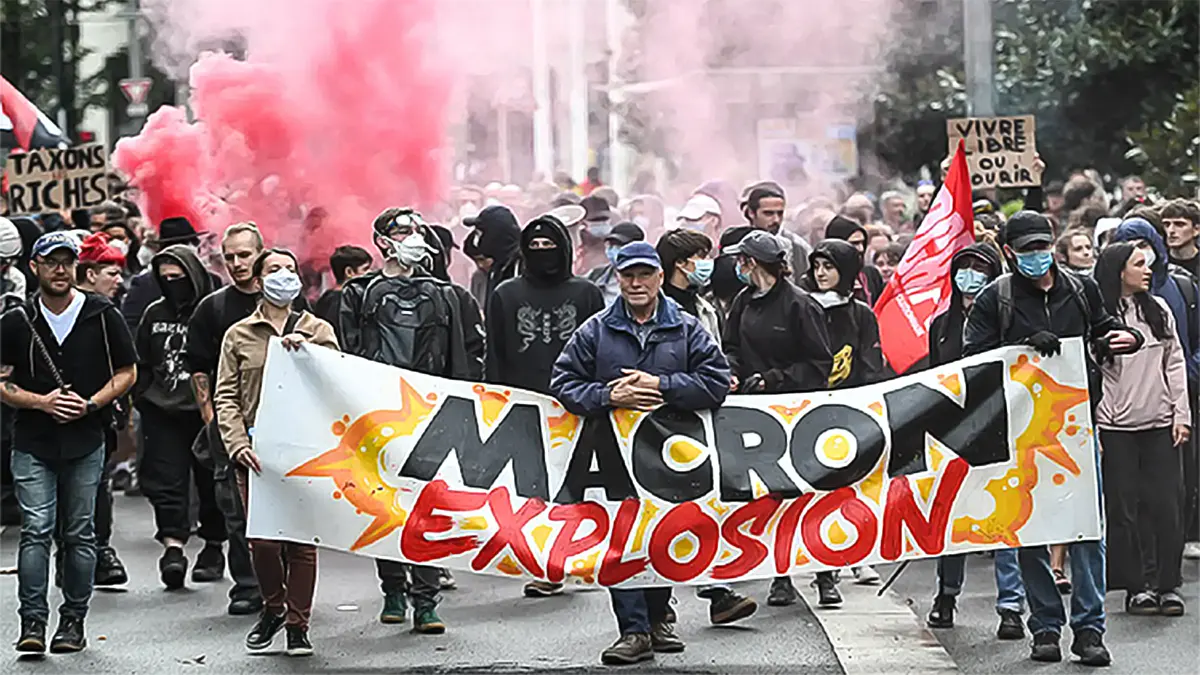
Hundreds of thousands of protesters filled the streets across France as nationwide strikes and demonstrations erupted against the government’s proposed austerity measures.
The protests mark the first major political crisis for newly appointed Prime Minister Sébastien Lecornu, who now faces growing public anger, labor unrest, and a deeply divided parliament.
What began as opposition to a controversial budget proposal has quickly evolved into a broader movement fueled by frustration over economic inequality, rising living costs, and political instability under President Emmanuel Macron.
Budget Cuts Trigger Nationwide Backlash
At the center of the unrest is a new government budget plan designed to reduce France’s growing public deficit.
The proposal includes an estimated €44 billion in spending cuts along with a freeze on most welfare programs.
Government officials argue the measures are necessary to stabilize the country’s finances. However, unions and protesters say ordinary citizens are being forced to carry the burden while wealthy corporations avoid meaningful sacrifices.
French labor unions have united in a rare show of solidarity, demanding the government:
- Reverse planned budget cuts
- Protect public services such as healthcare, education, and transportation
- Increase taxes on large corporations and the wealthy instead of reducing social support
Many demonstrators also see the new measures as a continuation of Macron-era economic reforms that have already sparked years of public anger.
Public Frustration Builds After Years of Political Tension
The protests come after a turbulent period in French politics that included controversial pension reforms and a snap election that left parliament fractured without a clear majority.
For many protesters, the new austerity plan represents another example of policies they believe favor business interests over working families.
That frustration has pushed large crowds into the streets of Paris, Marseille, Lyon, Toulouse, and several other major cities.
Union leaders say the movement could continue for weeks if the government refuses to negotiate.
Transportation and Public Services Severely Disrupted
The strikes have caused widespread disruption across the country, affecting millions of residents and tourists.
Major Transportation Shutdowns
Public transportation systems have been heavily impacted:
- Several Paris metro lines were shut down completely
- Regional train services faced major cancellations
- Intercity rail routes experienced severe delays
- Bus operations in multiple cities ran on reduced schedules
The disruptions created traffic congestion and long commuter delays throughout the country.
Schools, Hospitals, and Tourist Sites Affected
The strike action extended well beyond transportation.
Schools, pharmacies, and healthcare services reported high participation rates among workers, with some facilities temporarily closing.
Several famous tourist attractions also faced disruptions, including:
- Louvre Museum
- Palace of Versailles
Some locations closed their doors entirely as staff joined the nationwide demonstrations.
Heavy Police Presence as Clashes Break Out
In response to the growing unrest, the French government deployed approximately 80,000 police officers and gendarmes across the country.
Authorities reported clashes between protesters and police in several cities, leading to dozens of arrests.
Tear gas was used in some areas after confrontations escalated during demonstrations.
Despite the tensions, union organizers insist the protests are intended to pressure the government into reopening negotiations rather than create chaos.
A Critical Test for France’s New Prime Minister
The crisis represents a defining moment for Prime Minister Lecornu, who only recently took office following the collapse of the previous government led by François Bayrou.
Lecornu has promised a “profound break” from previous leadership and has already attempted to calm tensions by abandoning a highly unpopular proposal to remove two public holidays.
Still, many protesters remain unconvinced.
Critics argue that Lecornu remains closely aligned with Macron’s economic agenda and will continue pursuing policies viewed as favoring businesses and financial markets over workers.
His ability to negotiate with unions and opposition parties may determine whether the government can successfully pass its budget and avoid a deeper political crisis.
France Faces Another Period of Uncertainty
As demonstrations continue, France appears headed toward another prolonged period of political and social tension.
The outcome of the standoff could shape not only Lecornu’s future as prime minister but also the broader direction of French politics ahead of future elections.
For now, the streets of France remain filled with protesters demanding economic fairness, stronger public services, and a government they believe listens to ordinary citizens.