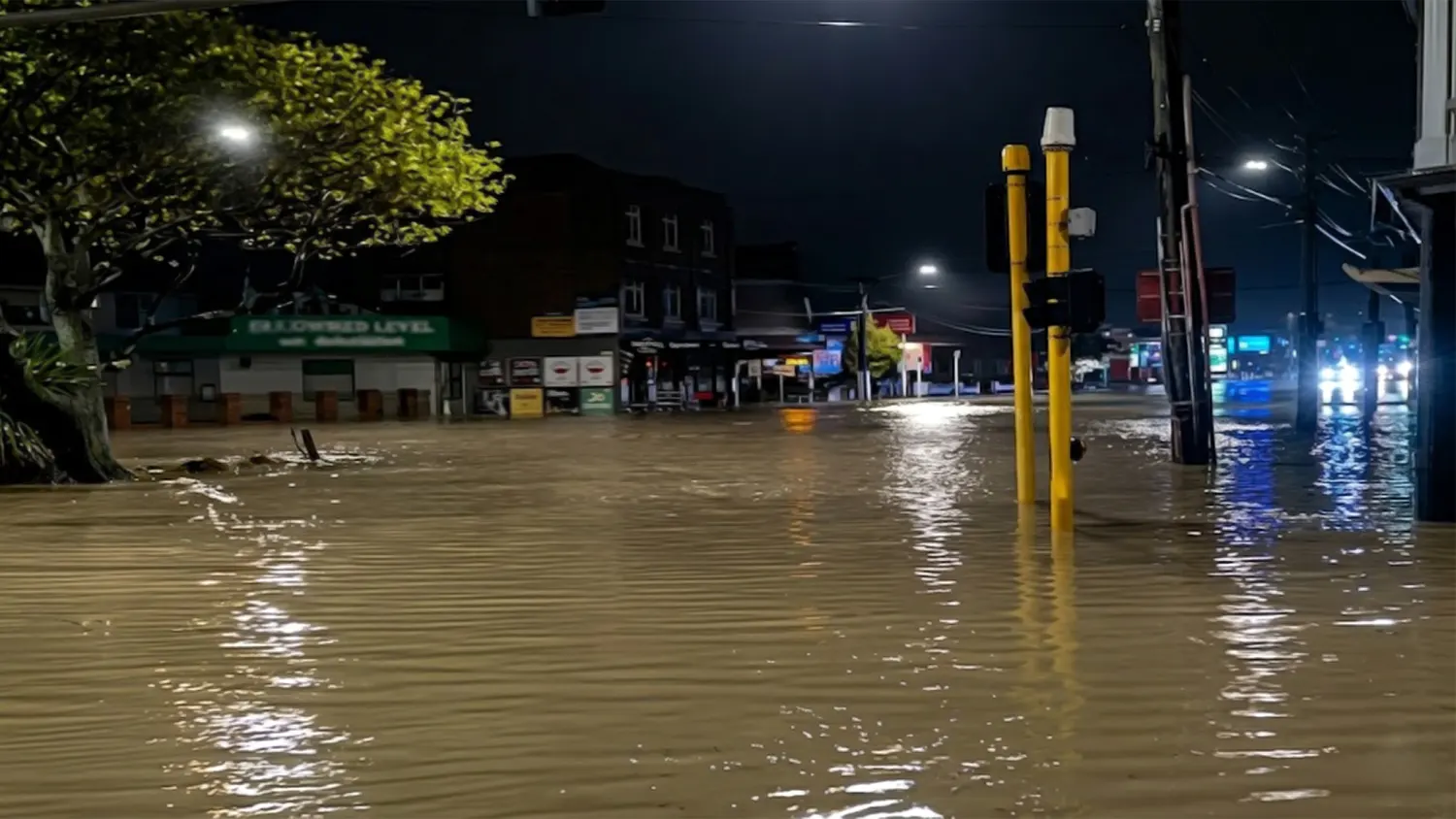
A historic urban flood disaster is currently gripping Wellington, New Zealand, as the capital faces one of the most severe weather emergencies in its modern history. As of April 21, 2026, a Local State of Emergency remains in effect, with authorities racing to manage the aftermath of a record breaking deluge that has overwhelmed infrastructure, displaced residents, and triggered life-threatening geological instability.
This is not just another storm. It is a compound disaster, intensified by prior extreme weather namely Cyclone Vaianu, which saturated the region just days earlier. The result is a cascading crisis where floodwaters, landslides, and infrastructure failure are converging simultaneously.
A City Overwhelmed: The Scale of the Flooding
To understand the severity of the situation, consider this: 77 millimeters of rain fell in a single hour, a rate experts describe as extreme even in tropical climates. Wellington, not built for such intense rainfall, has struggled to cope.
Floodwaters surged through neighborhoods, lifting manhole covers and turning streets into dangerous, debris-filled channels. In southern suburbs like Berhampore, Mornington, and South Karori, entire homes have been inundated some flooded to the ceiling and at least ten are now deemed uninhabitable.
Beyond the immediate devastation, the flood has exposed vulnerabilities in urban planning and drainage systems, raising urgent questions about how cities can adapt to increasingly volatile climate patterns.
Lives at Risk: Search and Rescue Efforts
Amid the chaos, search and rescue operations are ongoing. Authorities are urgently searching for Philip Sutton, a man in his 60s who was swept away when floodwaters and debris struck his home in Karori.
Rescue teams are focusing on the Karori South Road area, but progress is slow and dangerous. The ground remains unstable, and the threat of additional landslides complicates every step.
This human dimension underscores the true cost of such disasters: beyond infrastructure and property, lives hang in the balance.
The Hidden Danger: Landslides and Unstable Ground
While the rain has begun to ease, a more insidious threat is emerging. Wellington’s hilly terrain, usually one of its defining features, has become a major hazard.
The soil is now fully saturated, creating ideal conditions for landslides known locally as “slips.” In areas like Vogeltown, a massive landslide has already blocked Liardet Street, cutting off access and continuing to shift unpredictably.
Authorities are urging residents to watch for critical warning signs:
- Tilting trees
- New cracks in the ground or driveways
- Doors and windows that suddenly stick
These subtle indicators may precede catastrophic slope failure. Even more concerning, experts warn that landslides often occur after rainfall has stopped, as water continues to seep deeper into the soil.
Infrastructure Under Strain: A City Disconnected
The flooding has severely disrupted Wellington’s transport and infrastructure networks, isolating communities and complicating recovery efforts.
One of the most significant impacts is the closure of State Highway 2 (Remutaka Hill). A bridge washout between Kaitoke and Featherston has effectively cut off a major route linking Wellington to the Wairarapa region. Engineers are now assessing the damage, but reopening is not expected for several days.
Meanwhile:
- Rail services are delayed due to debris on tracks
- Flights have only partially resumed at Wellington Airport
- Urban roads are riddled with hidden hazards like displaced manhole covers
This widespread disruption highlights how critical infrastructure can fail under extreme weather, amplifying the overall impact of natural disasters.
Emergency Response: Shelters and Safety Measures
In response to widespread displacement, emergency shelters have been activated across the city. The Wellington City Mission and several local marae are providing refuge for families forced from their homes.
Authorities are issuing clear, urgent guidance:
- Avoid unnecessary travel to keep roads clear for emergency crews
- Do not attempt independent clean-up efforts yet, as hidden dangers such as downed power lines remain
- If you hear rumbling or cracking sounds, evacuate immediately to higher ground
These measures are not precautionary, they are essential for survival in a rapidly evolving hazard environment.
A Critical Transition: From Rainfall to Recovery
As of Tuesday evening, the situation is entering a transition phase. The most intense rainfall has passed, and the Red Heavy Rain Warning has been downgraded to Orange. However, this does not signal safety only a shift in risk.
The next 48 hours are considered highly dangerous, particularly due to:
- Continued soil saturation
- A Strong Wind Watch, with gusts capable of toppling weakened trees
- The potential for high tide backflow, worsening drainage in coastal areas
In short, the threat is no longer falling from the sky, it is embedded in the ground beneath residents’ feet.
Looking Ahead: Recovery and Lingering Risks
Weather forecasts offer cautious optimism. By Wednesday, only light “nuisance” showers are expected, and clearer conditions should emerge by Thursday and Friday. This will allow:
- Drying of flooded properties
- Deployment of heavy machinery to clear landslides
- More thorough infrastructure assessments
However, recovery will be neither quick nor simple. The combination of water damage, ground instability, and transport disruption means Wellington faces days, if not weeks of intensive recovery work.
A Broader Warning
Wellington’s crisis is not an isolated incident, it is part of a growing pattern of extreme weather events worldwide. The intensity, frequency, and compounding nature of these disasters suggest a new reality where cities must prepare for multi layered environmental threats.
This raises a critical question: Are urban centers equipped to handle the new extremes of climate driven disasters?
For Wellington, that question is no longer theoretical. It is unfolding in real time, in flooded streets, fractured hillsides, and communities fighting to recover.
For now, vigilance remains essential. The rain may have eased, but the danger has not passed.