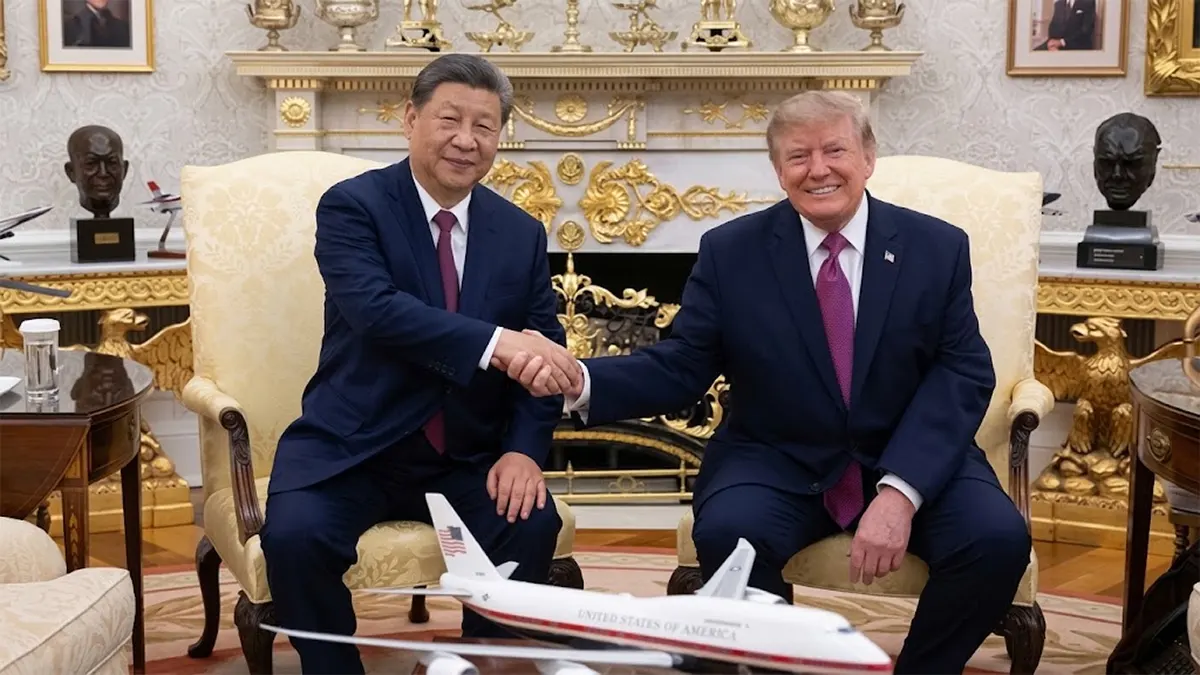
President Trump and President Xi Jinping sat down at the White House in September 2026 for their second face to face meeting of the year, following an earlier summit in Beijing. And while the headlines promised a “reset” in U.S.-China relations, what actually came out of the room was something narrower: a handful of targeted agreements rather than one sweeping deal.
No comprehensive economic treaty was signed. Instead, the two sides walked away with working mechanisms, trade carve-outs, and a couple of new communication channels while leaving the biggest, thorniest issues untouched.
A Trade Truce, Not a Trade Deal
The centerpiece of the summit was an extension of the existing tariff truce, keeping higher tariffs and export controls on pause. But the more interesting piece is a new mechanism nicknamed the “30 for 30” trade corridor.
Through the newly launched U.S.–China Board of Trade, both countries agreed to give favorable tariff treatment to $30 billion worth of “non-sensitive” goods flowing each way. On the U.S. side, that means agricultural products, seafood, timber, cosmetics, and medical devices heading to China. Going the other direction, it covers Chinese-made appliances, toys, holiday decorations, and child car seats coming into the U.S.
The idea is simple: let ordinary commercial trade keep moving even while the two governments spar over bigger strategic issues. The U.S. Trade Representative’s office defines “non-sensitive” narrowly, advanced microchips, defense technology, and dual-use AI hardware are explicitly excluded, as are critical minerals and EV batteries from China. The list isn’t fixed either; it’s meant to be updated on a rolling basis as officials review petitions from importers and exporters.
China also made a concrete commitment to buy at least 10 million metric tons of U.S. coal per year in 2027 and 2028, a tangible win Trump can point to for American energy producers.
Two New Boards, One Bigger Bureaucracy
Beyond the tariff carve-outs, the summit formally stood up two government to government bodies: the U.S.–China Board of Trade and the U.S.–China Board of Investment.
The Trade Board, led by U.S. Trade Representative Jamieson Greer and China’s Ministry of Commerce, isn’t just managing tariff lists, it also launched a dedicated agriculture working group tasked with reopening U.S. beef processing plants, lifting poultry export suspensions, and speeding up customs inspections.
The Investment Board has a different job: surfacing investment roadblocks on both sides. Top of the U.S. wish list is China’s grip on rare earth elements like neodymium and yttrium, which are essential for high-tech manufacturing. China, in turn, wants clearer rules around foreign investment screening and localization requirements in the U.S.
AI Got a Hotline, Not a Rulebook
Perhaps the most closely watched topic going into the summit was artificial intelligence, what Trump has taken to calling “super intelligence.” Here, the outcome was communication, not regulation.
The two sides agreed to build an AI incident hotline, modeled loosely on Cold War-era crisis lines, meant to give rapid notice if a serious AI-related national security incident occurs. They also created a recurring U.S.–China Super Intelligence (SI) Dialogue, with its first session expected by November 2026, to exchange views on AI risks.
What didn’t happen is arguably more telling. There’s no pause on AI development, no cap on compute power, and no slowdown in frontier model training from either country. The U.S. kept its export controls on advanced semiconductors fully intact, meaning high-end GPUs stayed off the table entirely. The two governments are approaching AI from fundamentally different angles, Washington wants minimal domestic regulation to keep its competitive edge, while Beijing is pushing state-level oversight and “human control” framing.
Taiwan: All Talk, No Change
Taiwan reportedly came up repeatedly behind closed doors, with Xi Jinping directly pressing Trump to harden U.S. language specifically, to say Washington “opposes” Taiwan independence rather than the longstanding phrase that the U.S. doesn’t “support” it.
The American response was firm. U.S. Ambassador to China David Perdue stated plainly afterward that “nothing has changed,” reaffirming the One China policy alongside the Taiwan Relations Act and existing communiqués. No language on Taiwan appeared in the final joint statements, and a previously discussed $14 billion arms package to Taipei remains in limbo neither released nor formally shelved.
Smaller Wins: Fentanyl and Pandas
Away from the headline issues, the two countries formalized cooperation on fentanyl precursor chemicals, building on China’s recent crackdown that led to 21 arrests tied to chemical manufacturing destined for North America. On a lighter note, the summit also sealed the lease of two new giant pandas for the Atlanta Zoo, a small but symbolically loaded gesture of goodwill.
Who Actually Won?
Foreign policy analysts largely see this summit as a short-term stabilizer rather than a decisive win for either leader but most agree the balance tilts slightly toward Beijing.
China avoided sudden tariff shocks, kept the $14 billion Taiwan arms package frozen, and gave up nothing on its semiconductor ambitions or industrial subsidies. Xi also got the optics of a grand White House visit, projecting China as Washington’s equal on the world stage.
The U.S., meanwhile, secured concrete wins for domestic audiences guaranteed agricultural exports, the coal deal, and continued fentanyl cooperation while keeping its tech restrictions fully in place. But analysts note that by buying time without conceding structural ground, China effectively neutralized U.S. pressure while building out its own semiconductor and AI capacity behind the scenes.