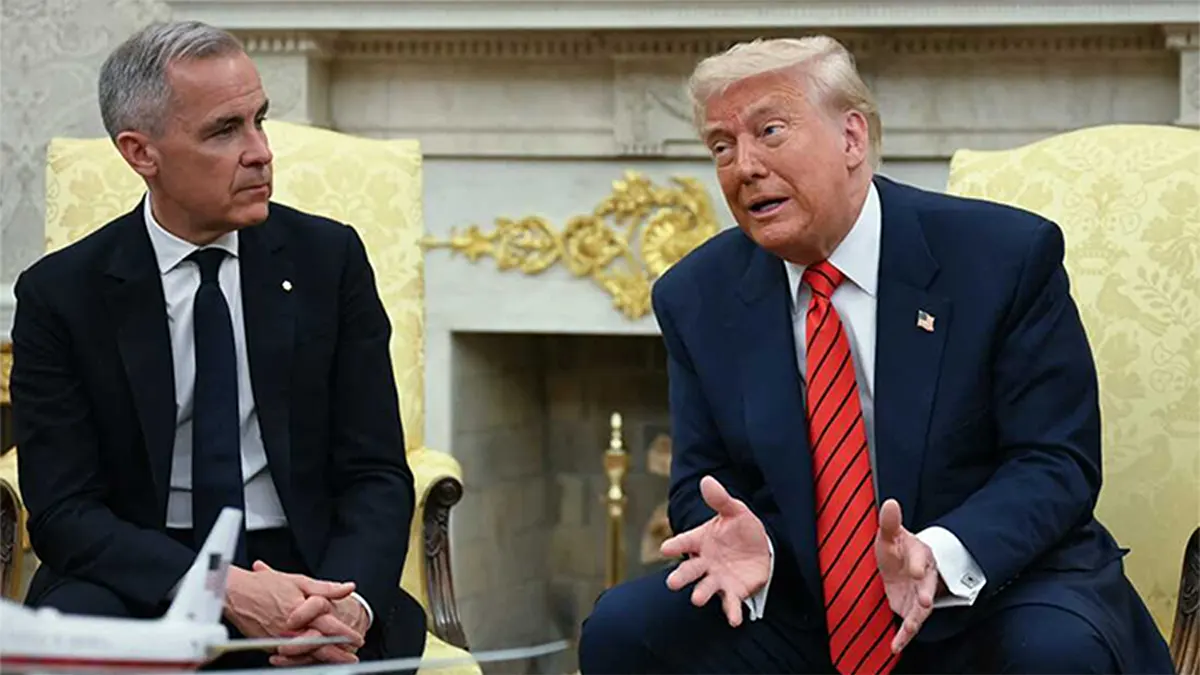
Canadian Prime Minister Mark Carney met U.S. President Donald Trump at the White House on Tuesday, October 7, 2025, for a second face-to-face meeting focused largely on the future of trade between the two countries.
The visit came as Canadian industries continued to face steep U.S. tariffs, putting pressure on businesses and workers on both sides of the border. While the meeting did not produce an immediate trade agreement, the two governments agreed to move quickly on sector-specific negotiations involving steel, aluminum and energy.
The talks were also an early test of whether Carney and Trump could find common ground before the scheduled 2026 review of the Canada-United States-Mexico Agreement (CUSMA).
Trade Disputes Put Pressure on the Relationship
Tariffs were at the center of Carney’s visit.
The Trump administration had imposed a 35% tariff on many Canadian goods not covered by CUSMA, while Canadian steel and aluminum faced a 50% U.S. tariff. Other Canadian industries, including autos and forestry, were also dealing with separate trade measures.
For Ottawa, the goal was to reduce those barriers and provide Canadian companies with more certainty.
The pressure was particularly significant for industries deeply integrated with the U.S. economy. Canadian factories often depend on cross-border supply chains, meaning tariffs can raise costs well beyond the company that actually pays the import duty.
That made tariff relief a central priority for Carney’s government.
The White House Meeting Took a More Positive Tone
Despite the difficult trade environment, Trump struck a noticeably friendlier tone during his Oval Office meeting with Carney.
Trump said the United States and Canada had “natural conflict” because companies in both countries compete for some of the same business. At the same time, he expressed optimism that the two sides could eventually resolve their differences.
Carney also emphasized the importance of the relationship between the neighboring countries.
The meeting was followed by a working lunch, with both leaders discussing trade and other international issues. The White House schedule described the visit as a working engagement rather than a formal state visit.
The warmer tone was significant because relations had deteriorated sharply during Trump’s second term, particularly after his repeated comments about Canada potentially becoming the 51st U.S. state.
Carney has consistently rejected that idea and emphasized Canada’s sovereignty.
No Immediate Tariff Deal, but Negotiations Will Continue
The most concrete result from the meeting was an agreement to keep working toward sector-specific deals.
Canadian Trade Minister Dominic LeBlanc said the two leaders directed their officials to move quickly on agreements involving steel, aluminum and energy. The discussions were described by Canadian officials as more detailed and substantive than previous encounters.
However, Canadian businesses did not receive immediate relief from the existing tariffs.
That distinction matters. The meeting produced a path toward further negotiations, but the tariffs remained in place after Carney left Washington.
Trump nevertheless suggested that Canada could be satisfied with the direction of the talks, saying he believed the two countries could reach an agreement.
CUSMA’s 2026 Review Adds Another Layer
Beyond the immediate tariff dispute, both countries have a much larger trade issue approaching.
The Canada-United States-Mexico Agreement, known as CUSMA in Canada and USMCA in the United States, is scheduled for its first joint review in 2026.
The agreement entered into force on July 1, 2020, and contains a mechanism requiring the three countries to review the pact after six years. The review could determine whether the agreement is extended or whether the countries continue into annual reviews.
That makes the 2025 negotiations especially important.
Any agreement reached on individual industries could influence the broader bargaining environment heading into the CUSMA review. For Canada, maintaining reliable access to the U.S. market remains crucial because the two economies are deeply interconnected.
Canada’s Economy Is Already Feeling the Effects
The trade dispute has moved beyond diplomatic arguments and into the Canadian economy.
A BMO analysis published on October 6 warned that different tariff scenarios could produce outcomes ranging from slower economic growth to a recession. Even a more moderate tariff environment could reduce Canada’s long-term economic growth compared with forecasts made at the beginning of 2025.
The effects are also uneven.
Steel, aluminum, automotive and forestry workers are among those exposed to the greatest risks because their industries depend heavily on the North American market.
Canadian officials have responded with measures designed to support affected businesses and workers while encouraging companies to diversify beyond the U.S. market.
But replacing Canada’s largest trading relationship would not be simple.
Washington Wants Its Own Economic Priorities Protected
For Trump, the negotiations are not simply about removing tariffs.
The administration has argued that U.S. trade policy should protect American manufacturing and encourage companies to produce more goods domestically. That creates a fundamental tension with Canada’s goal of maintaining open and predictable cross-border supply chains.
The automotive sector is a clear example.
Vehicles and their components can cross the Canada-U.S. border multiple times during production. Tariffs can therefore increase costs at several points in the manufacturing process, potentially affecting producers and consumers in both countries.
Trump acknowledged this competitive reality during his meeting with Carney, describing the disagreement as a competition between businesses in two closely connected economies.
A Second White House Meeting With High Stakes
This was Carney’s second White House meeting with Trump since becoming prime minister.
Their first meeting took place in May 2025, when the two leaders discussed trade and the future of the bilateral relationship. Since then, the tariff dispute has continued to evolve, with both governments making concessions in some areas while maintaining disagreements in others.
Carney’s challenge is to secure better access to the U.S. market without making concessions that could weaken Canada’s long-term economic position.
Trump, meanwhile, is seeking a trade relationship that he believes benefits American workers and businesses.
Those goals overlap in some areas, but not all.
The Next Test Comes in the Negotiations
The October 7 meeting did not resolve the Canada-U.S. trade dispute. Instead, it opened another round of negotiations.
Canadian and U.S. officials were expected to continue discussions on steel, aluminum and energy in the weeks ahead, while the wider CUSMA review looms over the relationship.
For Canada, the stakes extend well beyond individual tariffs. The country is trying to preserve one of the world’s most important cross-border economic relationships while reducing its vulnerability to sudden changes in U.S. trade policy.
For the United States, the negotiations offer an opportunity to reshape the terms of that relationship around Trump’s priorities.
The immediate outcome was therefore modest: no sweeping trade deal, but a commitment to keep negotiating. What comes next could determine whether the two neighbors can turn renewed talks into lasting economic certainty before the 2026 CUSMA review.