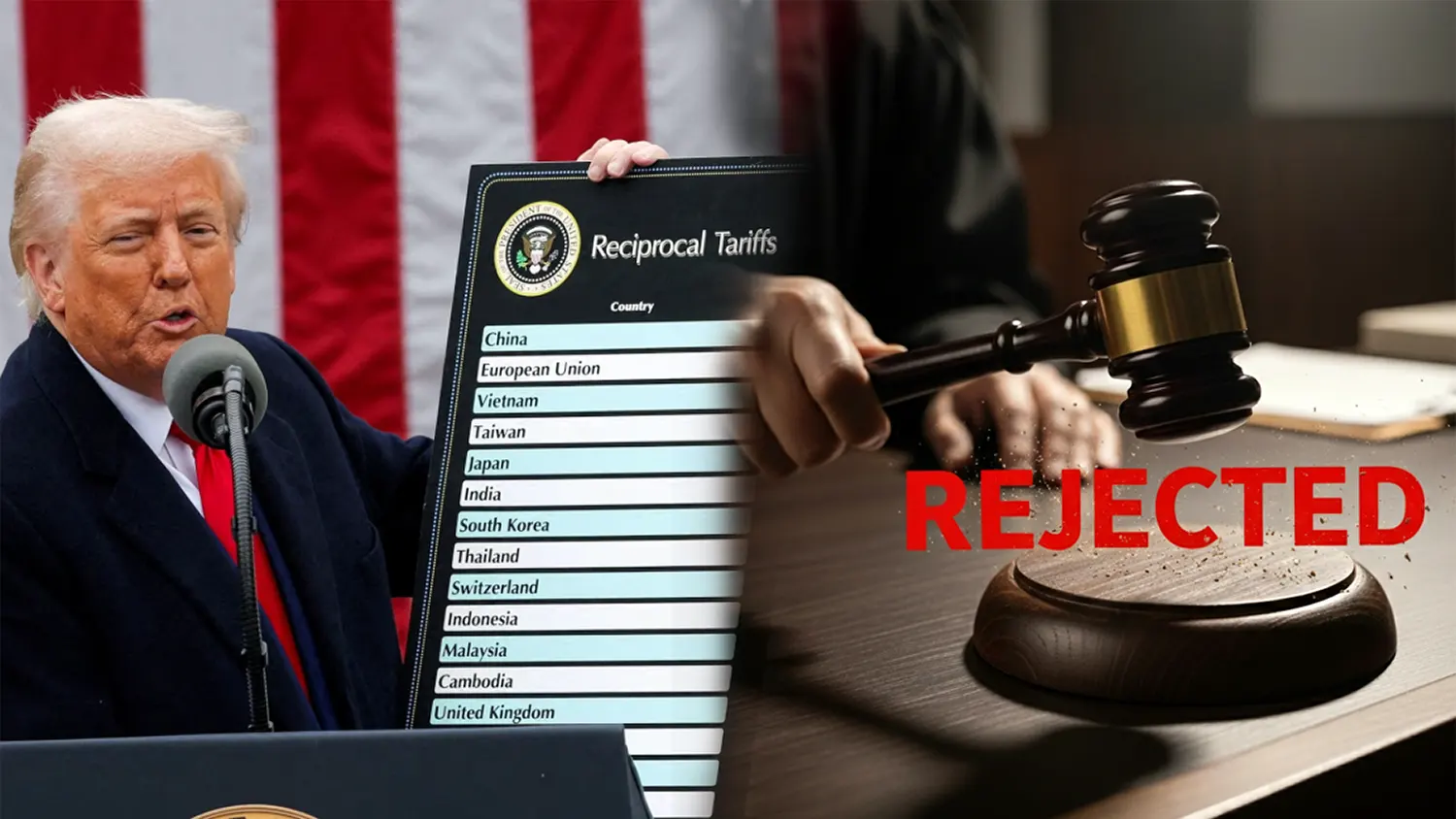
On August 29, 2025, a federal appeals court handed the Trump administration one of its sharpest legal defeats yet, ruling that the president broke the law when he used emergency powers to impose sweeping tariffs on some of America’s biggest trading partners.
The U.S. Court of Appeals for the Federal Circuit voted 7-4 that Trump had overstepped his authority under the International Emergency Economic Powers Act, known as IEEPA a law historically used for sanctions and asset freezes, not broad import taxes. The court was blunt: levying tariffs is taxing. And the power to tax belongs to Congress, not the White House.
The Tariffs in the Crosshairs
The ruling specifically voids two waves of Trump’s trade actions. First, the “reciprocal tariffs” imposed in February 2025 broad levies on imports from China, Mexico, Canada, and India, justified as a way to close trade deficits. Second, the “trafficking tariffs” of April 2025 duties targeting countries accused of failing to stop migration and drug flows into the United States.
Together, these measures represented some of the most aggressive unilateral trade actions in modern American history, imposed without a congressional vote, backed entirely by the president’s emergency powers.
The court said that was unconstitutional.
The Tariffs Aren’t Gone Yet
Despite the ruling, nothing changes at the border at least not immediately. The court issued a temporary hold until October 14, 2025, giving the Trump administration time to appeal to the Supreme Court.
That appeal is coming. Trump fired back on Truth Social, calling the court “highly partisan” and the ruling “a total disaster for the Country,” and vowing to fight it all the way to the top.
What’s notable is that the ruling doesn’t touch every tariff Trump has imposed. Duties on steel and aluminum imposed under a separate trade law and the existing China tariffs tied to intellectual property disputes remain fully intact. This case is specifically about whether emergency powers can be used as a backdoor to bypass Congress on trade taxes.
Billions in Potential Refunds and a Warning of “Financial Ruin”
Here’s where the stakes get very high, very fast. If the Supreme Court upholds this ruling, the U.S. government could be forced to refund billions of dollars in tariff revenue already collected from American importers.
The Justice Department has flagged this openly, warning that mass refunds could push the government toward what it described as “financial ruin.” That’s not hyperbole for dramatic effect the volume of tariffs collected under Trump’s trade program over the past year is enormous.
Importers who filed the original lawsuit are already preparing refund claims. Trade groups are watching closely. And businesses that absorbed higher costs on everything from electronics to car parts are hoping the Supreme Court finishes what the appeals court started.
What This Really Means for Presidential Power
Beyond the tariffs themselves, this ruling raises a much bigger question: how much economic power can a president exercise alone?
Trump’s entire second-term trade strategy was built on speed and unilateralism impose tariffs fast, without waiting for Congress, using emergency authority as the legal cover. That approach worked, politically and practically, until now.
Legal scholars say a Supreme Court ruling against Trump wouldn’t just kill these specific tariffs, it would redraw the boundaries of executive authority over trade for years, possibly decades. Future presidents would face tighter limits on how far they can go without congressional approval.
On the other side, if the Supreme Court rules in Trump’s favor, it would essentially cement the presidency’s power to reshape trade policy alone, a significant shift from how the Constitution has traditionally been interpreted.
The Political Fight That Comes With It
Predictably, the ruling broke along familiar lines. Democrats celebrated it as a defense of constitutional checks and balances. Republicans defended the president, with some warning the decision weakens America’s hand against China and other economic rivals.
The timing adds pressure. With 2026 midterm elections on the horizon, Trump has leaned hard into his tough on trade image as a political asset. A Supreme Court loss would hand his critics a significant talking point, that his most aggressive economic policies were built on a shaky legal foundation all along.
Global markets reacted cautiously but positively to the news. Stocks of major importers rose on hopes of eventual tariff relief. China, India, Canada, and Mexico are all watching the Supreme Court appeal closely, the outcome directly affects the cost of doing business with the United States.
The Clock Is Ticking
The Trump administration has until October 14 to get the Supreme Court to step in before the tariffs are automatically voided. Given the constitutional significance of the case, the Court is widely expected to take it.
Until a final ruling comes down, the tariffs stay. Businesses stay in limbo. And the fundamental question who actually controls American trade policy, the president or Congress remains unanswered.
The answer, whenever it comes, will matter long after Trump is out of the picture.