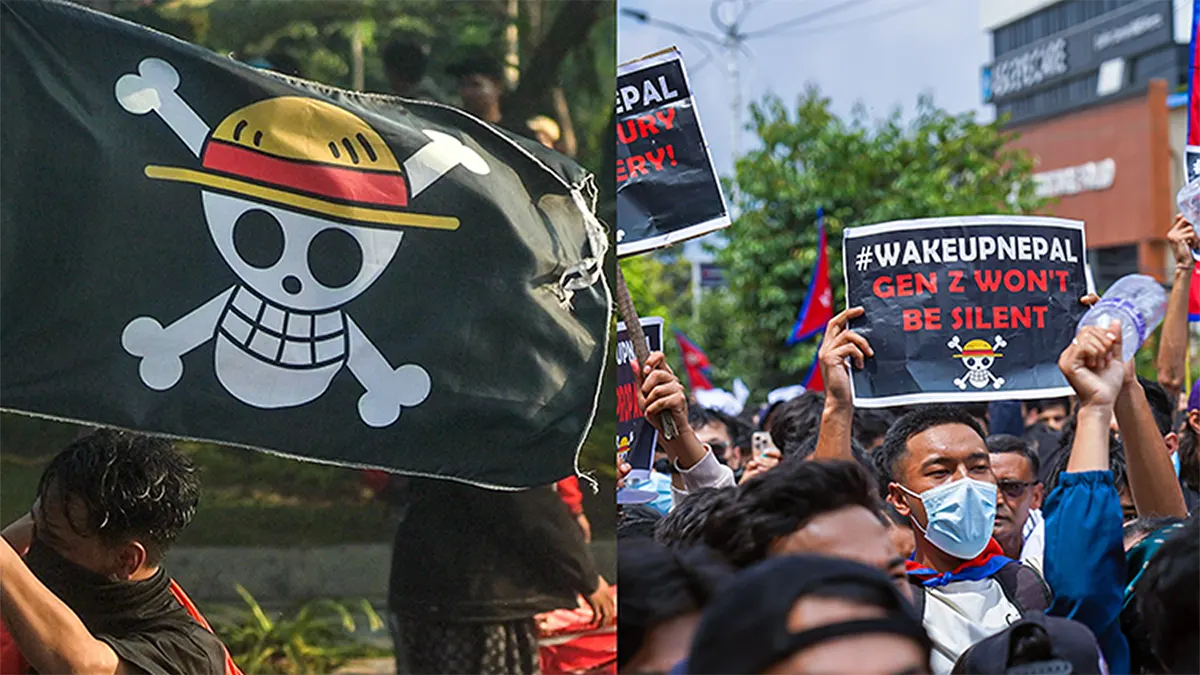
A pirate flag from a Japanese manga might seem like an unlikely symbol for political protest. Yet in 2025, the Straw Hat Pirates’ Jolly Roger from One Piece appeared at demonstrations across Asia and Europe, taking on a meaning far removed from its fictional origins.
The black flag, featuring a skull wearing the straw hat of One Piece protagonist Monkey D. Luffy, first gained widespread attention as a protest symbol in Indonesia in July 2025. It was later seen at demonstrations in Nepal, the Philippines and France.
For many young protesters, the image represents freedom, resistance and frustration with those in power. Its rapid spread also shows how pop culture can become a shared political language in the social-media era.
Why a Pirate Flag Became a Protest Symbol
In One Piece, Luffy and the Straw Hat Pirates are adventurers who repeatedly challenge powerful authorities and defend their own ideas of freedom and loyalty.
That fictional story has given the flag a natural connection to rebellion against authority. For protesters, however, the meaning is not simply about the anime.
In Indonesia, people began displaying the flag ahead of the country’s 80th Independence Day. The movement reflected dissatisfaction with government policies and broader concerns about political and economic conditions. Some officials criticized the symbol, while President Prabowo Subianto’s office said freedom of expression should be respected but warned against actions that could undermine the national flag.
The result was an unusual collision between popular culture and political expression.
Indonesia Gave the Movement Its First Major Push
The flag’s rise in Indonesia was closely connected to the period leading up to August 17, 2025, when the country celebrated 80 years of independence.
Students, artists and activists began displaying the Straw Hat flag as an alternative protest symbol. Some saw it as a way to criticize government policies without using traditional political imagery.
Artist Kemas Muhammad Firdaus, who painted a large One Piece-inspired mural in West Java, described the flag as a warning to the government to listen to its people. Demand for the flags became so strong that one garment workshop in Central Java stopped accepting new orders after being overwhelmed by requests.
The government response helped give the symbol even greater attention. Some officials described displaying it as potentially threatening national unity, while reports emerged of authorities confiscating some flags.
That controversy transformed what might otherwise have remained a fandom trend into a much more visible symbol of dissent.
The Flag Travels Beyond Indonesia
The symbol did not stay in Indonesia.
By September, the Straw Hat flag had appeared at demonstrations in Nepal, the Philippines and France, with protesters adapting it to their own political concerns.
In Manila, protesters carried the flag during the September 21 “Trillion Peso March,” a demonstration focused on alleged corruption involving flood-control projects. The same imagery had also appeared at an anti-corruption event at the University of the Philippines-Diliman.
In Nepal, the flag became associated with the country’s September youth protests, while in France demonstrators adopted the image after seeing how it had been used by young protesters in Asia.
The causes were not identical in every country. What connected them was the visual language of resistance.
Social Media Helped Turn Fandom Into Activism
The One Piece flag works particularly well in an internet-driven protest environment because millions of people already recognize it.
A traditional political symbol can require explanation. The Straw Hat flag does not. A single image can communicate ideas of rebellion, freedom and solidarity to people who know the story.
Social media then allows that image to travel almost instantly.
Photographs and videos from one demonstration can inspire protesters thousands of kilometers away. The flag becomes recognizable before a movement has established a formal organization or a single leader.
This is one reason pop culture has become increasingly useful to young activists. Memes, anime characters and other familiar images can carry political meaning without relying on long slogans or speeches.
Gen Z Is Blurring the Line Between Culture and Politics
The One Piece phenomenon also reflects a broader change in how younger generations express political ideas.
For many Gen Z activists, political participation does not necessarily begin with traditional organizations. It can begin with online communities, shared cultural references and viral images.
The Milk Tea Alliance and Thailand’s three-finger salute are earlier examples of symbols crossing national borders through digital networks. The One Piece flag follows a similar pattern, although its meaning varies according to the country and movement using it.
That flexibility is part of its strength.
A protester in Indonesia can use the flag to criticize government policies, while someone in the Philippines can use the same image in an anti-corruption demonstration. The symbol remains recognizable while its local political meaning changes.
Pop Culture Can Make Protest More Accessible
Political movements often depend on symbols that help people feel part of something larger than themselves.
The One Piece flag provides that sense of belonging through something many young people already understand. It is simultaneously a piece of fandom and a political statement.
That combination can make protest feel less formal and more accessible. Instead of presenting an elaborate political message, demonstrators can communicate an idea through an image that already carries emotional meaning.
It also creates a striking contrast. A cartoon pirate flag flying above a serious demonstration immediately attracts attention, making photographs and videos more likely to circulate online.
In that sense, the symbol is not just expressive. It is also highly effective visual communication.
The Symbol Does Not Mean the Same Thing Everywhere
Despite its growing popularity, it would be misleading to treat every person carrying the One Piece flag as part of one coordinated global movement.
The demonstrations in Indonesia, Nepal, the Philippines and France had different causes and political circumstances. The flag functions more like a shared cultural reference than a centralized political organization.
Its meaning can therefore shift from one protest to another.
For some, it represents opposition to corruption. For others, it expresses frustration with government decisions or a broader desire for political change. For fans of One Piece, it can also simply be a familiar symbol that makes them feel connected to a movement.
That ambiguity is precisely what makes the flag so adaptable.
A Fictional Flag With a Real-World Message
The rise of the One Piece flag does not mean anime has suddenly replaced traditional political movements. Instead, it shows how modern protest increasingly draws from the culture people encounter every day.
A fictional pirate crew created by manga artist Eiichiro Oda nearly three decades ago has given young protesters a recognizable way to express ideas about freedom, authority and resistance.
What happens to the symbol next remains uncertain. But its journey from manga pages to protest rallies demonstrates something important about digital-era activism: political symbols no longer have to come from politics itself.
Sometimes, they can come from the stories people grew up with and acquire an entirely new meaning when they enter the real world.