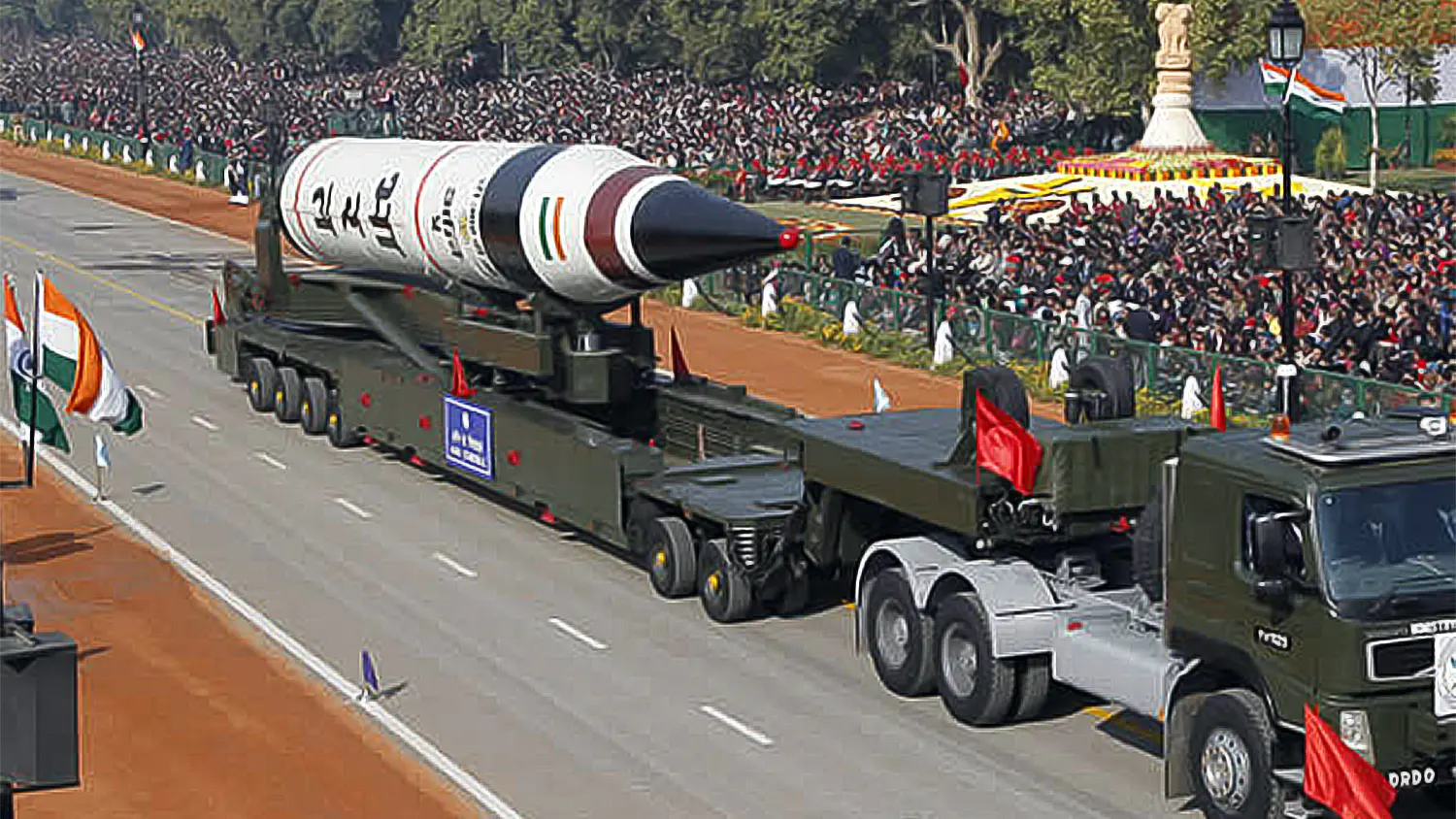
India has successfully test fired its Agni-5 ballistic missile, a powerful nuclear capable weapon capable of hitting targets more than 5,000 kilometers (3,100 miles) away. The test was conducted at the Integrated Test Range in Chandipur, Odisha, and confirmed all technical and operational systems worked as intended, according to India’s Ministry of Defence.
What Is the Agni-5?
The Agni-5 is a long range, nuclear capable missile developed by India’s Defence Research and Development Organisation (DRDO). Here are the key facts:
- Three stage, solid fueled missile — meaning it can be launched quickly without lengthy preparation
- Mobile canister launch system — it can be moved and fired from different locations, making it harder to target
- Range of 5,000+ km — enough to reach nearly all of Asia, including northern China, and parts of Europe
- Part of the broader Agni missile family, which includes versions ranging from 700 km to 3,500 km in range
In simple terms, the Agni-5 gives India the ability to strike distant targets with precision, a critical part of what defense experts call a nuclear deterrence strategy.
Why Did India Test This Missile Now?
The timing is significant. The test comes in the middle of ongoing tensions between India and China along their disputed Himalayan border.
While both countries have made some diplomatic progress including limited troop withdrawal from certain contested zones trust between the two nations remains low. Both sides have continued building roads, military bases, and infrastructure near the border.
By testing the Agni-5, India is sending a clear signal: its military capabilities are ready and operational.
The MIRV Upgrade — A Game Changer
One of the most closely watched developments in India’s missile program is the addition of MIRV technology, Multiple Independently Targetable Re entry Vehicles.
A previous Agni-5 test in March 2024 featured this new capability for the first time. What does MIRV mean in plain language? It means one missile can carry multiple nuclear warheads, each aimed at a different target.
This puts India in a rare group of countries including the US, Russia, China, UK, and France that possess this advanced capability. That said, defense analysts note that a few more years of testing will be needed before a MIRV-equipped Agni-5 becomes fully operational.
How Did Neighboring Countries React?
Pakistan, India’s other nuclear armed neighbor, has raised concerns. A Islamabad based defense think tank warned that India’s expanding missile program poses “serious risks” to regional stability in South Asia.
This reaction is expected. Any major missile advancement by India is closely watched and often matched by Pakistan, creating a constant cycle of military buildup in the region.
What India Says
The Indian government has framed the test as a routine user trial, a standard check to make sure the system is ready for use if ever needed.
Officials also reaffirmed India’s long-standing policy of “credible minimum deterrence” meaning India maintains just enough nuclear capability to deter an attack, without seeking to build an overwhelming arsenal.
The Big Picture
The successful Agni-5 test is more than a technical milestone. It reflects India’s growing ambition to be taken seriously as a major military power in Asia and beyond.
With China expanding its own military capabilities and Pakistan maintaining its nuclear arsenal, India sees a strong, modern missile program as essential to keeping the peace through strength.
As the region continues to navigate complex rivalries, tests like this one serve as a reminder that South Asia remains one of the world’s most strategically sensitive areas.