Peru is facing a deepening political crisis as thousands of demonstrators continue to fill the streets of Lima, demanding sweeping political reforms and the resignation of President Dina Boluarte.
What began as opposition to a controversial pension reform has rapidly evolved into a broader movement challenging the country’s political establishment. Protesters, labor unions, civil society organizations, and youth-led groups have joined forces, turning the demonstrations into one of the most significant expressions of public discontent in recent years.
Protesters Turn Their Attention to Peru’s Political Leadership
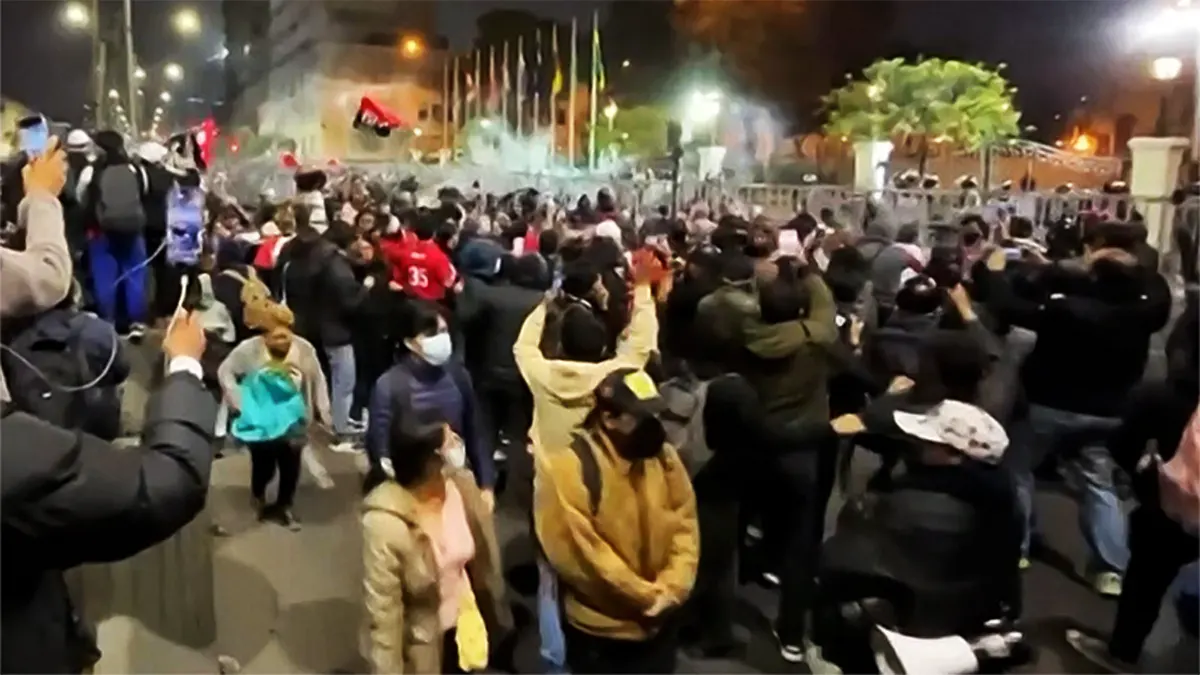
For a second consecutive weekend, large crowds gathered in the capital, marching toward key government institutions, including the National Congress and the Presidential Palace.
The demonstrations have become a focal point for frustration over long-standing concerns about governance, accountability, and corruption.
Among the protesters’ primary demands are:
- The resignation of President Dina Boluarte.
- The replacement of the current Congress.
- Justice for civilians killed during previous political unrest.
- Stronger measures to combat corruption within Peru’s political system.
Organizers say the movement is no longer centered on a single policy dispute but has grown into a broader call for political change.
Weekend Demonstrations Lead to Violent Confrontations
As crowds moved through central Lima, tensions escalated between demonstrators and security forces.
Authorities attempted to prevent protesters from reaching heavily guarded government buildings by erecting barricades around sensitive areas. In several locations, confrontations broke out as some demonstrators tried to push through police lines.
According to preliminary reports, protesters used stones, sticks, and improvised incendiary devices during clashes.
Security forces responded with tear gas and crowd-control measures, while journalists and human rights organizations raised concerns over reports that pellets or rubber projectiles were used against demonstrators.
The weekend unrest resulted in at least 30 injuries, including police officers, journalists, photographers, and protesters.
Officials also confirmed several arrests linked to allegations of rioting and attacks on law enforcement personnel.
Transportation Strike Expands the Reach of the Movement
The unrest was further amplified by a 48-hour transportation strike organized by major labor federations.
The strike significantly disrupted daily life across Lima, affecting buses, taxis, and other public transportation services. Thousands of commuters faced delays and cancellations, adding to the growing frustration surrounding the political situation.
By drawing in workers and residents directly affected by the transportation shutdown, the strike broadened participation beyond traditional protest groups and increased pressure on the government.
The combination of mass demonstrations and labor action has highlighted the widening scope of public dissatisfaction.
President Boluarte Faces Record-Low Public Support
Despite the government’s decision to partially reverse the pension reform that initially sparked the protests, public anger has shown little sign of easing.
President Dina Boluarte now faces one of the most difficult periods of her presidency, with recent opinion polls placing her approval rating at an extraordinarily low level.
Political analysts note that the administration’s handling of demonstrations has become a major source of criticism. Human rights organizations have repeatedly questioned the government’s response to protests, arguing that some security measures have been excessive and risk further inflaming tensions.
Rather than calming the situation, critics say the government’s approach has strengthened calls for broader political reforms.
Growing Pressure for Structural Change
The current wave of demonstrations reflects concerns that extend far beyond pension policy.
Many Peruvians view the protests as part of a larger struggle against political dysfunction, corruption, and declining public trust in state institutions.
The growing alliance between youth activists, labor unions, and civil society organizations has created a broad-based movement capable of sustaining pressure on the government.
As momentum builds, discussions about possible political concessions—including the prospect of early elections—have become increasingly prominent.
Uncertain Road Ahead for Peru
With demonstrations continuing, public support for the government weakening, and opposition groups remaining mobilized, Peru appears headed for a prolonged period of political uncertainty.
The key question now is whether the Boluarte administration can regain public confidence or whether mounting pressure will force significant political changes.
For now, the streets of Lima remain the center of a national debate over leadership, accountability, and the future direction of Peru’s democracy.