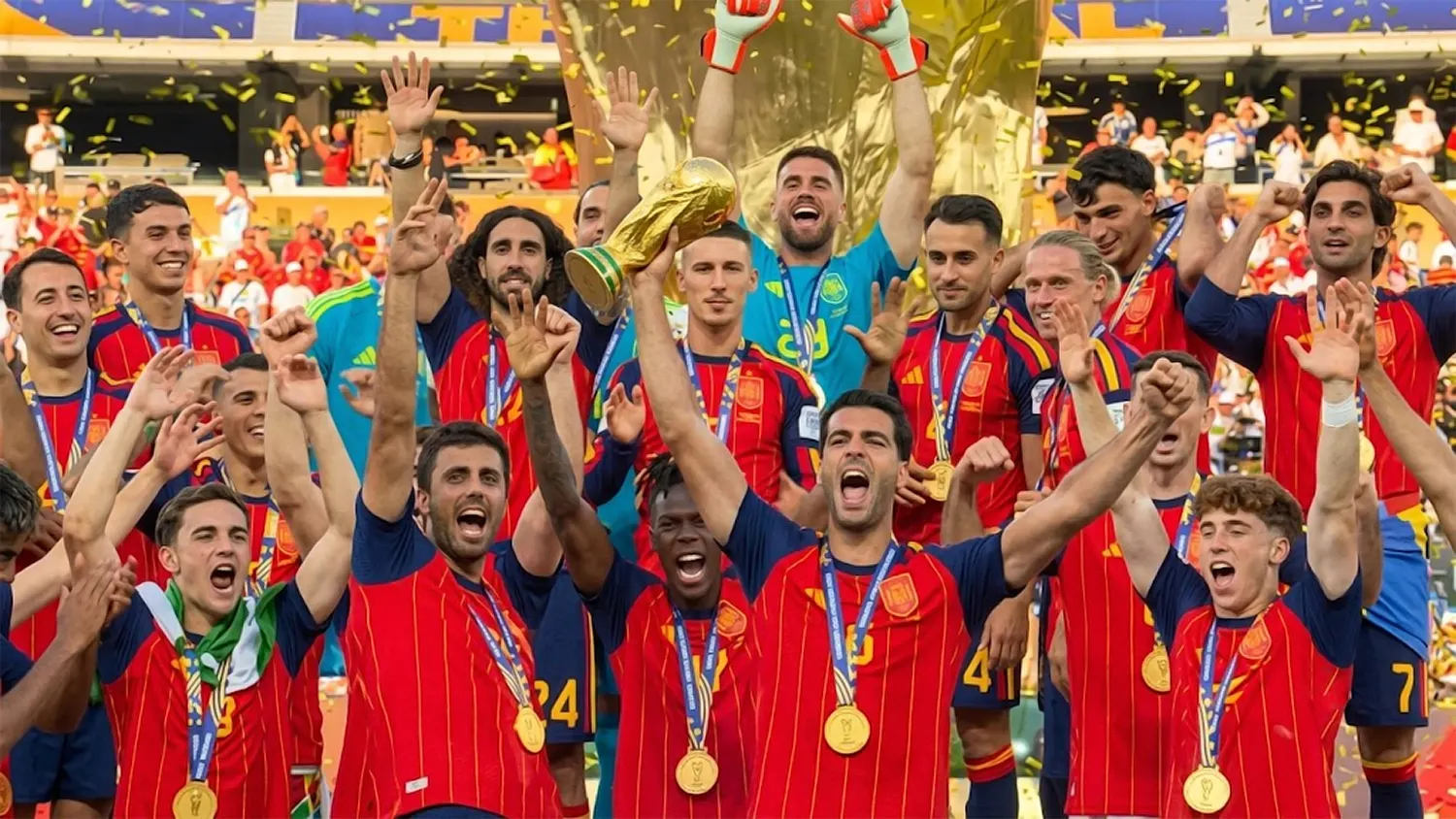
Spain are world champions once again after defeating Argentina 1-0 after extra time in the 2026 FIFA World Cup Final at MetLife Stadium in East Rutherford, New Jersey. A dramatic winner from Ferran Torres in the 106th minute sealed Spain’s second World Cup title after an intense tactical battle that saw Argentina’s defense pushed to its limits.
Despite dominating possession and creating far more chances throughout the match, Spain had to overcome an extraordinary performance from goalkeeper Emiliano “Dibu” Martínez, whose record-breaking display nearly carried Argentina to a penalty shootout.
Ferran Torres Delivers the Defining Moment
The breakthrough finally arrived early in the second half of extra time.
A move started by Lamine Yamal found Pedro Porro charging down the right flank. His cross floated toward the back post, where Nico Williams headed the ball back into the middle for Ferran Torres, who struck a first-time finish into the roof of the net.
The goal proved to be the decisive moment after more than 100 minutes of relentless Spanish pressure.
Spain Dominate From Start to Finish
While the scoreline remained close, the overall performance told a different story.
Spain controlled possession, dictated the tempo, and consistently forced Argentina deep into their own half. By the final whistle, La Roja outshot Argentina 20-3, highlighting their dominance throughout the contest.
Argentina, meanwhile, struggled to create meaningful attacking opportunities and failed to register a single shot during the first half.
Martínez Produces a World Cup Final for the Ages
If not for Emiliano Martínez, the final could have been decided long before extra time.
The Argentine goalkeeper produced 12 saves, setting a new record for the most saves in a FIFA World Cup final.
Among his biggest interventions were:
- Blocking Lamine Yamal’s early effort inside five minutes.
- Recovering brilliantly after spilling Dani Olmo’s long-range strike.
- Producing a stunning flying save to deny Yamal’s curling free kick in stoppage time of normal time.
- Making several close-range stops throughout the match to keep Argentina alive.
His heroics ensured Spain needed extra time to finally break the deadlock.
Argentina’s Defense Hit by Injuries and a Late Red Card
Argentina’s defensive plan unraveled as the match progressed.
Just before halftime, Lisandro Martínez was forced off through injury, with Nicolás Otamendi taking his place.
The problems worsened in the 70th minute when Cristian Romero also left injured, forcing another defensive reshuffle.
Then came the biggest setback.
Deep into stoppage time, midfielder Enzo Fernández received his second yellow card after a late challenge on Pau Cubarsí, leaving Argentina to play the entirety of extra time with only ten men.
VAR Denies Spain Before the Winner Arrives
Spain thought they had finally scored in the 95th minute.
Following another save by Martínez, Nico Williams tapped into an empty net before celebrations were cut short by VAR.
Officials ruled that Mikel Merino had committed a foul on Otamendi during the build-up, overturning the goal.
Spain continued attacking and eventually found the breakthrough 11 minutes later through Torres.
Argentina’s Final Push Falls Short
Even with ten players, Argentina refused to surrender.
Late in extra time, Lionel Messi delivered a dangerous corner that nearly curled directly into goal before Leandro Paredes found Giuliano Simeone inside the penalty area.
Under heavy pressure, Simeone fired over the crossbar, ending Argentina’s final opportunity to force penalties.
Moments later, the final whistle confirmed Spain as 2026 FIFA World Cup champions.
Spain Rewrite the Record Books
The victory marked another historic milestone for Spanish football.
With the triumph, Spain became the first nation ever to simultaneously hold both the men’s and women’s FIFA World Cup titles.
Their defensive record was equally remarkable, conceding just one goal across eight matches, the fewest ever by a World Cup-winning team.
Spain also extended their unbeaten run to 38 matches, setting a new record for a European men’s national team.
Rodri Named Player of the Tournament
Spain captain Rodri was awarded the Golden Ball as the best player of the 2026 FIFA World Cup after another tournament filled with commanding midfield performances.
The 30 year old orchestrated Spain’s play throughout the competition, combining exceptional passing with defensive discipline that formed the foundation of La Roja’s title-winning campaign.
A Midfield Masterclass
Rodri completed 694 passes across eight matches, breaking his own World Cup record for the most completed passes in a single tournament.
In the final against Argentina, before being substituted in the 99th minute, he produced another dominant display:
- 116 touches
- 101 completed passes from 106 attempts (95%)
- Won 8 of 10 ground duels
- Helped neutralize Lionel Messi and Argentina’s counter-attacks
His consistency proved vital as Spain conceded only one goal throughout the tournament.
Joining Football’s Elite
Rodri’s latest achievement places him among football’s most decorated players.
He became just the 11th player in history to win the FIFA World Cup, UEFA Champions League, and the Ballon d’Or.
He also completed a rare international double after being named Player of the Tournament at both UEFA Euro 2024 and the 2026 FIFA World Cup.
2026 FIFA World Cup Individual Awards
Alongside Rodri’s Golden Ball, several stars earned recognition for their performances throughout the tournament.
- Golden Ball: Rodri (Spain)
- Silver Ball: Lionel Messi (Argentina)
- Bronze Ball: Kylian Mbappé (France)
- Golden Boot: Kylian Mbappé (France) – 10 goals in eight matches
- Golden Glove: Unai Simón (Spain) – Seven clean sheets
- Best Young Player: Pau Cubarsí (Spain)
Spain’s collective brilliance ultimately proved too much for every opponent, capping one of the most dominant World Cup campaigns in tournament history.