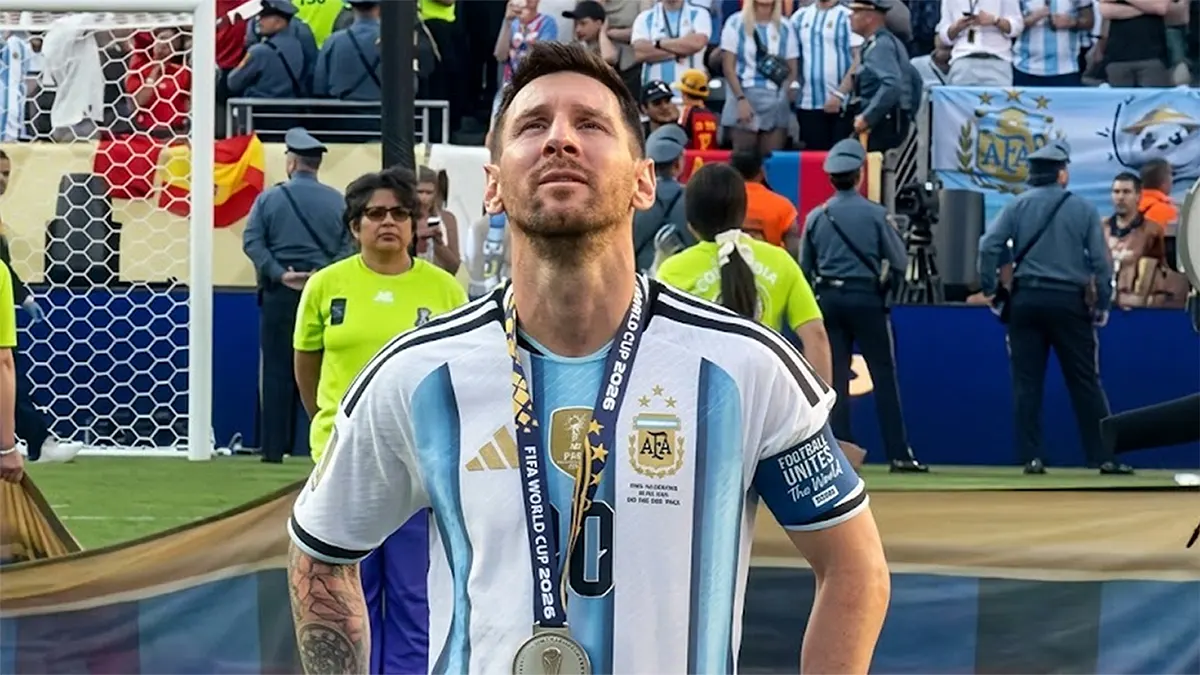
Lionel Messi has retired from international football, bringing one of the greatest chapters in Argentina’s history to an emotional close.
The 39-year-old announced his decision on August 31, 2026, confirming that he will no longer represent the Argentina national team after more than two decades in the famous blue-and-white shirt.
Messi’s farewell comes after a career that included 207 appearances, 125 goals, a World Cup title, two Copa América championships and countless individual records. It also comes after a final World Cup campaign that ended in disappointment, with Argentina losing 1–0 to Spain in extra time.
But unlike Messi’s brief retirement in 2016, this time there is little suggestion of a return.
Messi’s final Argentina chapter ended at the 2026 World Cup
Messi’s last appearance for Argentina came in the 2026 FIFA World Cup final against Spain on July 19.
Argentina ultimately lost 1–0 after Ferran Torres scored in the 106th minute, denying Messi the perfect ending to his international career. Spain controlled much of the match, while Argentina struggled to create clear opportunities in a tightly contested final.
Even so, Messi had produced an outstanding tournament.
He finished the 2026 World Cup with eight goals and four assists, contributing 12 goal involvements during Argentina’s run to the final. FIFA’s tournament statistics placed him among the competition’s leading performers.
The defeat meant Messi finished his World Cup career with a runner-up medal rather than another championship. Yet the final result did little to diminish the scale of what he had already achieved.
Across six World Cups, Messi scored 21 goals in 34 appearances, leaving the tournament as its second-highest scorer behind Kylian Mbappé.
Why Messi says the time has finally come
Messi’s decision was not made immediately after the World Cup final.
According to FIFA, he had already written his farewell letter on July 21, just two days after Argentina’s defeat to Spain. He waited several weeks before making the decision public.
In his message, Messi explained that retiring was painful but that he understood the time had come. He emphasized that he had always given everything to Argentina and wanted to leave knowing he had done all he could for the national team.
The death of his father, Jorge Messi, on August 8 added another deeply personal dimension to the decision. Messi said the loss left him questioning how much longer he would continue playing football and ultimately made him even more convinced that it was time to step aside.
That makes this retirement fundamentally different from what happened a decade earlier.
2016 was frustration. 2026 is closure.
Messi briefly retired from international football in 2016 after Argentina lost the Copa América Centenario final to Chile on penalties.
At the time, he was only 29.
Argentina had lost the 2014 World Cup final and then consecutive Copa América finals, and Messi had become the focus of intense criticism for failing to deliver a major international trophy.
He eventually changed his mind.
What followed transformed his relationship with Argentina forever.
Messi won the 2021 Copa América, Argentina’s first major senior trophy in 28 years. A year later, he helped Argentina defeat Italy in the 2022 Finalissima before producing the defining achievement of his international career: leading Argentina to the 2022 FIFA World Cup title in Qatar.
Argentina then won another Copa América in 2024.
By the time Messi reached the 2026 World Cup, the question that had followed him for much of his career, whether he could win a major trophy with Argentina, had already been answered.
There was nothing left for him to prove.
That is why his 2026 decision carries a sense of finality that his 2016 announcement never did.
From teenage prodigy to Argentina’s greatest player
Messi’s senior international career began on August 17, 2005, against Hungary in Budapest.
He was just 18 years old.
His debut lasted only a matter of seconds after he was sent off shortly after entering the match, but it marked the beginning of a 21-year journey that would eventually make him Argentina’s most capped player and leading scorer.
Before that, Messi had already represented Argentina at youth level. He played for the country’s U-20 side from 2004 and helped Argentina win the 2005 FIFA World Youth Championship.
He later added an Olympic gold medal at the 2008 Beijing Games.
The early years with the senior team, however, were far more complicated.
Messi was repeatedly compared with Diego Maradona, and his extraordinary success at club level created enormous expectations whenever he wore Argentina’s shirt. For years, international success remained just out of reach.
Then everything changed.
The trophies that completed Messi’s Argentina story
The 2021 Copa América was the breakthrough.
Argentina defeated Brazil 1–0 at the Maracanã, giving Messi his first major senior international title with his country. The trophy removed one of the biggest sources of criticism surrounding his career.
The following year brought an even greater triumph.
At the 2022 World Cup in Qatar, Messi captained Argentina to the title after a dramatic final against France. He scored seven goals during the tournament and won the Golden Ball as the World Cup’s best player.
Argentina’s victory gave Messi the trophy he had spent much of his career chasing.
Two years later, Argentina won the 2024 Copa América, adding another major international title to his collection.
By the end of his career, Messi had helped Argentina win:
- 2022 FIFA World Cup
- 2021 Copa América
- 2024 Copa América
- 2022 Finalissima
- 2008 Olympic Gold Medal
- 2005 FIFA World Youth Championship
The sequence tells the story of a career that went from repeated heartbreak to sustained international dominance.
Messi leaves Argentina with records that may stand for generations
Messi retires as Argentina’s record holder for both appearances and goals.
He finished with 207 senior caps and 125 goals, putting significant distance between himself and Argentina’s previous leading scorers.
His World Cup numbers are equally remarkable.
Messi played at six editions of the tournament, from Germany 2006 through North America 2026. His 34 World Cup appearances are a record, while his 21 goals rank second all-time. He also finished with 12 World Cup assists.
He is also the only player to win the FIFA World Cup Golden Ball twice, doing so in 2014 and 2022.
Perhaps most remarkably, Messi became the first player to score in every knockout round of a single World Cup during Argentina’s 2022 triumph.
His international numbers ultimately became a reflection of both longevity and consistency:
| Record | Messi’s total |
|---|---|
| Argentina appearances | 207 |
| Argentina goals | 125 |
| World Cup appearances | 34 |
| World Cup goals | 21 |
| World Cup assists | 12 |
| World Cup tournaments | 6 |
| World Cup titles | 1 |
| Copa América titles | 2 |
FIFA also records Messi as the leading scorer in Argentina’s World Cup qualifying history, while his overall international career established him as one of the most productive creators as well as scorers of his generation.
The perfect ending was never really necessary
There is an understandable temptation to judge Messi’s final international match by the result.
Argentina lost.
Spain lifted the World Cup.
Messi did not score in the final.
But football careers are rarely defined by their final 120 minutes.
Messi’s Argentina story had already reached its emotional climax four years earlier in Qatar. The 2022 World Cup was the moment when years of criticism, disappointment and comparisons with Maradona finally gave way to celebration.
The 2026 World Cup instead served as a farewell tour.
Even without another trophy, Messi reached the final at 39 and finished the tournament with eight goals and four assists. That performance was another reminder that his ability to influence matches survived well into the final stage of his international career.
Argentina now has to imagine football without Messi
Messi’s retirement does more than close his own international career.
It begins a new era for Argentina.
For more than 20 years, the national team was built around the presence of its No. 10. Younger players grew up watching him, then eventually became his teammates. Now they must take responsibility for a team that has spent years competing at the highest level.
Messi himself acknowledged that transition in his farewell, expressing a desire to make room for the next generation.
Argentina will therefore enter its next international cycle without the player who has defined its modern history.
There is no obvious way to replace Messi.
There can only be a new chapter.
A 21-year journey comes to an end
Messi’s international career began with an awkward red card against Hungary when he was an 18-year-old prodigy.
It ends at 39, as Argentina’s record appearance holder, record scorer, World Cup champion and one of the defining figures in football history.
Between those two moments came almost everything the sport can offer: painful defeats, criticism, missed opportunities, redemption, trophies and unforgettable performances.
His 2016 retirement was an emotional reaction to defeat.
His 2026 retirement is something else entirely.
It is closure.
Messi leaves Argentina knowing that he fulfilled the dream that once seemed impossible. He won the World Cup. He won the Copa América. He became the country’s most successful international player.
And while Argentina will eventually find its next great star, the era that belonged to Lionel Messi is now over.
For the first time since 2005, Argentina must prepare for a future without its No. 10.