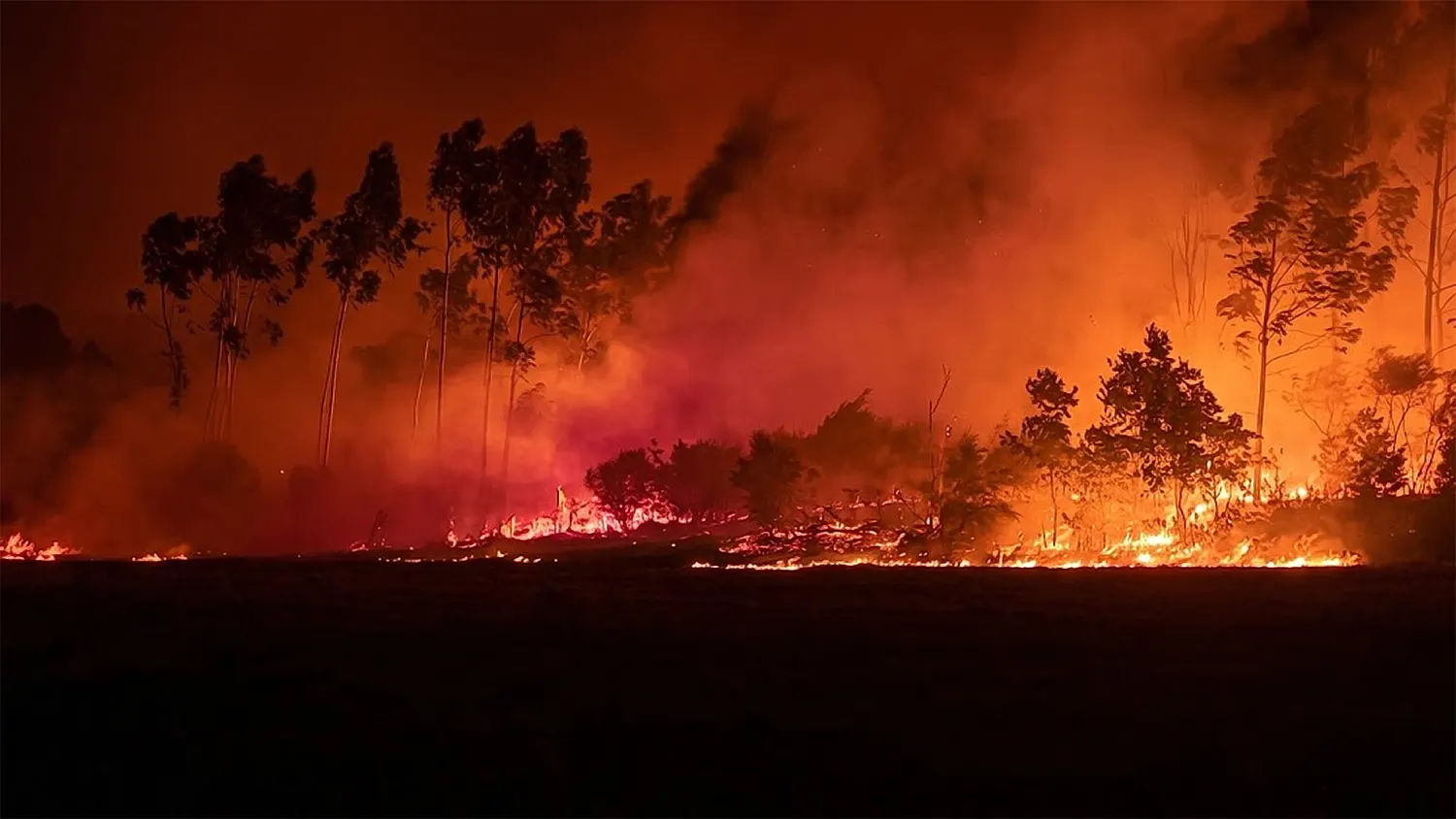
Europe is facing one of its most dangerous starts to the wildfire season in recent years, with Portugal, Spain, Greece, and parts of southern France battling major blazes fueled by an intense summer heatwave.
Authorities across Southern and Western Europe have activated emergency measures, deployed thousands of firefighters, and requested international assistance as soaring temperatures, strong winds, and prolonged drought continue to drive fires across the region.
Meteorologists warn the situation is likely to remain critical through at least mid-July, with another powerful heatwave expected to intensify conditions in several countries.
Portugal Faces Europe’s Most Severe Wildfire
Portugal remains the epicenter of the current wildfire crisis.
A massive blaze in the Vouzela area of the Viseu district has expanded rapidly, burning more than 13,000 hectares and stretching across an estimated 50-kilometer fire perimeter.
The wildfire has been fueled by temperatures reaching 44°C, strong winds, and exceptionally dry vegetation.
More than 1,200 firefighters have been deployed alongside helicopters and water-bombing aircraft. Portugal has also activated the European Civil Protection Mechanism, receiving assistance from neighboring countries, including aircraft from Italy and Spain and more than 100 Spanish ground personnel.
Fire officials say the blaze remains highly volatile and continues to spread westward and southwestward.
Greece Battles Multiple Fires Near Major Cities
Greece is simultaneously responding to several wildfires as dry conditions and gusty winds increase the risk of new outbreaks.
Near Thessaloniki, firefighters have largely contained the main fire fronts, but authorities continue urging residents to remain indoors after a recycling facility caught fire, sending thick smoke across nearby communities.
Another significant wildfire continues to burn near Mandra, west of Athens, where more than 150 firefighters, volunteers, aircraft, and helicopters are working to protect homes and surrounding forests.
Although some fire fronts have been brought under control, Greece’s emergency 112 alert system remains active, warning residents in vulnerable rural communities to prepare for possible evacuations if conditions worsen.
Spain Enters Peak Wildfire Season
Spain is also experiencing one of its busiest fire seasons, with thousands of hectares already destroyed.
In Catalonia’s Girona region, firefighters are struggling to contain a fast-moving wildfire that has burned nearly 2,200 hectares and created a perimeter stretching roughly 40 kilometers.
Authorities describe the situation as extremely challenging, with hidden hotspots and rising daytime temperatures causing repeated flare-ups despite containment efforts.
Additional fires and precautionary evacuations have also been reported in Aragón and Andalusia, where emergency crews remain on high alert.
New Blaze Erupts Along France-Spain Border
A new wildfire has also broken out in the Pyrenees-Orientales region near the France-Spain border.
The fire has already scorched approximately 1,000 hectares, while nearly 600 firefighters are battling difficult terrain that has complicated efforts to reach the flames.
Officials say the wildfire remains uncontained, with mountainous conditions slowing suppression efforts.
Why Europe’s Wildfires Are Escalating
Experts say the wildfires are being driven by an unusual combination of record-breaking heat, persistent drought, and strong winds.
The ongoing heatwave has dried forests and grasslands across much of Southern Europe, creating ideal conditions for fires to spread rapidly.
Meteorologists explain that a persistent high-pressure system, often referred to as a heat dome, has trapped hot air over the region for days, pushing temperatures above 40°C in several countries.
At the same time, low humidity and gusty winds have allowed even small fires to grow into large-scale emergencies.
Warm Nights Are Making Firefighting More Difficult
One of the biggest concerns for emergency crews is the lack of overnight cooling.
Normally, lower nighttime temperatures and rising humidity help firefighters slow advancing flames.
Instead, many parts of Portugal, Spain, and southern France are experiencing “tropical nights,” with temperatures remaining between 22°C and 25°C after sunset.
These unusually warm nights prevent vegetation from recovering moisture, allowing fires to burn almost continuously around the clock.
Thousands of Firefighters Continue Emergency Operations
Firefighters across Europe are working around the clock despite increasingly difficult conditions.
International cooperation has become essential as countries share aircraft, specialized crews, and firefighting equipment through European emergency response mechanisms.
Officials say weather conditions not firefighting resources are currently determining how quickly many fires spread.
Injuries Reported as Evacuations Prevent Greater Loss of Life
While no confirmed deaths have been directly linked to the current wildfires, authorities have reported multiple injuries.
In Portugal, at least nine people have been injured, including three firefighters with minor injuries and one civilian who suffered severe burns.
Several firefighters in Spain and France have also required treatment for smoke inhalation and heat exhaustion.
Large-scale evacuations have helped prevent higher casualty numbers.
Residents near Perpignan in southern France were awakened overnight and evacuated as flames approached residential areas, while authorities in Thessaloniki evacuated neighborhoods affected by toxic smoke from the burning recycling facility.
Heatwave Has Become the Bigger Public Health Emergency
Although the wildfires dominate headlines, experts say the extreme heatwave itself has proven even deadlier.
Across Europe, an estimated more than 5,600 excess deaths have been linked to prolonged periods of extreme heat in recent weeks.
Among the hardest-hit countries are:
- France: More than 2,025 excess deaths
- Belgium: More than 1,222
- Spain: More than 1,029
- Germany: Around 810
- Netherlands: Around 480
Older adults have accounted for the majority of heat-related fatalities, highlighting the growing public health risks associated with prolonged extreme temperatures.
More Extreme Heat Expected Through Mid-July
Weather agencies, including the World Meteorological Organization (WMO) and Copernicus, warn that relief is unlikely in the coming weeks.
Second Heat Dome Targets Iberian Peninsula
Between July 6 and July 10, another intense heat dome is expected to settle over Spain and Portugal before expanding into western and southern France.
Forecasts indicate temperatures could again reach 40°C to 43°C across inland Spain and Portugal.
Heat Expected to Shift Across Europe
By mid-July, meteorologists expect the hottest conditions to migrate eastward, increasing wildfire risks in:
- Northern Italy
- Hungary
- Romania
- Western Balkans
Many of these regions are already experiencing drought conditions, raising concerns that new wildfires could develop as temperatures climb.
Travelers Advised to Monitor Local Alerts
Authorities continue urging residents and travelers across Southern Europe to stay informed as conditions evolve rapidly.
Visitors are encouraged to monitor official emergency alerts, follow evacuation orders when issued, and remain aware that road closures, smoke conditions, and local travel disruptions can change with little warning.
Major tourist destinations including Madrid, Barcelona, Athens, and Lisbon remain open, but officials advise checking local conditions before traveling into nearby rural or forested areas.