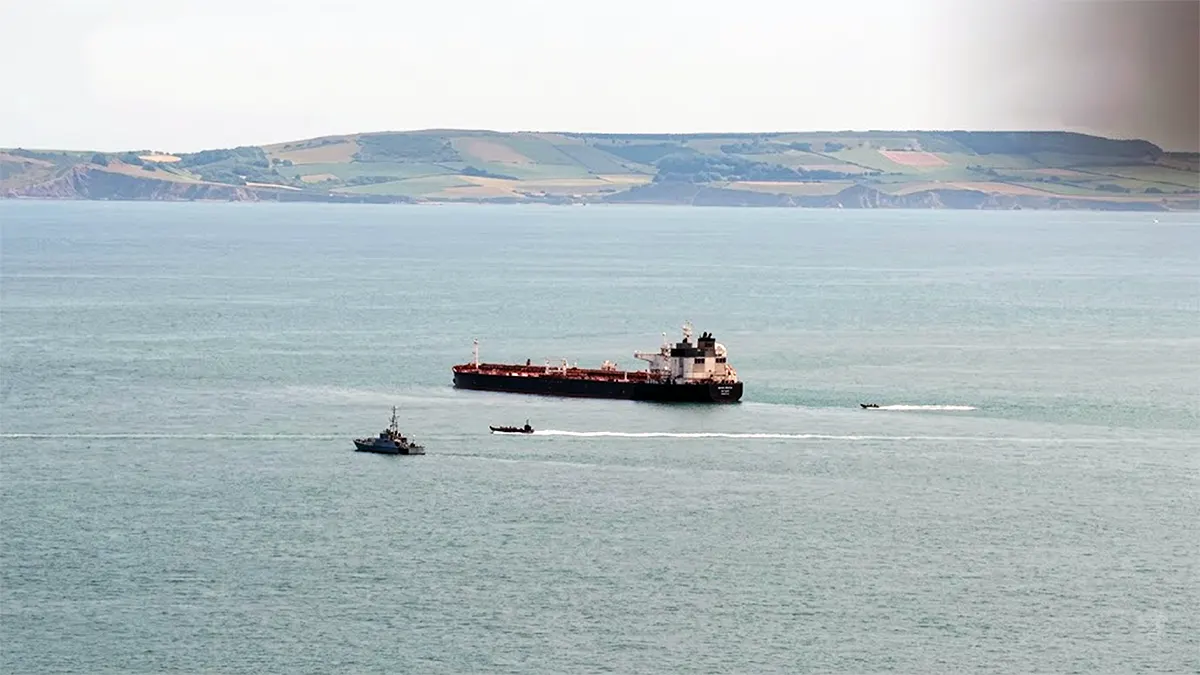
Royal Marine Commandos fast-roped onto a 700,000-barrel Russian crude carrier in the dead of night. Now Moscow is crying piracy, India is quietly panicking, and the shadow fleet is already running.
In the early hours of Sunday morning, something happened in the English Channel that has never happened before. Royal Marine Commandos from 42 Commando rappelled from helicopters onto the deck of the Smyrtos, a massive Aframax tanker loaded with roughly 700,000 barrels of Russian Urals crude oil and seized it.
The operation took six hours. It involved RAF P-8 Poseidon surveillance aircraft, Wildcat and Chinook helicopters, the Type 23 frigate HMS Sutherland, and the minehunter HMS Ledbury. By the time it was over, the Smyrtos had been escorted to anchor off the Dorset coast near Weymouth, where it now sits under watch by the UK National Crime Agency and environmental teams.
It was the first time Britain has ever led its own military operation to board and seize a vessel from Russia’s shadow fleet. And within hours, other tankers in the Channel began turning around.
The Legal Window Britain Jumped Through
The Smyrtos had left the Russian Baltic port of Ust-Luga on June 5, carrying its cargo toward Sikka, India. Under normal circumstances, international maritime law grants ships the right to “innocent passage” through territorial waters, a protection that makes boarding them extremely difficult.
But British authorities had spotted a critical opening.
In the days before the interception, the West African nation of Cameroon under intense pressure from the European Union purged its shipping registry, stripping 36 vessels of their registration. The Smyrtos was one of them. Without a valid flag, it was legally classified as a stateless vessel. And under international law, coastal states have the authority to board, inspect, and detain stateless ships when there are reasonable grounds to suspect wrongdoing.
Prime Minister Keir Starmer, who had granted the military expanded powers back in March to target sanctions-busting ships, confirmed the seizure publicly. “This successful operation delivers yet another blow to Russia,” he said, “and reminds those fuelling Putin’s war in Ukraine that we will not let them hide.”
Russia’s Response: “This Is Piracy”
Moscow wasted no time. Kremlin spokesperson Dmitry Peskov issued a furious statement calling the boarding “a blatant act of state-sponsored piracy on the high seas,” accusing Britain of masking “an illegal, aggressive economic blockade behind a thin veil of technical loopholes.”
But Russia’s pushback isn’t just rhetorical, it comes with two specific legal counter-arguments designed to complicate Britain’s position.
The first challenges the timing of the flag removal. Russian diplomats argue that stripping a ship’s registration while it is actively in transit through open waters then using that stripped status to justify a military boarding violates the spirit of maritime law, regardless of what the letter of it technically allows.
The second is more strategically calculated. The Smyrtos is technically owned by a Chinese shell company and managed by an Indian firm. Russia is attempting to frame the seizure not as a sanctions enforcement action against Moscow, but as a violation of Chinese and Indian commercial sovereignty hoping to turn a bilateral dispute with Britain into a much wider diplomatic fracture between the West and Asia.
The Russian Ministry of Foreign Affairs has warned of “severe asymmetrical consequences” if the vessel is not immediately released. Maritime intelligence agencies are already mapping out what that retaliation might look like: Russian naval vessels shadowing British commercial ships, a surge in GPS spoofing and jamming against Western merchant fleets in the Baltic and North Seas, and most significantly, a rapid migration of the remaining shadow fleet tankers away from registries susceptible to Western pressure, toward far more opaque flags like Eswatini or Comoros that would permanently close this legal loophole.
Ukraine Praised It, Now Wants Europe to Go Further.
The reaction from Kyiv was immediate and enthusiastic. President Volodymyr Zelenskyy publicly praised Britain’s “principled resolve,” tying the operation directly to the war effort. Russia funds an estimated 75% of its crude exports through a shadow network of roughly 700 tankers and choking that revenue, Zelenskyy argued, directly limits Russia’s ability to sustain its battlefield operations.
But Zelenskyy didn’t stop at praise. He called on European allies to move urgently toward legislation that would allow not just the detention of shadow fleet vessels, but the outright confiscation and sale of the oil they carry, a move that would dramatically escalate the economic pressure on Moscow and mark a significant new frontier in Western sanctions enforcement.
India Is Caught in the Middle and It Shows
Perhaps the most delicate fallout from Sunday’s operation is playing out thousands of miles away, in New Delhi and in India’s massive refining sector.
The 101,400 tonnes of Urals crude aboard the Smyrtos was legally purchased by Indian refiners and was bound for Sikka Port in Gujarat, home to Jamnagar, the world’s largest oil refining complex. The ship itself is managed by an Indian maritime firm. India didn’t sanction Russia. India didn’t violate any of its own laws. And now an entire Aframax cargo is sitting anchored off the English coast with an uncertain legal future.
India’s Ministry of External Affairs has been careful not to condemn the UK operation directly. Instead, it has emphasized, with pointed language, that “legitimate commercial contracts and global energy supply chains must not be disrupted.” New Delhi’s position has always been that its purchase of Russian crude is a matter of national energy security, not political alignment and it has consistently reminded Western partners that it never signed on to the G7 price cap on Russian oil.
Behind the scenes, however, the scramble is real. Indian legal teams are working to determine whether the 700,000 barrels can be recovered or whether they’ll be tied up in British courts for months. The MEA is quietly verifying the nationalities of the crew on board and will demand consular access if any Indian seafarers are being detained or interrogated by the NCA.
And in the private sector, the reaction has been closer to outright panic. Shipping data from Sunday morning shows that at least three other shadow fleet tankers, the Maini, the Lion I, and the Sona abruptly reversed course to avoid entering the English Channel. Other India-bound vessels have been spotted taking the significantly longer and more expensive route around the north of Scotland and west of Ireland to bypass British and French jurisdiction entirely.
India will not stop buying Russian oil. That much is clear. But this operation has made it unmistakably clear that shipping Russian oil through European waters now carries real risk and Indian buyers will pay the price in longer routes, higher freight costs, and more complex logistics for the foreseeable future.
The Bigger Picture: A Legal Blueprint for Shutting Down the Shadow Fleet
The seizure of the Smyrtos matters beyond this single ship and this single cargo. What Britain has demonstrated is that there is a legally viable, militarily executable playbook for intercepting shadow fleet tankers and that playbook hinges on the registration status of the vessel.
That’s exactly why Russia’s most likely long-term response isn’t military. It’s administrative: moving its fleet of roughly 700 tankers to flag registries so obscure and uncooperative that no amount of EU diplomatic pressure will ever get them purged again.
The race, in other words, isn’t just on the water. It’s in shipping registries and legal frameworks and back-channel diplomatic pressure campaigns and Sunday’s operation just made everyone involved move a lot faster.