China just hosted the leaders of its two biggest geopolitical rivals within the same week and it came out winning on both ends.
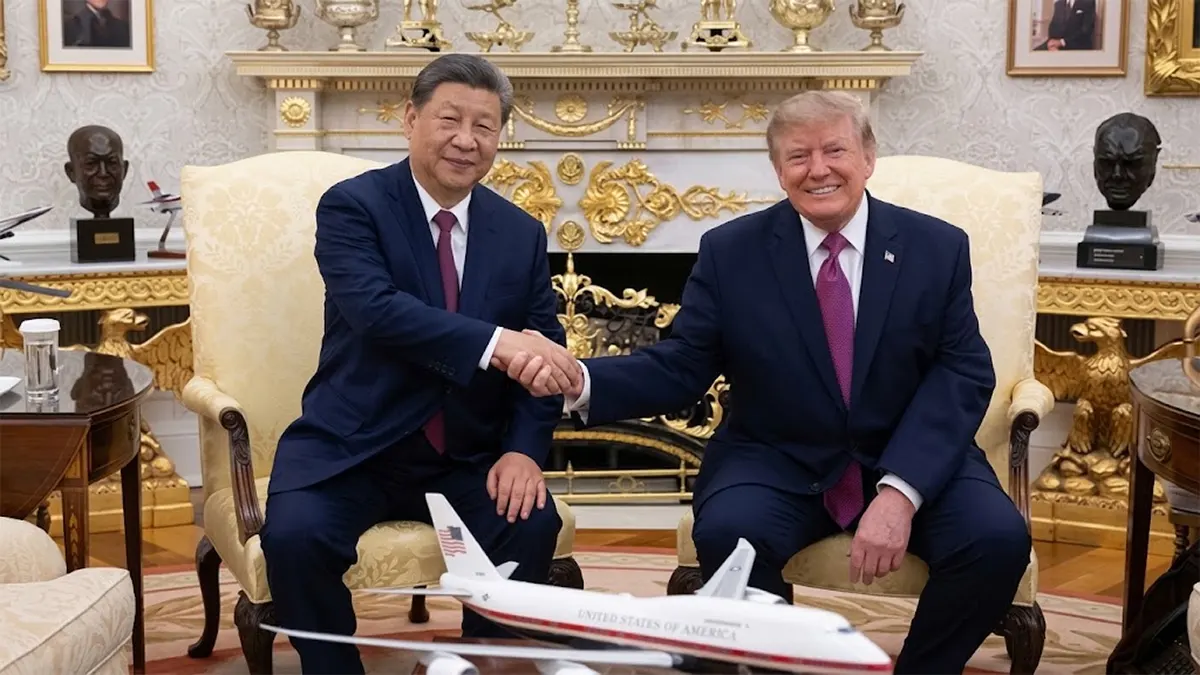
In a span of four days, Xi Jinping welcomed U.S. President Donald Trump for a high stakes summit on May 14–15, and then rolled out the red carpet again for Russian President Vladimir Putin on May 19–20. Hosting the leaders of the world’s two most heavily armed nuclear powers back to back isn’t just a scheduling flex, it’s a deliberate signal to the rest of the world: Beijing is now the undisputed center of global diplomacy.
Trump Came First, Then Putin Walked in Four Days Later
The sequencing was no accident. Trump’s visit ended in a trade stalemate, with talks dominated by the ongoing U.S.-Iran war and its disruption of global shipping lanes. Then, barely four days later, Putin landed in Beijing on the evening of May 19 for a two day state visit officially timed to mark the 25th anniversary of the China-Russia Treaty of Good Neighbourliness and Friendly Cooperation.
But the anniversary framing is largely ceremonial. The real substance of Putin’s visit centers on economic survival and strategic alignment in a world increasingly shaped by Western sanctions and a destabilized Middle East energy market.
By laying out the red carpet for both men in the same week, Xi Jinping sent a clear message to Washington: China cannot be easily isolated. And to Moscow, the message was equally pointed: you need us more than we need you.
What Putin Actually Came to Beijing to Resolve
The core of the Putin-Xi agenda wasn’t symbolic, it was transactional, and it broke down into four concrete priorities.
The Power of Siberia 2 pipeline sat at the top of the list. This long-delayed, 1,600-mile natural gas pipeline would run through Mongolia into China, giving Russia an overland alternative to its lost European export markets. With the U.S.-Iran war severely disrupting shipping lanes through the Strait of Hormuz, China is now highly motivated to lock in a sanctions-proof, overland energy source. Russia is pushing hard to finalize pricing contracts. China is in no rush and that delay itself is leverage.
De-dollarization and trade insulation came next. Putin highlighted that bilateral trade between the two countries has now reached unprecedented volumes, conducted almost entirely in Russian rubles and Chinese yuan deliberately bypassing the U.S. dollar and the Western banking system it underpins. Formalizing this financial architecture deeper into their economic framework was a key deliverable of the visit.
Dual-use technology and military cooperation, while never stated explicitly in public, formed a critical subtext. Russia’s growing dependence on Chinese supply chains particularly for electronic components, drone parts, and industrial inputs was on the table in discussions with Xi and Premier Li Qiang. China officially maintains neutrality on Ukraine, but the supply chain realities tell a more complicated story.
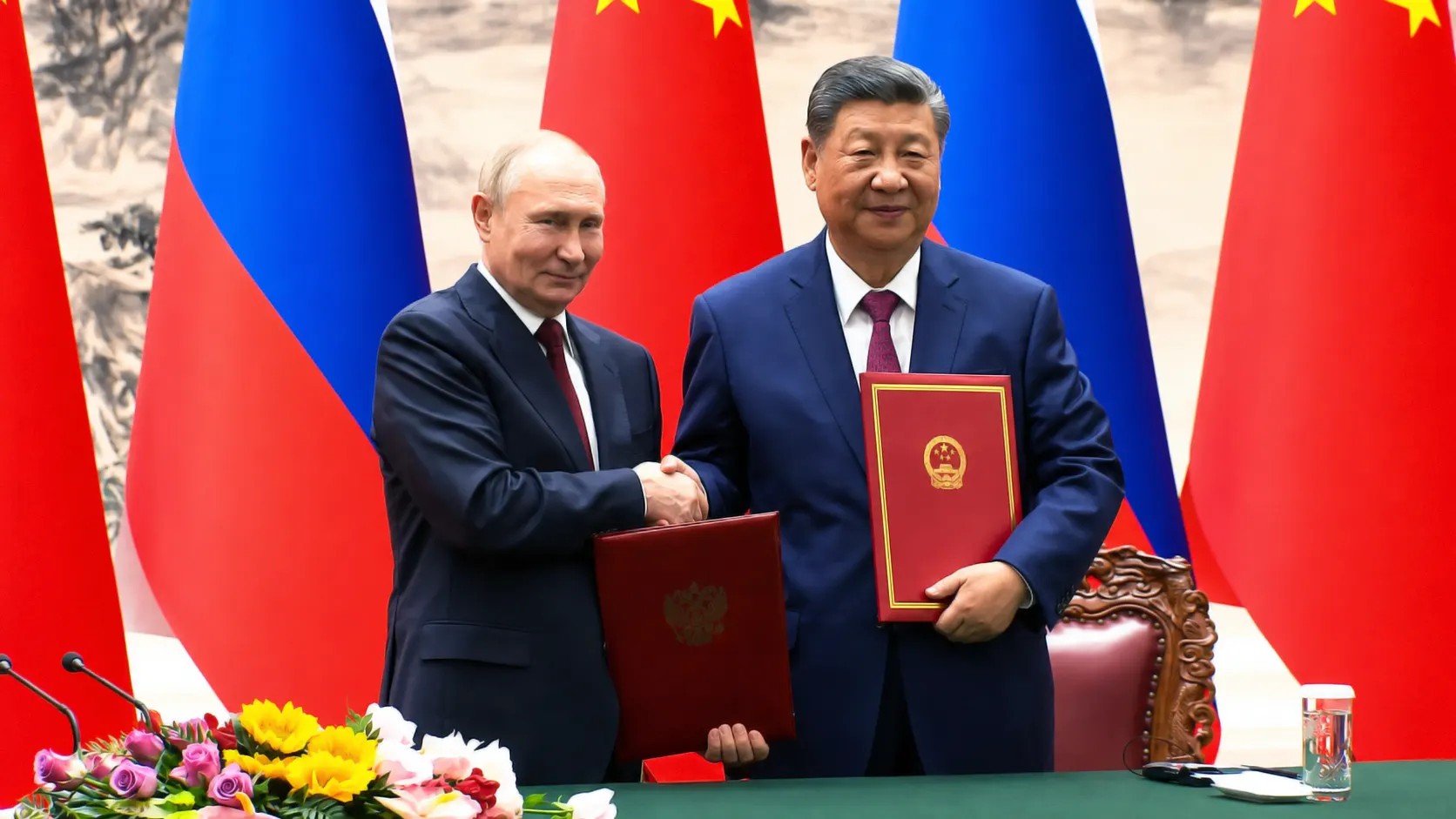
A joint declaration on global order rounded out the agenda. The two leaders signed a landmark 47-page joint statement laying out a shared vision for a “multipolar world order” a direct ideological challenge to Western-dominated international institutions. Xi also used the meeting to quietly advise Putin that further military escalation in the Middle East would be “inadvisable,” reflecting Beijing’s careful effort to balance its partnership with Moscow against the global economic stability it depends on.
The Signing Ceremony That Took Four Ministers at Once
Following bilateral talks at the Great Hall of the People, the volume of agreements signed was significant enough that officials had four ministers signing different documents simultaneously just to get through the paperwork efficiently.
The agreements covered a deliberately wide range of areas institutional, economic, cultural designed to show that the Russia-China relationship is deepening at the structural level, not just the rhetorical one.
The 47-page joint declaration served as the headline document, formally framing the Russia-China partnership as a stabilizing “balancing force” against Western dominance. Alongside it, the leaders extended the 2001 Treaty of Good-Neighbourliness, the legal and political bedrock of their current diplomatic alignment for another term.
On the economic side, a set of de-dollarization agreements further entrenched bilateral trade in local currencies, while energy cooperation pacts reinforced Russia’s role as a long-term “reliable energy supplier” to China even as the final pricing details on Power of Siberia 2 remained unresolved. A cultural initiative, the Russia-China Years of Education (2026–2027), was also formally launched, covering student exchanges and joint university research, a soft power move designed to deepen ties well beyond energy and defense.
The sheer breadth of the signing ceremony was itself the message: this relationship is now too institutionally embedded to be easily reversed by political winds.
Why China Is Playing Both Sides and Winning
Here’s the part that doesn’t get enough attention: China isn’t actually allied with Russia. China is allied with its own economic rise and right now, both the U.S. and Russia are useful tools for that goal.
The numbers make this clear. The U.S. and Europe are China’s largest export markets. A serious rupture with the West triggered by, say, openly supplying Russia with weapons would expose China to secondary sanctions severe enough to stall its domestic economy. Russia, by contrast, offers something different: cheap, overland raw materials. Oil, gas, timber, all bought at steep “friendship rate” discounts because Moscow has nowhere else to sell.
China’s ideal scenario is a world where the U.S. stays stable enough to keep buying Chinese goods, and Russia stays dependent enough to keep selling discounted energy. That’s not an alliance, it’s a brilliant double extraction.
The diplomatic mechanics of this balance depend on one key tool: “neutrality” as a shield. By officially claiming non-involvement in the Ukraine war, Beijing maintains access to both rooms. It can host Trump to negotiate trade, and then host Putin four days later to talk about a multipolar world order and frame itself to the global audience as the only indispensable mediator on earth.
The power dynamic underneath all of this has also fundamentally shifted since 2022. Russia now relies on China for over 90% of its sanctioned technology imports and depends on Beijing as its primary energy buyer. Putin walked into these talks needing concrete breakthroughs. Xi did not. That asymmetry shapes every negotiation including why Power of Siberia 2 pricing still hasn’t been finalized, years after talks began.
What China Is Actually Walking Away With
Strip away the diplomatic language, and the back to back summits delivered China two distinct categories of gain.
On the economic side, Beijing secured discounted Russian energy bought in Chinese yuan simultaneously locking in cheap inputs and expanding the global footprint of its own currency. At the same time, by keeping dialogue open with Trump, China protected its export economy from a catastrophic breakdown with its largest consumer market.
On the diplomatic side, the optics alone were a victory. Hosting both Trump and Putin in the same week positions Beijing as the world’s irreplaceable crossroads, the one capital that neither Washington nor Moscow can afford to alienate. Rolling out the red carpet for Trump reminded Putin that Russia is not China’s only option, giving Xi maximum leverage on pipeline pricing terms. And hosting Putin immediately after sent Washington a quiet but unmistakable warning: push Beijing too hard on trade or Taiwan, and we have a heavily armed alternative.
It is a high-wire act, not a flawless strategy. If China crosses the line from dual-use components into direct weapons transfers, the U.S. and Europe have the tools to trigger secondary sanctions that would hit China’s economy hard. Beijing knows exactly where that line is and so far, it is walking it with precision.
Washington Isn’t Watching Passively
The U.S. is not sitting still. Rather than issuing sweeping blanket sanctions on China which would detonate global markets, Washington is surgically targeting the specific pipelines of money and materials keeping Russia’s economy afloat.
The most powerful tool is secondary banking sanctions, first authorized in late 2023. Any foreign bank including major Chinese state banks can be cut off from the U.S. dollar system if found facilitating transactions for Russia’s military-industrial complex. The result: Chinese banks dramatically tightened compliance throughout 2025 and into 2026, creating massive payment bottlenecks that have slowed overall China-Russia trade volumes.
The U.S. Department of Commerce is simultaneously blacklisting Chinese tech firms supplying dual-use goods microchips, drone parts, advanced optics to the Russian military. Companies like Xiamen Limbach and Redlepus Vector Industry have already been added to the Entity List, cutting them off from American software and semiconductor equipment.
Washington is also playing a cleverer game with Russian crude oil markets. This week, the U.S. Treasury extended a 30-day sanctions waiver allowing energy-vulnerable countries to temporarily access Russian seaborne oil stranded at sea with Treasury Secretary Scott Bessent explicitly stating the goal is to prevent China from monopolizing cheap Russian crude, forcing Moscow to diversify its buyers and weakening its exclusive bond with Beijing.
And as Chinese suppliers began routing tech components through third countries like Turkey, Kazakhstan, and the UAE to dodge direct sanctions, the U.S. shifted focus to these proxy networks sanctioning dozens of shell companies in Central Asia and the Middle East in early 2026 alone.
The American strategy isn’t to stop all trade between China and Russia. It’s to force Chinese banks and tech firms to choose: the Russian market, or continued access to the Western financial system. So far, that pressure is making China’s support for Moscow cautious, limited and never quite enough to tip the balance.
The week of May 14–20, 2026 may be remembered as the moment Beijing stopped being a player in the global order and became its organizing principle, at least for now.