The explosion in Liuyang has quickly become one of the deadliest industrial accidents in recent years and a stark reminder of the risks embedded in a global supply chain few consumers ever see. The blast, which struck on May 4, 2026, is now under national scrutiny, with investigators racing to determine how a routine workday turned into a catastrophe. At least 26 people were killed and 61 injured, according to local authorities, placing the incident among the most severe in the region’s recent history.
But the scale of the disaster becomes clearer when placed in context. Liuyang is widely known as the world’s “fireworks capital,” producing roughly 70% of global supply. That raises a deeper question: how did an industry so central to global celebrations become the site of such devastation?
A routine afternoon shattered by a chain reaction
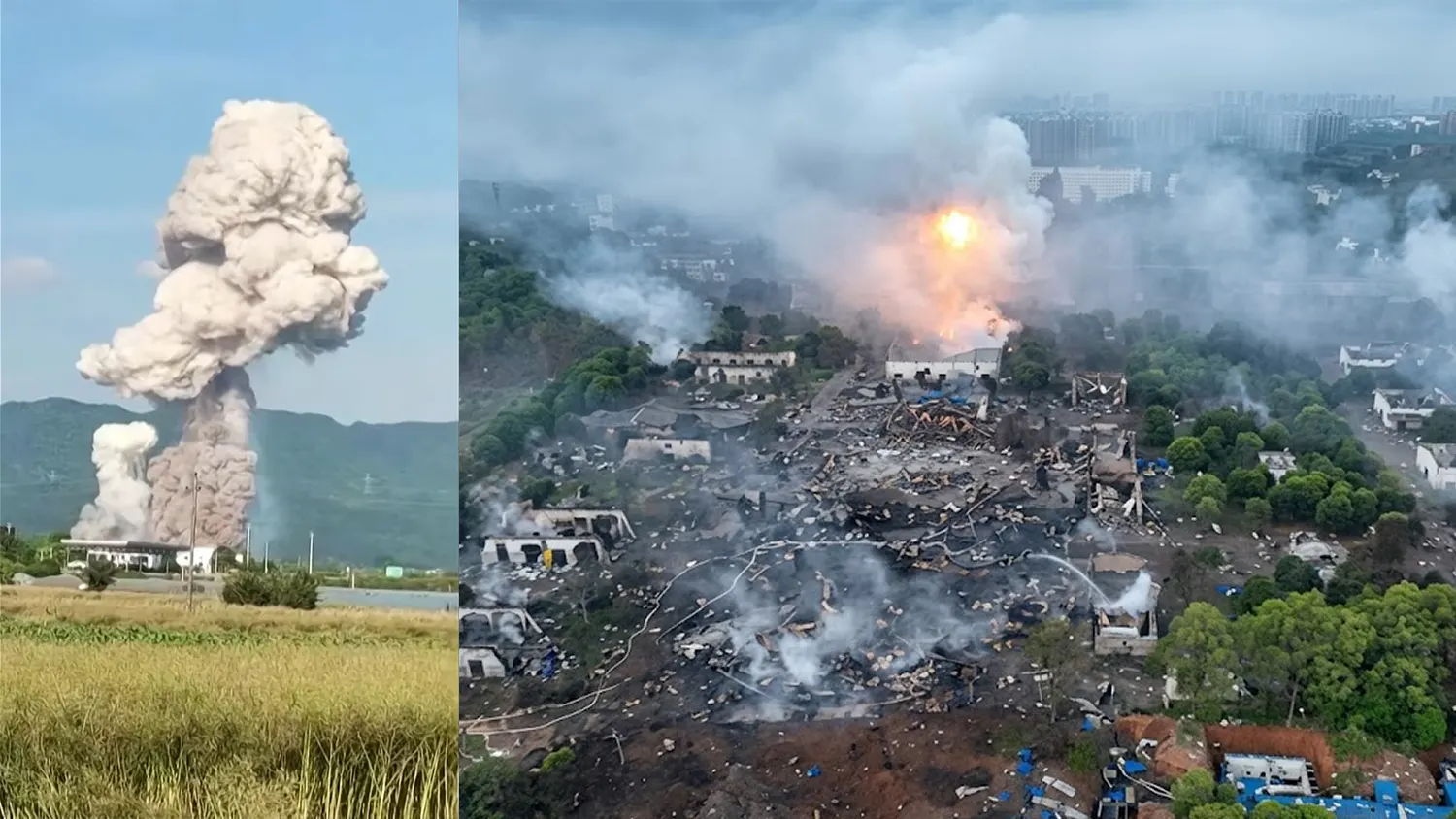
The blast occurred at approximately 4:43 PM at the Huasheng Fireworks Manufacturing and Display Co. facility in Guandu Town. Eyewitnesses described “continuous thunderous bangs” that echoed for kilometers, shattering windows and warping metal doors in nearby homes. Aerial footage later revealed a massive crater and flattened workshop buildings, indicating the sheer force of the explosion.
Initial findings suggest the fire began in a workshop containing semi-finished products. What followed was a rapid chain reaction of explosions, fueled by large volumes of combustible materials stored on-site. Workers had little chance to contain the blaze as successive blasts intensified the destruction.
That sequence of events points to a second, more troubling factor: the way hazardous materials were stored and managed within the facility.
When storage risks turn a fire into a catastrophe
Investigators now believe high-risk storage conditions amplified the disaster’s scale. The factory sat dangerously close to two black powder warehouses. Although they did not detonate, the heat and instability forced authorities to establish a 3-kilometer exclusion zone, severely limiting rescue efforts.
Emergency teams deployed drones and robotic units to cool the warehouses using water mist and foam. This intervention likely prevented a secondary explosion that could have caused even greater loss of life. Still, the initial blast triggered structural collapse, trapping workers and blocking escape routes in seconds.
These findings have shifted attention toward regulatory compliance. Authorities are examining whether the plant exceeded storage limits or failed to maintain required cooling systems, both critical safeguards in fireworks manufacturing.
A medical system pushed to its limits
As the investigation unfolds, the human toll remains front and center. At Liuyang People’s Hospital, doctors are treating the majority of the injured under “Level 1 Emergency” conditions, the highest alert status. At least 15 survivors are in critical condition, suffering from blast lung injuries and severe chemical burns.
Specialists from across Hunan province have been mobilized to assist. Burn units are operating at full capacity as medical teams confront injuries caused by high-temperature combustion of magnesium and sulfur, compounds commonly used in fireworks.
Search and rescue operations have now largely concluded. In an emotional briefing, Changsha Mayor Chen Bozhang confirmed the final death toll and acknowledged the scale of the tragedy. “We are deeply grieved and filled with remorse,” he said, before a moment of silence for the victims.
Yet even as rescue efforts wind down, another concern has taken center stage: environmental safety.
Clean air readings offer rare relief after toxic fears
In the aftermath of such explosions, toxic fallout is often a major concern. Fireworks smoke can carry heavy metals like barium and strontium, posing risks to both air and water quality. However, early monitoring results have delivered an unexpected but significant reassurance: air and water quality have returned to normal levels.
Environmental teams deployed mobile monitoring stations to track particulate matter, sulfur dioxide, and chemical runoff. They also tested nearby water sources for nitrates and perchlorates common oxidizers in fireworks. Favorable weather conditions helped disperse the smoke plume quickly, reducing long-term exposure risks.
Even so, the site itself remains hazardous. Cooling operations around the black powder warehouses continue, and the exclusion zone remains in place as investigators begin detailed forensic work.
This relative environmental stability shifts the focus toward a broader impact that may prove harder to contain: economic disruption.
A shutdown that could ripple across global celebrations
In response to the disaster, authorities have ordered a complete halt to fireworks production across Hunan province. What began as a local suspension in Liuyang has expanded into a province-wide shutdown for safety inspections.
Given Liuyang’s dominance in global supply, the implications are immediate. Potential shortages and price increases are already being discussed within the international fireworks market. If the shutdown persists, major events worldwide could face supply constraints later this year.
At the same time, police have detained company management as part of a criminal investigation, reflecting China’s policy of “strict accountability” in industrial accidents. President Xi Jinping has called for an “all-out effort” to determine responsibility and prevent similar incidents.
For now, the community in Liuyang is moving from emergency response to mourning. Families are identifying victims, while investigators continue to piece together what went wrong. The outcome may not only reshape local safety practices but also redefine the future of an industry that lights up skies around the world.