Israeli strikes across southern Lebanon on April 27 killed at least 14 people, expanded into the Bekaa Valley, and intensified demolition operations underscoring how a U.S.-extended ceasefire is rapidly unraveling despite ongoing diplomacy.
That breakdown matters beyond the battlefield. A truce that collapses in practice risks triggering wider regional escalation tied to Iran negotiations and global stability, making the next phase of this conflict unusually consequential.
But the real shift becomes clear in the pace and scale of violence over the past 24 hours.
When the ceasefire becomes the trigger for escalation, not restraint
Monday’s strikes marked the deadliest single day breach since the truce began on April 16, with attacks reported across Bint Jbeil, Nabatieh, and Marjayoun. What began as localized strikes quickly expanded in both intensity and geography.
The escalation followed a familiar pattern. Israel described the attacks as “preemptive” operations against Hezbollah infrastructure, while Hezbollah framed its own actions as defensive responses to ongoing incursions.
The result is not just a violation of the ceasefire, but a reversal of its purpose. Instead of containing violence, the agreement now appears to coexist with and even justify continued military action.
That contradiction becomes more stark when measured in casualties.
Initial reports cited four deaths. Within hours, updated figures confirmed at least 14 fatalities and dozens injured in a single day, reflecting how quickly conditions on the ground are deteriorating.
And beyond the numbers, the geography of the conflict is beginning to shift.
A battlefield no longer confined to the south
For the first time since the truce began, Israeli forces struck the Bekaa Valley, a move widely seen as a major strategic expansion beyond the southern front.
This is not a routine escalation. The Bekaa Valley serves as a critical logistical and weapons corridor for Hezbollah, meaning strikes there signal a willingness to target deeper infrastructure rather than frontline positions alone.
At the same time, Hezbollah has demonstrated evolving capabilities. The group has deployed fiber-optic-guided drones resistant to electronic jamming, underscoring a growing technological dimension to the conflict.
Together, these developments suggest a shift from contained border conflict to multi zone engagement with higher strategic stakes.
And that widening battlefield is mirrored by a transformation on the ground in southern Lebanon itself.
The “buffer zone” strategy is redrawing the map in real time
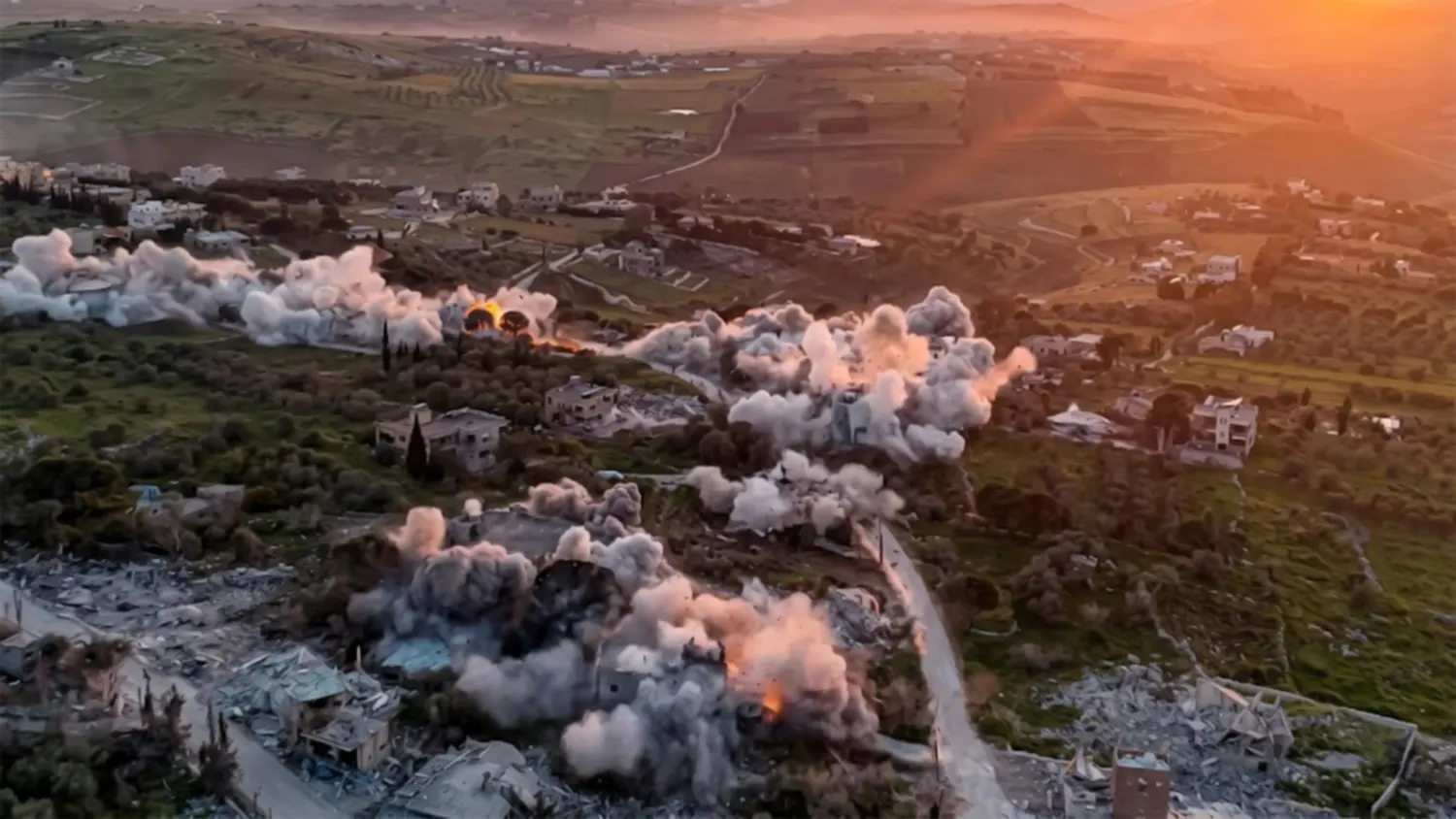
In the Tyre district, military operations have moved beyond airstrikes into systematic demolition of entire residential areas.
Villages such as Chihine and Hanin have seen large scale blasts and bulldozer activity, part of what Israeli officials describe as efforts to establish a 10 kilometer deep “buffer zone,” often called the “Yellow Line.”
Residents and local observers report that entire sections of towns like Beit Lif and Yater have been leveled, while UN peacekeepers have confirmed large explosions without being able to fully assess the damage.
This is not just tactical clearing. It represents a long term territorial reshaping, one that effectively prevents civilians from returning even if hostilities pause.
Which leads directly to a deeper fracture: the gap between military objectives and diplomatic messaging.
Diplomacy continues, but on terms that no longer align
In Washington, the ceasefire extension is still framed as progress. But on the ground, actions by both sides reflect fundamentally incompatible definitions of what the truce allows.
Israel maintains the right to continued operations against Hezbollah infrastructure, even during negotiations. Hezbollah rejects that premise outright, calling ongoing attacks proof that diplomacy is “ineffective” and one sided.
At the same time, international mediation is increasingly fragmented. Pakistan has suggested Lebanon is part of a broader U.S.–Iran ceasefire framework, while the U.S. and Israel treat it as a separate and unresolved theater.
These are not minor differences. They are structural contradictions that make a stable ceasefire difficult to sustain.
And as those contradictions deepen, the humanitarian consequences are becoming more severe.
Displacement is shifting from temporary crisis to permanent reality
The scale of displacement has now reached over 1.6 million people, with many unable to return not because of active fighting alone, but because their homes no longer exist.
The demolition strategy has created what officials describe as a “no return zone”, where civilians attempting to go back have faced warning fire or renewed strikes.
Since the escalation began in early March, the toll has surpassed 2,520 deaths and nearly 8,000 injuries, figures that continue to rise as operations intensify.
Even basic infrastructure is under strain. Repeated strikes and access disruptions have made aid delivery increasingly difficult, compounding the long-term impact on civilian populations.
This is no longer just a humanitarian emergency tied to active conflict. It is evolving into a structural displacement crisis with lasting consequences.
And beyond Lebanon, the implications are spreading outward once again.
A localized conflict now testing global fault lines
What happens in southern Lebanon is increasingly tied to broader geopolitical dynamics. The conflict is now intersecting with U.S.–Iran negotiations, European policy debates, and global energy concerns.
Recent discussions within the European Union about suspending trade concessions with Israel reflect growing international friction tied directly to the humanitarian situation.
At the same time, instability in the region continues to raise concerns about potential disruptions to global energy markets, particularly if the conflict expands further.
This positions Lebanon not just as a flashpoint, but as a pressure point in a wider geopolitical system, where local actions can trigger international consequences.
Which brings the focus back to the immediate trajectory of the conflict.
A ceasefire in name only, as escalation becomes the new baseline
The past 24 hours have clarified what was previously ambiguous. The ceasefire has not collapsed formally, but it has lost its practical function as a restraint on violence.
Instead, both sides are operating within a framework where negotiations continue in parallel with sustained military activity, a dynamic some observers describe as “continuous war under diplomatic cover.”
With schools closed in northern Israel, mass displacement in Lebanon, and expanding strike zones, the conflict is no longer on the brink of escalation.
It has already crossed that threshold.
And as the situation stands now, the central paradox remains unchanged: a ceasefire still exists on paper but on the ground, the war is not slowing down.