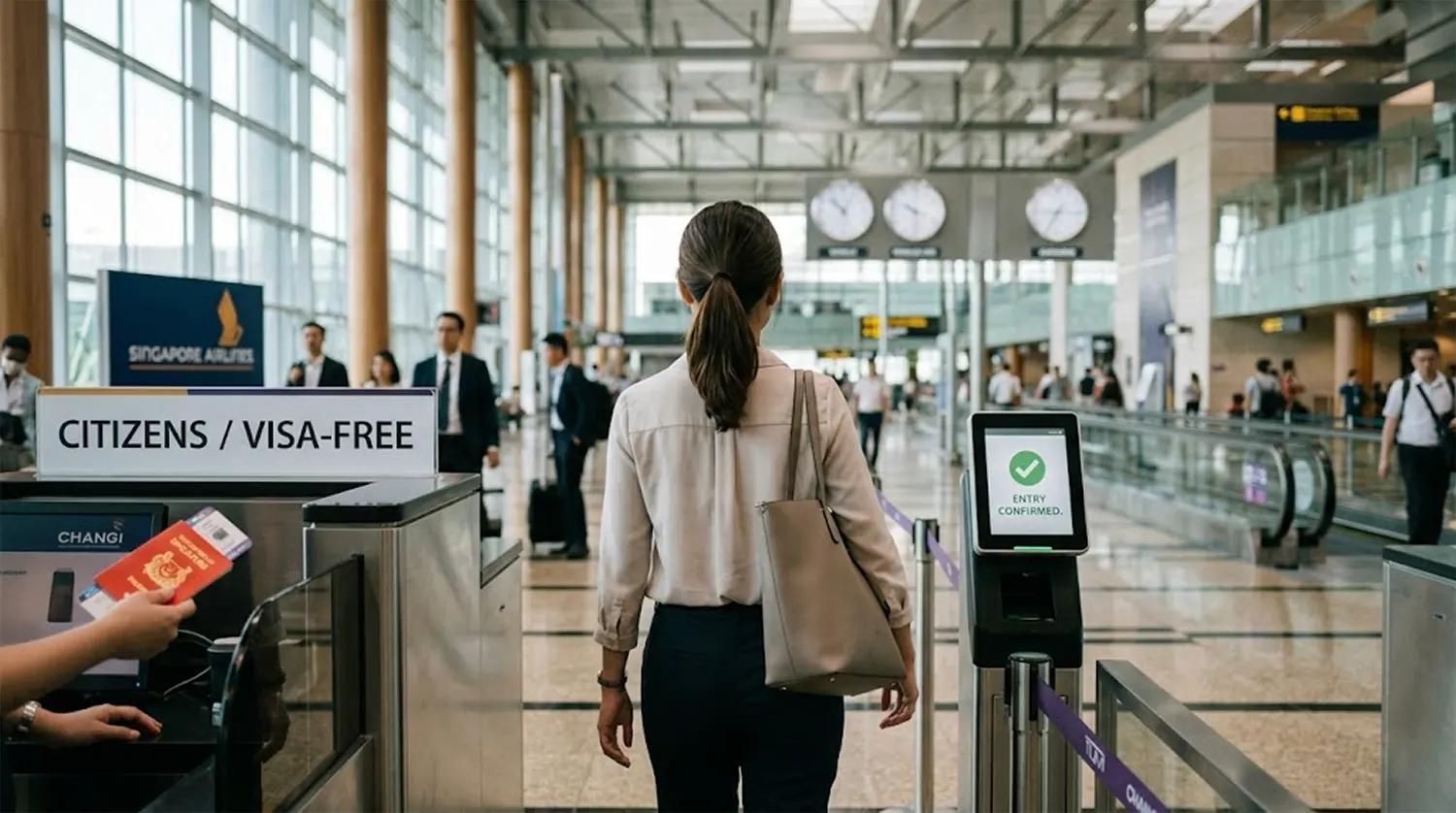
Singapore has retained the world’s strongest passport in 2026, offering visa free or visa on arrival access to up to 195 destinations, according to the Henley Passport Index, which tracks global travel freedom.
That headline matters because passport strength shapes who can move freely across borders for work, tourism, and opportunity while exposing a widening gap between the world’s most and least mobile citizens.
But the real story sits beneath the rankings. Singapore’s lead is narrow but consistent, while countries across Europe dominate the broader top tier. Japan and South Korea follow closely in second place, with up to 188 destinations. A cluster of European economies fills ranks three to five, reflecting what analysts call “numerical dominance” rather than outright leadership.
At the same time, traditional powers are slipping. The United States now sits at 10th place with access to 179 destinations, down from its top ranking in 2014. The United Kingdom has followed a similar trajectory. This shift signals a broader rebalancing in global mobility one that favors diplomatic consistency over historical influence.
A widening gap between global mobility’s winners and losers
What makes this ranking more than a leaderboard is the growing “mobility gap” between nations. A Singaporean can travel to nearly 200 destinations with minimal friction. By contrast, citizens of Afghanistan can access just 24 to 26 countries without prior visas.
This disparity highlights a stark reality: freedom of movement is increasingly unequal. It affects access to education, business opportunities, and even emergency travel. In practical terms, where you are born still determines how easily you can cross borders.
To understand why, it helps to look at how passport strength is actually measured. The International Air Transport Association provides the underlying data, using the same systems airlines rely on to determine boarding eligibility.
The scoring itself is blunt by design. Each destination is scored either 1 or 0. If a traveler can enter without prior approval or obtain a visa on arrival, it counts as full access. If paperwork must be completed before departure, it scores zero. In short, “strength” means freedom from bureaucracy.
The hidden metric: access to economic power, not just places
Yet raw numbers only tell part of the story. Analysts increasingly point to a second measure known as Henley Passport Power (HPP), which evaluates access to global economic weight rather than just destination count.
This distinction matters. Access to major economies like the US or EU carries disproportionate value, even if the total number of accessible countries is slightly lower. A passport that opens doors to high GDP regions can offer far greater real world opportunity.
That shift in thinking reframes the rankings. It is no longer just about how many borders you can cross, but which borders actually matter economically.
Against that backdrop, Singapore’s dominance becomes clearer and more deliberate.
How Singapore turned diplomacy into a travel advantage
Singapore has not always held the top spot outright. In the early 2010s, it ranked within the top 10 but trailed countries like the US, UK, and Germany. The turning point came in July 2023, when it broke a long standing tie with Japan to become the sole holder of first place.
Since then, Singapore has maintained its lead for three consecutive years 2024 through 2026 despite close competition. This consistency reflects strategy rather than chance.
At the core is high reciprocity. Singapore allows easy entry for most nationalities, encouraging other countries to extend the same privilege. Its role as a global business hub reinforces this exchange, making openness mutually beneficial.
Equally important is diplomatic neutrality. Often described as a “friend to all,” Singapore avoids entanglement in major geopolitical conflicts. This reduces the risk of retaliatory visa restrictions that can quickly erode passport strength.
Trust, wealth, and reputation: the real drivers of visa free access
But diplomacy alone does not explain everything. The strongest factor is economic. Wealth reduces the risk of visa overstays, which is a primary concern for destination countries.
The logic is simple. Citizens of high income nations are unlikely to seek illegal work abroad. As a result, Singaporeans are viewed as low risk, high spending travelers, making visa free agreements easier to secure.
Closely tied to this is institutional trust. Singapore’s passports are highly secure and difficult to forge. Foreign governments trust its vetting systems, assuming that travelers have already passed stringent internal checks.
Then comes reputation. Over time, “good traveler behavior” reinforces policy decisions. Singaporeans are widely seen as law abiding and respectful abroad. While informal, this perception influences whether countries maintain or expand visa free access.
Finally, reciprocity ties it all together. Visa policies often operate as a diplomatic exchange, embedded in broader trade and political relationships. Singapore leverages its openness to secure similar treatment for its citizens.
In the end, Singapore’s passport strength reflects more than paperwork rules. It is a product of economics, trust, and long term diplomacy working in sync. And as global mobility becomes more unequal, the gap between those who can move freely and those who cannot is likely to widen making that small red passport an even more powerful symbol of access in the years ahead.