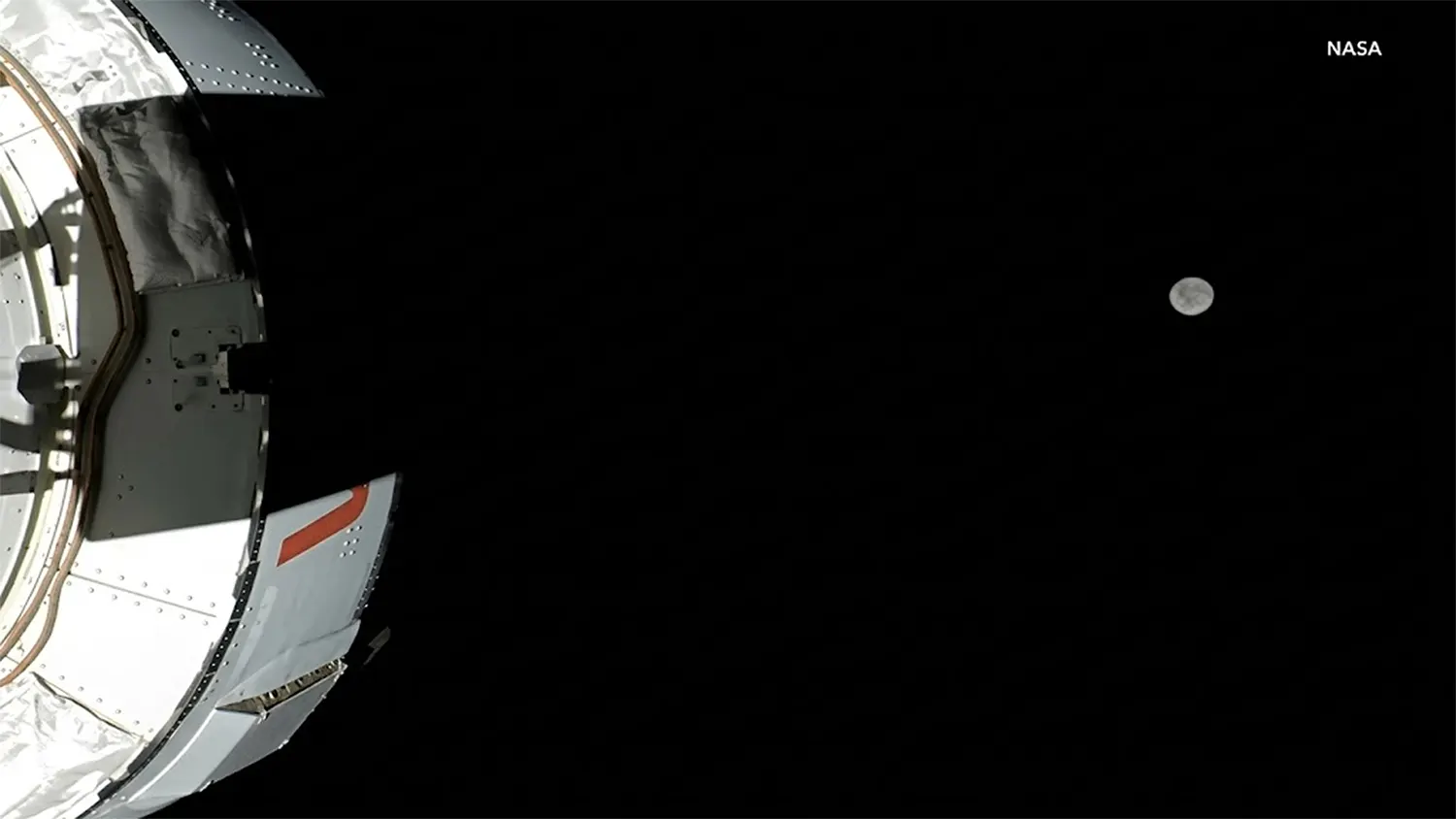
Where were you when humans quietly pushed past a boundary that had stood for more than half a century?
On April 6, 2026, a spacecraft carrying four astronauts slipped farther from Earth than any human in history. And as they now race back home, the story they’re bringing with them is already reshaping how we think about going to the Moon and beyond.
The Moment We Broke Our Own Cosmic Record
At 7:07 PM ET, the spacecraft Orion spacecraft nicknamed Integrity reached a staggering distance of 252,760 miles (406,771 km) from Earth.
That single number matters more than it seems.
For 56 years, the record was held by the crew of Apollo 13, a mission remembered as a near disaster turned survival story. Now, four astronauts Reid Wiseman, Victor Glover, Christina Koch, and Jeremy Hansen have gone about 4,100 miles farther.
For the first time in over half a century, humanity extended its physical reach into space.
And that extra distance isn’t just symbolic, it’s the gateway to a new era of exploration.
When the Moon Turned the Sun Off
As the spacecraft swung behind the Moon, something extraordinary happened.
The crew witnessed a total solar eclipse but from space, and from the Moon’s far side.
The Moon completely blocked the Sun, revealing the solar corona, the Sun’s faint outer atmosphere. (The corona is usually invisible because the Sun’s brightness overwhelms it.)
They saw a version of a solar eclipse no human had ever seen before.
Even more surreal, sunlight reflected faintly off Earth called “Earthshine” lit the darkness just enough to reveal the lunar surface in ghostly detail.
Astronaut Victor Glover summed it up simply: it looked like science fiction.
And yet, the most powerful moments were still to come.
Seeing the Moon With Human Eyes Again
At their closest approach just 4,067 miles above the surface, the Moon didn’t look like a distant object anymore.
It looked close. Personal.
About the size of a basketball held at arm’s length.
For the first time since 1972, humans saw the Moon’s far side with their own eyes not through cameras, but directly.
That distinction matters more than you might think.
Cameras flatten images. They compress depth. But human vision does something different it perceives distance, scale, and texture all at once.
That’s why astronaut Jeremy Hansen was audibly stunned. The craters weren’t just shapes they had depth, like cliffs and valleys stretching into darkness.
And that depth is exactly what scientists need.
Why a “Flyby” Is Actually a High Stakes Test
If this mission sounds like a scenic loop around the Moon, it’s not.
It’s what engineers call a “shakedown cruise”, a full system test under real conditions.
Think of it like taking a brand new submarine into deep water before trusting it to dive to the ocean floor.
This is the first time the Orion spacecraft has had to keep humans alive in deep space.
That includes:
- Managing carbon dioxide from breathing
- Controlling heat and moisture from bodies
- Protecting against radiation outside Earth’s magnetic shield (the invisible field that blocks harmful space radiation)
In other words, the astronauts themselves are part of the experiment.
And survival isn’t the only skill being tested.
Learning to “Drive” in Deep Space
Early in the mission, the crew practiced manual control of the spacecraft carefully maneuvering near a spent rocket stage.
That might sound routine, but it’s critical.
Future missions will require astronauts to dock with other spacecraft near the Moon
like a lunar lander or a space station in orbit.
Before we can land on the Moon again, we have to prove we can navigate precisely in deep space.
It’s the difference between driving on an empty road… and parallel parking in orbit.
The Moon’s Most Dangerous Real Estate
While passing the Moon, the crew became scouts.
Their target: the lunar south pole.
Unlike the relatively flat regions where Apollo astronauts landed, this area is chaotic
filled with deep craters, jagged ridges, and extreme lighting.
Some craters never see sunlight. These are called permanently shadowed regions.
And inside them?
Water ice.
Hidden ice at the Moon’s south pole could fuel future space missions.
Water can be split into hydrogen and oxygen key ingredients for rocket fuel and
breathable air. That makes the Moon not just a destination, but a potential refueling station for deeper space travel.
But reaching that ice is risky.
Bright peaks sit next to pitch black craters. Slopes are steep. Shadows hide hazards.
That’s where human vision helped again adding context that even high resolution maps
can miss.
The Moment Earth Disappeared
Then came perhaps the most emotional moment of the mission.
At 6:45 PM ET, the crew watched Earth slowly sink below the Moon’s horizon.
Earthset.
A small, blue marble home to everything we know vanished from view.
Moments later, communication cut off.
For 40 minutes, the astronauts were completely alone, shielded by the Moon from all radio contact.
For those 40 minutes, they were the most isolated humans in history.
No voices. No signals. Just silence and a view no one else could share.
When contact resumed, they were already heading home.
Falling Back to Earth On Purpose
Right now, the spacecraft is on what’s called a “free return trajectory.”
That means it doesn’t need engines to get home.
The Moon’s gravity bent its path just enough that Earth is now pulling it back like a slingshot releasing a stone.
Even if systems failed, physics alone would bring them home.
It’s the same principle that helped save Apollo 13.
If all goes as planned, the mission will end with a splashdown in the Pacific Ocean on April 10.
From record-breaking distance… to ocean waves in just a few days.
Why This Mission Changes Everything
At first glance, this mission might seem like a rehearsal.
No landing. No moonwalk.
But that misses the bigger picture.
This mission proves that humans can once again live, work, and navigate beyond Earth orbit.
That’s something we haven’t done since the early 1970s.
And it sets the stage for what comes next:
- Testing landers in orbit
- Returning astronauts to the lunar surface
- Building a long term presence near the Moon
In simple terms:
- Artemis I: the spacecraft works
- Artemis II: humans can survive and operate it
- Artemis III and beyond: humans return to the surface
Each step builds on the last.
The Next Giant Leap Starts Quietly
It’s easy to miss moments like this.
There was no single footprint. No flag planted.
Just four people, a spacecraft, and a journey a little farther than anyone had gone before.
But that’s how exploration often works not in giant leaps, but in careful, measured steps.
And this one matters.
Because the next time humans pass this distance, they may not just be visiting the Moon.
They might be on their way somewhere even farther.