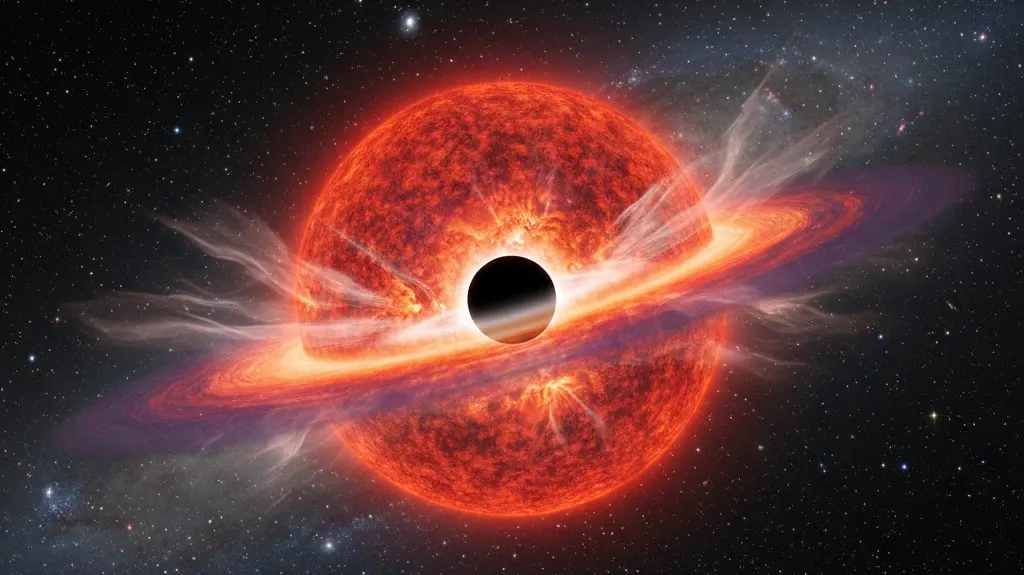
Astronomers have finally solved one of the universe’s most puzzling mysteries: what happens when a massive star quietly collapses into a black hole instead of exploding in a brilliant supernova. The discovery, led by astrophysicist Kishalay De of Columbia University and the Flatiron Institute, focuses on a star named M31 2014 DS1 in our neighboring Andromeda Galaxy,
just 2.5 million light years away.
The Cosmic Cold Case
For nearly a decade, astronomers were baffled by the sudden disappearance of one of Andromeda’s brightest stars.
M31 2014 DS1 was a luminous supergiant, about 13 times the mass of the Sun. In 2014, it briefly brightened in infrared,
a “dying gasp” before fading rapidly. By 2023, it had vanished from visible light.
Instead of the dramatic explosion expected from a star of this size, the core collapsed under gravity to form a black hole.
Its outer layers were only gently pushed outward, leaving behind a faint infrared glow the heat of stellar debris slowly falling into the newborn black hole.
Why This Discovery Matters
Traditionally, scientists believed that any star over 8 solar masses must end in a supernova. M31 2014 DS1 challenges that assumption. Its quiet collapse suggests that the internal physics of dying stars gravity, gas pressure, and shock waves are far more chaotic and unpredictable than previously thought.
This finding may also solve a cosmic mystery: astronomers see far more black holes than supernovae, implying that many massive stars “blink out” quietly rather than exploding spectacularly.
JWST’s Role in Observing a Star’s “Afterlife”
The James Webb Space Telescope (JWST) is monitoring
M31 2014 DS1 in infrared light. While invisible to the naked eye, the star left a glowing dust shroud material ejected just before the core collapsed. JWST’s instruments, including MIRI and NIRSpec, are tracking the temperature of this swirling debris disk, observing fallback accretion about 1% of the star’s mass slowly raining onto the black hole. This faint glow will be visible for decades, offering a unique opportunity to study a black hole’s early life.
The Neutrino Signature: Listening to a Star’s Heart
When a massive star dies normally, it emits a flood of neutrinos tiny, ghost like particles that carry away energy and trigger the shockwave of a supernova. In M31 2014 DS1’s case, no significant neutrino burst was detected, confirming the star’s quiet collapse. This “missing” neutrino signature helps explain the Red Supergiant Problem: many massive stars vanish without supernova fireworks.
Future detectors like DUNE and Hyper Kamiokande will capture even fainter signals, helping astronomers identify failed supernovas across the cosmos.
A Glimpse into the Future: Milkomeda and the Fate of Black Holes
The new black hole in Andromeda is more than a curiosity
it’s a piece of a cosmic puzzle. In about 8 billion years,
the Milky Way and Andromeda may collide to form Milkomeda, an enormous elliptical galaxy.
- Black Hole Feeding Frenzy: During the merger, central black holes will feed on clouds of gas and dust, creating brilliant quasars and tidal disruption events as stars are torn apart.
- Gravitational Waves: The supermassive black holes will spiral together, releasing ripples in space time with the energy of
10 quintillion suns. - Cosmic Kick: The final merged black hole could eject nearby stars into the galaxy’s outskirts.
While this cosmic spectacle is billions of years away, studying
M31 2014 DS1 today offers a preview of how black holes grow, interact, and shape the universe.
Why It Inspires Wonder
This “failed supernova” reminds us that the universe is full of surprises. Stars don’t always die the way we expect.
Sometimes, they quietly become black holes, leaving subtle clues for telescopes like JWST to uncover. Each discovery deepens our understanding of stellar life cycles, black hole formation, and the grand cosmic dance of galaxies.
As we watch the faint infrared glow of M31 2014 DS1, we are witnessing the universe’s quiet poetry, a star that vanished,
yet tells a story billions of years in the making.