
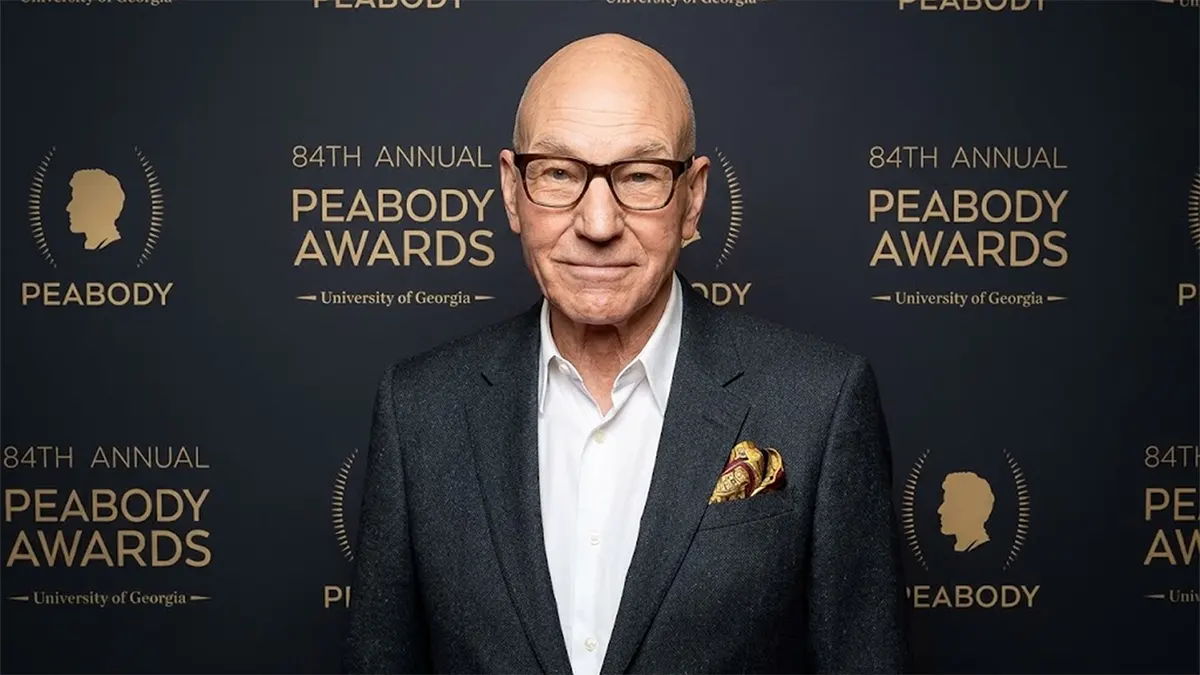
Sir Patrick Stewart, the acclaimed English actor best known for playing Captain Jean-Luc Picard in Star Trek and Professor Charles Xavier in the X-Men franchise, has died at the age of 86. His death marks the end of a remarkable career that spanned more than six decades across classical theater, television, and film.
Stewart died peacefully at his home in Los Angeles on October 28, 2026, surrounded by his wife, singer-songwriter Sunny Ozell, family, and close friends. According to a statement released by his representative on October 29, the actor had experienced what his family described as a “brief and poignant journey with Alzheimer’s disease and Lewy body dementia.” His diagnoses had not previously been made public.
While millions of viewers remember him as the commanding captain of the USS Enterprise or the wise leader of the X-Men, Stewart’s influence reached far beyond the science fiction and superhero worlds. He was also one of Britain’s most respected Shakespearean actors, a passionate advocate against domestic violence, and a performer whose intelligence, warmth, and sense of humor made him equally memorable away from the spotlight.
Patrick Stewart Made Captain Jean-Luc Picard a Television Icon
For an entire generation of television viewers, Captain Jean-Luc Picard became one of the most recognizable characters in science fiction history.
Stewart first portrayed the character in Star Trek: The Next Generation, which premiered in 1987. As commander of the USS Enterprise-D, Picard offered a different kind of science fiction hero. Rather than relying on physical strength or impulsive action, he approached challenges through diplomacy, reason, intellectual curiosity, and a strong sense of responsibility.
His portrayal helped establish The Next Generation as one of the most influential television series in the Star Trek franchise. The show ran for seven seasons, producing 178 episodes and establishing Stewart as an international star.
He subsequently reprised Picard in four feature films, including Star Trek: Generations (1994) and Star Trek: First Contact (1996). More than two decades after the original series ended, he returned to the character in Star Trek: Picard, which ran from 2020 to 2023.
What made his performance particularly memorable was the humanity he brought to the role. Picard was not simply a starship captain. He was a thoughtful leader who valued knowledge, respected different cultures, and believed that understanding was often more powerful than confrontation.
Through Stewart’s performance, the character became a lasting symbol of intelligent and compassionate leadership.
Professor X Brought a Different Kind of Heroism to the X-Men
Stewart’s influence on popular culture extended beyond the world of Star Trek.
In 2000, he made his debut as Professor Charles Xavier in the original X-Men film. Playing the founder of the X-Men and mentor to young mutants, Stewart brought a combination of wisdom, authority, and compassion to the Marvel character.
Professor X believed that mutants and humans could coexist despite their differences. His struggle against prejudice and discrimination gave the X-Men films a deeper emotional foundation, allowing the superhero stories to explore themes of acceptance, identity, and social division.
Stewart continued portraying the character across several films, including X2: X-Men United, X-Men: The Last Stand, and X-Men: Days of Future Past.
One of his most powerful performances came in James Mangold’s Logan (2017). Instead of presenting Professor X as the confident and influential mentor audiences had come to know, the film showed an aging and vulnerable Charles Xavier dealing with physical and mental decline.
The performance revealed a different side of the character, emphasizing his humanity and vulnerability. It also demonstrated Stewart’s willingness to challenge the expectations surrounding one of his most famous roles.
His appearances in Doctor Strange in the Multiverse of Madness (2022) further extended his connection to the Marvel universe.
From Shakespeare to Hollywood: The Foundation of His Acting Career
Long before becoming a global entertainment icon, Stewart had established himself as a respected classical theater performer.
Born on July 13, 1940, in Mirfield, West Yorkshire, England, he developed an interest in acting and literature during his youth. Encouraged by a schoolteacher who introduced him to Shakespeare, he eventually pursued professional acting training at the Bristol Old Vic Theatre School.
In 1966, Stewart joined the Royal Shakespeare Company (RSC), beginning a relationship with classical theater that would shape much of his professional life.
He spent approximately 15 years as a core member of the company and later returned for additional productions. Across his career, he performed in more than 40 RSC productions, taking on major Shakespearean characters such as Macbeth, Othello, Shylock, Prospero, Henry IV, and Mark Antony.
His stage work demonstrated a remarkable command of language, dramatic timing, and character development.
Stewart received three Laurence Olivier Awards, including recognition for his portrayal of Claudius in Hamlet, opposite David Tennant. His performance as Macbeth also earned widespread critical acclaim and a Tony Award nomination when the production transferred to Broadway in 2008.
One of his most distinctive theatrical achievements was his solo adaptation of Charles Dickens’ A Christmas Carol, in which he portrayed more than 40 characters.
His friendship and stage partnership with fellow actor Sir Ian McKellen also produced memorable productions of Samuel Beckett’s Waiting for Godot and Harold Pinter’s No Man’s Land.
Despite his international fame, Stewart repeatedly returned to the theater, demonstrating that his passion for acting had never been limited to film and television.
How Patrick Stewart Changed Science Fiction and Superhero Cinema
Stewart’s success in major entertainment franchises helped demonstrate that classical acting and mainstream blockbuster filmmaking could work together.
Before Star Trek and X-Men, science fiction and action films often placed considerable emphasis on physical action and conventional heroic personalities. Stewart brought a different approach, showing that intelligence, moral conviction, and emotional depth could be just as compelling as physical strength.
As Jean-Luc Picard, he made thoughtful leadership central to a science fiction franchise. As Professor X, he gave a comic-book character the emotional complexity of a classical dramatic role.
His performances also helped establish a path for other classically trained actors to become leading figures in mainstream entertainment.
His contemporaries and collaborators, including Ian McKellen, later demonstrated similar success in major franchises, while actors such as Kenneth Branagh, Helen Mirren, and Benedict Cumberbatch continued the connection between classical theater and modern blockbuster cinema.
Beyond his signature franchises, Stewart appeared in a wide range of films.
His filmography included David Lynch’s Dune (1984), John Boorman’s Excalibur (1981), the thriller Green Room (2015), and the animated film The Prince of Egypt (1998).
He also developed a recognizable voice-acting career, most notably as CIA Deputy Director Avery Bullock in the animated comedy series American Dad!.
Patrick Stewart Was More Than His Serious On-Screen Persona
Despite his reputation for playing authoritative and intellectual characters, Stewart had a considerable talent for comedy.
He frequently embraced roles that deliberately challenged his serious public image. His appearance in Ricky Gervais’ Extras demonstrated his willingness to make fun of his own theatrical reputation.
He also voiced Avery Bullock in American Dad! and appeared in comedy productions such as Family Guy.
His distinctive voice became one of his most recognizable professional assets, making him a popular choice for narration and animated performances.
Away from acting, Stewart was also known for his self-deprecating humor, love of animals, and willingness to engage with popular internet culture.
These qualities helped introduce him to audiences who might otherwise have known him only through his dramatic performances.
His Advocacy Against Domestic Violence Became a Personal Mission
One of the most important parts of Stewart’s life away from entertainment was his work against domestic violence.
His commitment to the issue was deeply personal. In his memoir, Making It So: A Memoir, published in 2023, he discussed witnessing his father’s physical abuse of his mother during his childhood.
Rather than keeping those experiences private, Stewart used his public platform to challenge domestic violence and encourage greater awareness of its impact.
He became a prominent supporter and patron of Refuge, a British organization that provides support and accommodation for women and children experiencing domestic abuse.
He regularly spoke about the responsibility of men to challenge abusive behavior and support survivors.
His advocacy demonstrated a different dimension of his public life. The same sense of responsibility and moral conviction that audiences recognized in his fictional characters was also reflected in his real-world activities.
Stewart additionally supported human rights initiatives, including Amnesty International, and organizations working with military veterans.
Education and His Connection to the University of Huddersfield
Despite spending much of his professional life working internationally, Stewart maintained a strong connection to his Yorkshire roots.
From 2004 to 2015, he served as Chancellor of the University of Huddersfield, his hometown university.
His involvement went beyond the traditional responsibilities of a ceremonial chancellor. He regularly participated in university events, supported students, attended graduation ceremonies, and encouraged greater access to higher education.
The university recognized his contribution by naming its drama building and theater after him.
His connection to education reflected his own journey from a working-class upbringing to international recognition, as well as his belief in the importance of giving young people opportunities to pursue their ambitions.
In 2001, Stewart was appointed an Officer of the Order of the British Empire (OBE), with his honor formally recorded in 2002. He received a knighthood from Queen Elizabeth II in 2010 for his services to drama.
Co-Stars and Friends Remember a Remarkable Actor
Following news of Stewart’s death, tributes came from colleagues, friends, and fellow performers across the entertainment industry.
William Shatner, who portrayed Captain James T. Kirk in the original Star Trek series, remembered Stewart as a friend and colleague whose performances brought intelligence, grace, and humanity to the franchise.
Hugh Jackman, who worked alongside Stewart in the X-Men films, described him as a tremendous friend and an actor from whom he had learned a great deal.
Sir Ian McKellen also paid tribute to their long friendship and theatrical partnership, remembering Stewart as someone who wore his heart openly and was deeply loved by those around him.
These tributes reflected a common theme: Stewart’s influence was not limited to the characters he played. He was also a respected colleague, mentor, and friend to many people within the entertainment industry.
Remembering Sir Patrick Stewart: A Legacy Beyond the Screen
Sir Patrick Stewart’s career was defined by an unusual combination of classical theatrical discipline and mainstream entertainment success.
He could command a Shakespearean stage, lead a science fiction television series, bring emotional depth to a superhero franchise, and deliver comedy without appearing constrained by his reputation.
His performances as Jean-Luc Picard and Professor Charles Xavier introduced millions of people to characters who valued compassion, knowledge, tolerance, and responsibility.
Yet his legacy extends beyond those iconic roles. His commitment to theater, education, human rights, and domestic violence advocacy demonstrated how an internationally recognized performer could use his influence for causes beyond entertainment.
Stewart leaves behind a body of work that spans generations, from Shakespearean productions to some of the most recognizable film and television franchises in modern popular culture.
He may be remembered as Captain Picard and Professor X, but his greatest legacy was the humanity he brought to every role and the causes he championed beyond the screen.