Ukraine has launched two of its largest drone offensives against Russia in rapid succession, sending hundreds of long-range unmanned aircraft toward Moscow and other regions deep inside Russian territory.
The attacks, reported on August 16 and August 18, underline how quickly Ukraine’s long-range strike campaign is expanding. They also triggered a new confrontation with Britain after reports that British-made drones were among the systems used in strikes inside Russia.
Russia has responded by warning London that its growing military support for Kyiv could carry unspecified “consequences.” Britain, however, says its support for Ukraine will continue.
Hundreds of drones targeted Moscow and other Russian regions
The first major wave came overnight into Sunday, August 16, when Russia’s Defence Ministry said its air defenses intercepted 822 Ukrainian drones across the country. Russian officials said roughly 600 were directed toward the Moscow region.
The attack caused casualties and damage despite the large number of reported interceptions. An 83 year old man was killed in the Moscow region, while five other people were reported killed in the Rostov region. Fires and damage were also reported at several locations.
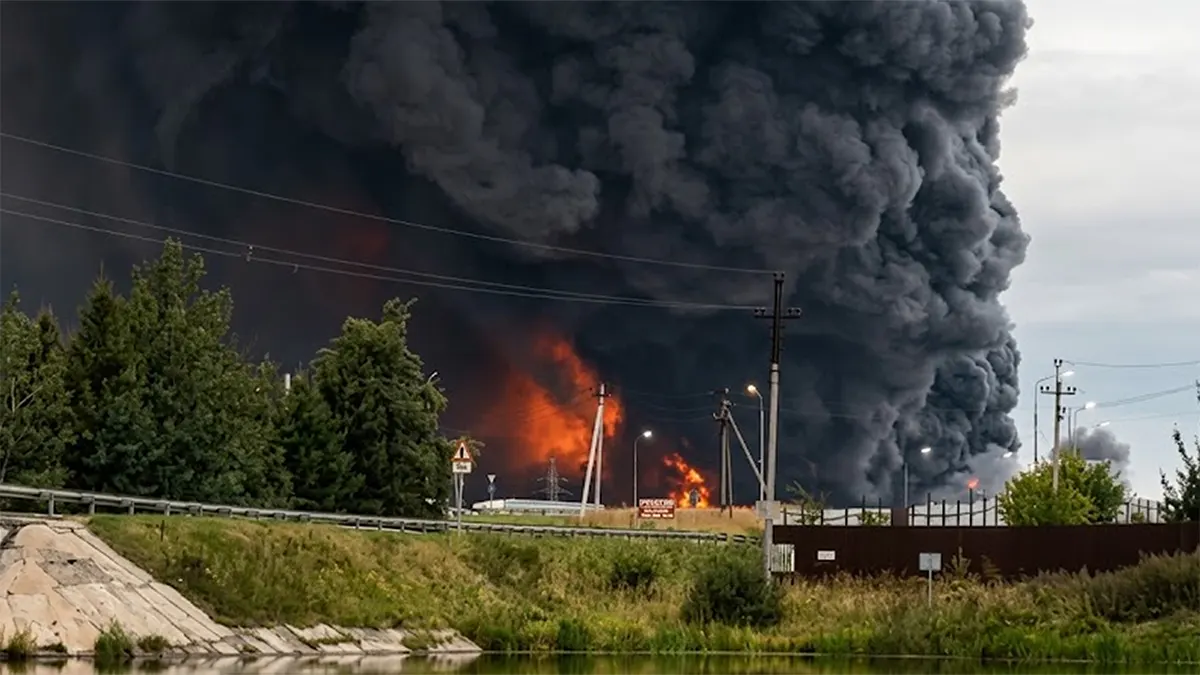
One of the most visible incidents occurred at a large Wildberries logistics warehouse near Podolsk, south of Moscow. The facility caught fire after the attack, sending a large plume of smoke into the sky. Wildberries is one of Russia’s largest e-commerce companies, and Ukrainian forces have increasingly targeted the company’s logistics network, alleging that some of its facilities support Russia’s military-industrial supply chain.
The scale of the August 16 assault made it one of Ukraine’s largest aerial attacks on Russia since the full-scale war began.
But Kyiv did not stop there.
A second mass attack followed within days
Another large Ukrainian drone offensive was reported overnight into Tuesday, August 18.
Russian officials said nearly 800 drones were intercepted during the new barrage, with a large share directed toward the Moscow region. Attacks and interceptions were also reported in areas including Rostov, Ryazan and occupied Crimea, as well as over the Black Sea and Sea of Azov.
Moscow Mayor Sergei Sobyanin said hundreds of drones had been aimed at the Moscow area, while Russian authorities reported temporary disruption around airports as air defenses responded.
The repeated attacks suggest that Ukraine is not simply attempting isolated strikes. Instead, it is developing a strategy based on large, sustained drone swarms designed to saturate Russian air defenses.
That approach allows Ukraine to put pressure on a wide geographic area while forcing Russia to expend valuable air-defense resources against relatively inexpensive unmanned systems.
Ukraine is building a deep-strike drone campaign
The growing scale of the attacks reflects Ukraine’s expanding domestic defense industry.
Rather than relying exclusively on expensive Western missiles, Ukraine has developed and deployed large numbers of domestically produced long-range drones. These systems can be launched in substantial numbers and used against military, energy, industrial and logistics targets.
Ukrainian forces have increasingly demonstrated the ability to strike hundreds of miles beyond the front line. Recent operations have targeted Russian military-industrial facilities, oil infrastructure, transport networks and logistics hubs.
The objective is broader than simply destroying individual facilities.
By sending large numbers of drones toward heavily defended areas such as Moscow, Ukraine can force Russian air defenses to spread their attention across multiple targets. Even drones that are intercepted can impose costs by requiring radar coverage, interceptor missiles, electronic warfare systems and personnel.
The August attacks therefore represent both a physical strike campaign and a test of the limits of Russia’s air-defense network.
The British-made drone question changes the political stakes
The military story has another dimension.
Reports in The Sunday Times said Ukraine has used British-made long-range drones in strikes against targets inside Russia. One of the systems identified in reporting is the Nyan, a one-way effector developed by British company Callen-Lenz, which is owned by BAE Systems.
Callen-Lenz describes the Nyan as a pneumatic-catapult-launched unmanned aircraft with a single gas-turbine engine and a range of more than 250 kilometers, depending on fuel load and mission profile.
The company has not publicly identified Ukraine as the customer for its operational deployments. However, defence publication Janes reported in June that the Nyan had been delivered in the thousands and was already in operational use with an undisclosed customer believed to be Ukraine.
That distinction matters.
The overwhelming majority of drones involved in Ukraine’s large-scale attacks are understood to be Ukrainian-developed or Ukrainian-produced systems. The reported use of British technology is therefore better understood as part of a mixed fleet rather than evidence that Britain supplied the hundreds of drones involved in each individual barrage.
Why Moscow is angry with London
For Moscow, the issue is not simply the number of drones.
Russia has long accused Western countries of becoming increasingly involved in the war by providing Ukraine with weapons, intelligence and other military assistance. Reports that British-designed systems are being used against targets inside internationally recognized Russian territory give Moscow another argument for claiming that Western involvement has crossed a new threshold.
Russian Foreign Minister Sergei Lavrov said on August 18 that Russia reserves the right to regard Britain as a participant in the war because of what Moscow describes as direct Western involvement in military operations. The Russian Embassy in London separately warned that Britain would face unspecified “consequences.”
Moscow has not clearly defined what those consequences would mean.
They could involve diplomatic pressure, cyber activity, economic retaliation or other forms of asymmetric action. At this stage, however, Russia has not announced a specific military response against Britain.
The rhetoric nevertheless marks another deterioration in relations between Moscow and London.
Britain says its support for Ukraine will not change
The British government has rejected Russia’s warning.
Prime Minister Andy Burnham said Britain would continue to support Ukraine “100%,” emphasizing that the UK’s position on helping Kyiv had not changed.
The British Ministry of Defence has also maintained its broader commitment to supplying Ukraine with military equipment. Britain has pledged to provide large numbers of drones as part of its continuing military assistance package.
The response indicates that London does not accept Moscow’s argument that supplying military equipment makes Britain a direct party to Ukraine’s attacks.
That leaves both sides with sharply different interpretations of the same development: Russia sees Western-made systems striking Russian territory as evidence of deeper Western participation, while Britain views its assistance as support for Ukraine’s ability to defend itself.
The “first” needs some qualification
The reported use of British-made drones inside Russia is significant, but it should not be confused with the first time Western-supplied weapons have been used against Russian targets.
Britain previously supplied Ukraine with Storm Shadow cruise missiles, which Kyiv used extensively against Russian military positions and infrastructure. Western governments had placed restrictions on the use of some Western weapons, particularly concerning strikes against internationally recognized Russian territory, because of fears that attacks deep inside Russia could increase the risk of direct NATO-Russia confrontation.
The current development is different in one important respect.
Reports indicate that British-produced unmanned systems have now been used in strikes against targets inside Russia itself, rather than being confined to Ukrainian territory or Russian-occupied Ukrainian regions. Reuters reported that this was the first such use highlighted by the latest reporting on British-made drones.
That does not mean Britain has directly ordered or conducted the strikes. Nor does the presence of British-made equipment establish that every Ukrainian drone attack against Russia involved Western technology.
Instead, it points to a more complicated battlefield reality in which Ukrainian-built weapons and Western-supplied technology are increasingly operating alongside one another.
Ukraine’s drone strategy is becoming harder for Russia to contain
The broader significance of the August attacks may ultimately have less to do with any single British-made drone than with Ukraine’s ability to manufacture and deploy long-range weapons at scale.
The August 16 and August 18 attacks demonstrate a sustained effort to push the war deeper into Russia while placing additional pressure on its air-defense network.
For Moscow, that creates a difficult problem. Defending every potential target across a country as large as Russia is extremely demanding, particularly when an attacker can launch hundreds of relatively inexpensive drones in a single operation.
For Ukraine, meanwhile, the strategy offers a way to strike Russian military and industrial infrastructure without depending entirely on limited stocks of Western cruise missiles.
That makes the drone campaign an increasingly important part of the war.
And with British-made systems reportedly joining Ukraine’s growing fleet, the attacks have also created a new political fault line between Moscow and London, one that could become more significant if Ukraine’s deep-strike campaign continues to expand.