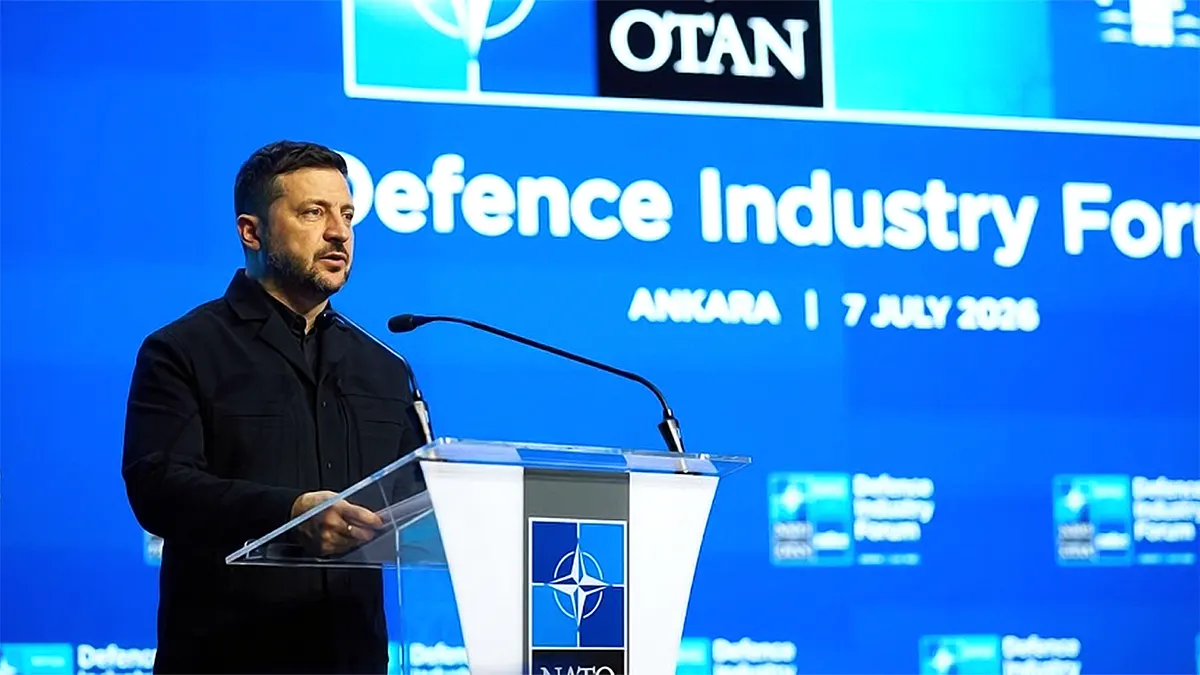
Volodymyr Zelensky walked into the NATO summit in Ankara this week with a message that flipped the usual script. For years, the conversation around Ukrainian membership centered on risk, the fear that letting Ukraine in would drag the alliance into war. This time, Zelensky argued the opposite: Ukraine isn’t a liability NATO would inherit. It’s a battle-tested asset the alliance can’t afford to leave outside its doors.
“Do you really believe it would be right to leave outside NATO, a country and a people with this level of defensive capability?” he asked leaders gathered in the Turkish capital on July 7, 2026.
It’s a fair question, backed by numbers most militaries can only imagine.
A New Kind of War, Written in Drone Footage
Zelensky didn’t just make a political case, he made a technical one. He described the shift to drone warfare as a change on the scale of machine guns in World War I or tanks in World War II: a redefinition of how battles are actually fought.
The claim comes with a grim statistic attached. According to Zelensky, Ukraine is now eliminating around 30,000 Russian soldiers every month, with nearly 28,000 in June alone and he says Ukraine holds video confirmation for each one. The overwhelming majority, he noted, were struck by drones rather than traditional weapons.
He was careful to frame this without triumphalism. “We take no pride in this,” he said, describing it instead as evidence of what a defensive war now looks like when a country has no choice but to fight it.
Ukraine’s naval drones have followed a similar evolution moving from simple explosive boats used to sink Russian warships into multi-purpose platforms capable of striking targets on land and in the air from the sea. That shift has quietly reshaped the balance of power across the Black Sea.
The Money Question Gets Answered With Europe Footing the Bill
While the membership question stalled, the financial one didn’t. NATO’s Ankara summit declaration locks in €70 billion a year in military support for Ukraine through 2026 and 2027, €140 billion in total.
Two details stand out. First, the money is denominated in euros, not dollars, a deliberate signal that Europe is stepping up regardless of shifting political winds in Washington. Second, the commitment comes from European NATO members and Canada, not the alliance as a whole, the United States isn’t part of this particular pledge.
The funding isn’t entirely new money; it folds in the EU’s existing €90 billion defense loan program alongside bilateral packages from individual countries. Still, agreeing on the figure wasn’t easy. Some EU states that hadn’t previously committed major funding pushed back before eventually signing on.
Alongside the headline number, the PURL initiative which lets European nations, along with partners like Australia and New Zealand, pool money to buy American-made weapons for Ukraine moved forward as a key delivery mechanism. Individual countries also struck their own deals on the sidelines, including a fresh drone agreement between Ukraine and the Netherlands, part of more than $50 billion in collective arms agreements announced during the summit.
The Missile Shortage Nobody Can Ignore
Money means little without the right hardware, and that’s where Zelensky pressed hardest. Russia’s ballistic missile strikes on Kyiv have intensified in recent weeks, and Ukraine’s defense leans heavily on U.S.-made Patriot interceptors, a supply that can’t keep pace with global demand.
Zelensky pushed two asks simultaneously:
- Immediate resupply of PAC-2 and PAC-3 interceptors through the PURL framework, pulling from allied stockpiles as fast as possible.
- A long-term European alternative what he called an “Anti-Ballistic Coalition” to build an independent, affordable missile shield rather than wait years for Patriot production to catch up.
“Europe’s security cannot wait until 2030 or beyond, it is needed today,” he told the summit. NATO Secretary General Mark Rutte backed the push publicly, and leaders agreed to fast-track missile transfers through PURL. The political fight over membership may be unresolved, but the physical missiles are moving.
Membership Still Waits at the Door
For all the money and hardware, the one thing Zelensky explicitly asked for, a path into NATO didn’t materialize. The alliance’s position hasn’t shifted: membership can’t happen while a country is actively at war.
Leaders repeated the now-familiar language that Ukraine’s path is “irreversible,” without attaching a timeline. Instead, Ankara’s real achievement was institutional: shifting the financial and logistical weight of supporting Ukraine onto Europe, so the country isn’t left exposed while the political question sits unresolved.
Zelensky closed his remarks by thanking the leaders who have explicitly backed Ukrainian membership, arguing that an alliance without Ukraine’s modern combat experience isn’t equipped for “the challenges of the modern world.” He called for more determination on air defense as a defining outcome of the summit and urged partners to work with Ukraine on defenses against every type of drone threat.
The trip delivered real wins, billions in funding, missile commitments, new weapons deals. The membership door, for now, stays shut.