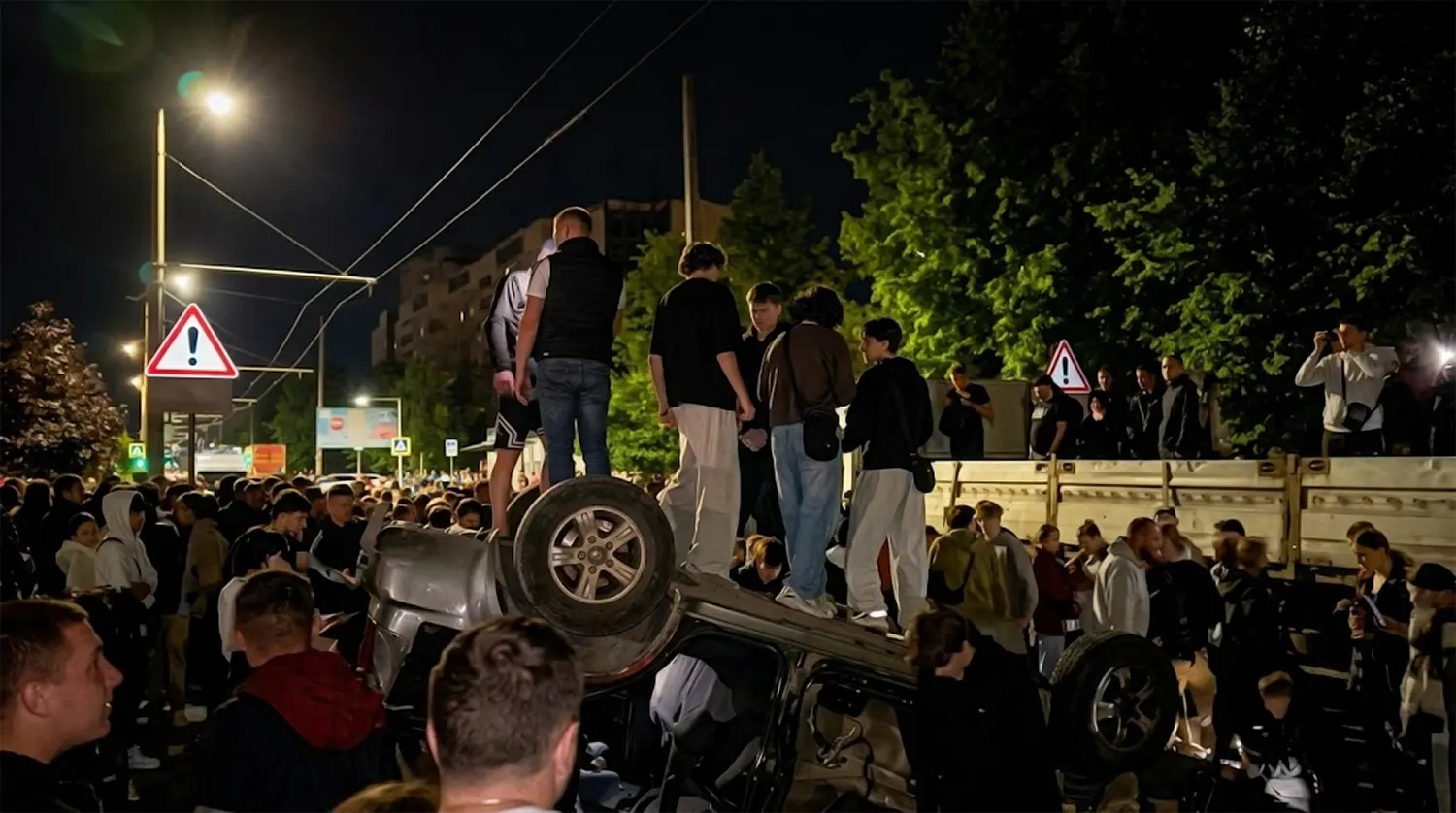
A tense night in western Ukraine turned violent on July 8, 2026, when roughly 200 residents in Lviv’s Sykhiv district surrounded a military recruitment vehicle, smashed its windows, and flipped it onto its side. The clash, one of the most dramatic public confrontations over Ukraine’s draft laws in recent memory, has reignited a painful national debate: how far should a country go to force its citizens into war?
What Sparked the Confrontation
The unrest started around 9:30 p.m. local time, when recruitment officers and police stopped a 30 year old man for a routine document check. The check revealed he was wanted for evading military registration, and officers moved to detain him for transport to a draft center for a medical exam.
According to eyewitnesses, the arrest was rough, and it didn’t take long for the mood on the street to shift. As one vehicle drove off with the detained man, a second recruitment van left behind became the target of a fast-forming crowd. Over the following hours, the confrontation escalated: people shouted “shame,” smashed the van’s windows, tore uniforms off officers, and eventually flipped the vehicle onto its side. A police officer sent to calm the situation was hurt, suffering head trauma and multiple injuries.
A Symptom of Deeper Exhaustion
Ukrainian officials moved quickly to investigate and condemn the violence, but they also acknowledged what’s really driving it. The Prosecutor General’s Office opened a criminal case for obstructing the armed forces and assaulting law enforcement, and Ukraine’s Security Service (SBU) detained a suspect accused of beating the officer.
President Volodymyr Zelensky called the incident “a very bad story,” while Lviv Mayor Andriy Sadovyi labeled the crowd’s behavior shameful but also called it a symptom of deeper strain in Ukrainian society. Officials have urged citizens to stay focused on Russia, warning that domestic unrest plays directly into enemy propaganda. Meanwhile, the regional recruitment office promised its own internal review into whether the initial arrest was carried out lawfully.
This wasn’t an isolated event. Attacks on draft officers were rare in the war’s early months, but more than 100 such incidents have already been reported in 2026 alone, a sign of just how much public patience has worn thin.
Why Ukraine Is Leaning So Hard on the Draft
When Russia launched its full-scale invasion in 2022, tens of thousands of Ukrainians volunteered to fight. But four years into a brutal war, that pool of willing recruits has largely dried up, and the soldiers who signed up early have mostly been unable to leave the front lines.
To keep the military staffed, Ukraine has turned to mandatory mobilization for men aged 25 to 60. The government’s reasoning is blunt: without forced conscription, the front lines could collapse, threatening the country’s survival. But that logic runs headlong into a population that is simply exhausted worn down by casualty fears and, in many cases, furious over how the draft is enforced. Some men have reportedly been forced into unmarked vans off the street, a practice locals have nicknamed “busification.”
The Human Cost, in Numbers
Both Ukraine and Russia treat military losses as closely guarded secrets, so exact casualty figures are hard to confirm. Still, independent analysts have pieced together estimates that show the scale of the toll.
- Military deaths: Western intelligence sources and think tanks like the Center for Strategic and International Studies (CSIS) estimate 100,000 to 140,000 Ukrainian soldiers have been killed since 2022, with total military casualties killed, wounded, and missing ranging from 500,000 to 625,000.
- Official figures: Zelensky has at times cited a lower number, officially acknowledging around 55,000 military deaths.
- Civilian deaths: The United Nations has verified nearly 16,000 civilian deaths, though it says the true figure is likely much higher, especially in Russian-occupied areas like Mariupol where records are incomplete.
Why the Average Soldier Is Over 40
One detail helps explain why the draft feels so personal to so many families: the average Ukrainian soldier on the front lines is between 40 and 43 years old. For comparison, the average U.S. soldier in Vietnam was around 22.
Two factors explain this unusual demographic. First, Ukraine went through a steep drop in birth rates during the economic collapse of the 1990s, leaving the country with relatively few men in their 20s today. Second, draft policy has deliberately protected that smaller, younger generation seen as vital to rebuilding the country after the war by keeping the minimum mobilization age higher. Even after officials lowered the draft age from 27 to 25, the bulk of the fighting force, and the bulk of the casualties, remains middle-aged men.
That means the men being pulled off the streets are often husbands, fathers, and primary breadwinners, not young, single recruits. When neighbors see a familiar, middle-aged man forcibly detained, it tends to provoke an immediate, protective reaction. That dynamic is widely seen as the emotional trigger behind the Lviv riot.
An Impossible Bind
At its core, the unrest in Lviv isn’t really about whether Ukraine should keep fighting Russia, most Ukrainians still support that goal. It’s about how the draft is being carried out and the toll it’s taking on families.
Three grievances keep surfacing: the aggressive tactics used to meet recruitment quotas, the fact that soldiers who signed up early in the war still have no clear path to being released from service, and the emotional weight of watching older, established family men be the ones sent to fight and die.
It’s a bind with no easy answer. Ukraine’s government believes forced mobilization is the only way to prevent the country from being overrun. Its citizens, worn down by years of loss and fear, are reaching a breaking point over what that policy actually costs them. The overturned van in Sykhiv is just the latest, most visible sign of that tension boiling over.