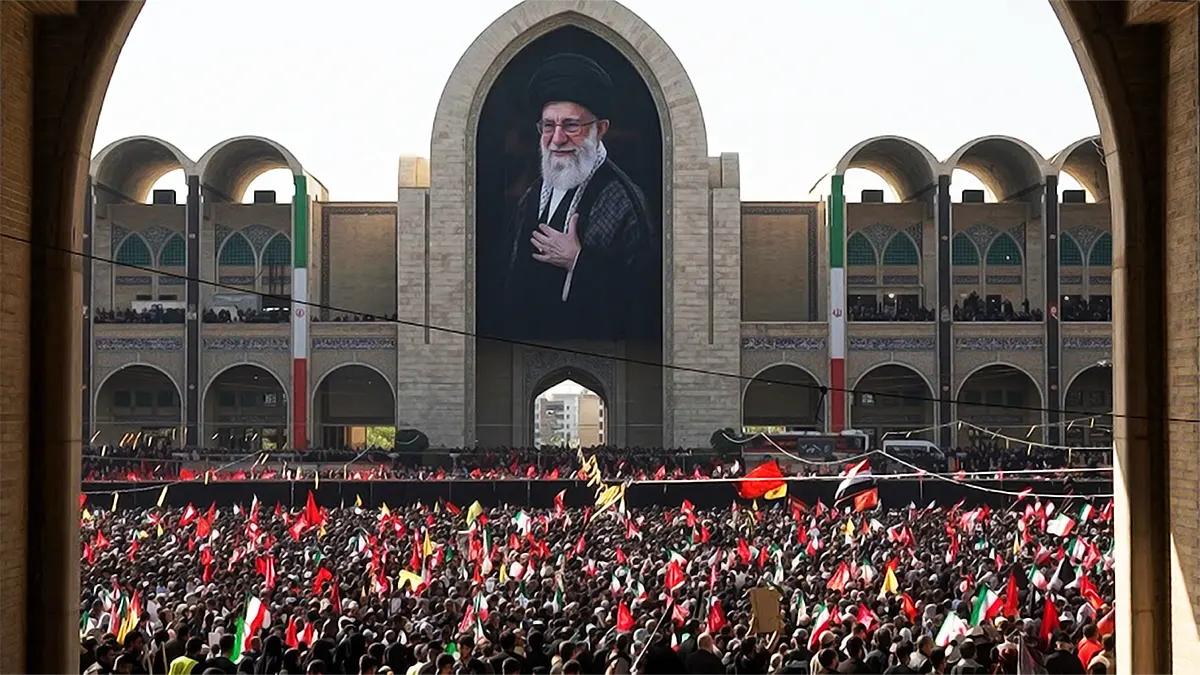
Tehran is in the middle of a seven-day farewell few could have imagined four months ago. Iran’s late Supreme Leader, Ayatollah Ali Khamenei, is being mourned in a sprawling state funeral that began this week, following his assassination in joint US-Israeli airstrikes on February 28, 2026. Millions are expected to fill the streets before his burial in Mashhad. But behind the scale of the ceremony sits a country that remains sharply split over how to feel about it.
A Funeral Built to Project Strength
Khamenei’s coffin, along with those of several family members killed in the same strike, was laid in state at the Imam Khomeini Grand Mosalla in Tehran the same vast prayer complex built to honor his predecessor, Ayatollah Ruhollah Khomeini. From there, the ceremonies stretch across Tehran, Qom, and the Iraqi holy cities of Najaf and Karbala, before ending with burial at the Imam Reza shrine in Mashhad, the city where Khamenei was born.
For Iran’s remaining clerical leadership and the Islamic Revolutionary Guard Corps (IRGC), the sheer scale of the event is the point. After a punishing war that killed the country’s top leader, officials are using the funeral to send an unmistakable message of stability and defiance, both to their own population and to the outside world.
Billions in Rials and Quiet Coercion
That message hasn’t come cheap, and the bill is landing at an especially painful moment for ordinary Iranians. The funeral is unfolding against a backdrop of severe economic strain, and reports from independent media and worker testimonies suggest the government leaned hard on the private sector to cover costs.
Automobile manufacturers and industrial firms around Tehran were reportedly pressured to contribute billions of rials toward roadside service booths handing out food and drinks to mourners. Separately, accounts have surfaced of state employees being offered incentives, including food rations, simply to help swell attendance numbers. For a country already stretched thin by war and sanctions, the optics of forced generosity haven’t gone unnoticed.
Why It Took Four Months to Say Goodbye
Khamenei’s funeral was originally planned for March, just days after his death. It didn’t happen and the reasons for the four-month delay reveal just how precarious the situation still is.
Active war made a mass gathering too dangerous. When Khamenei was killed on February 28, it marked the opening moment of an intense US-Israeli bombing campaign. Bringing millions of mourners and dozens of foreign leaders into Tehran while the skies were still hostile was never realistic, so the original March 4–6 event was frozen.
The regime needed room to regroup. Officials also used the delay to arrange a smooth transition of power to Khamenei’s son and successor, Mojtaba Khamenei, and to plan a complicated, multi-city itinerary spanning two countries.
Religious law complicated the wait. Islamic law forbids chemical embalming, which raised questions about how a body could be preserved for months. Iranian authorities secured a clerical exemption allowing specialized refrigerated cold storage instead, a workaround that satisfied religious requirements while buying the time needed to stabilize the country.
The July 4 timing wasn’t an accident. International observers note that opening the public funeral on the same day as the United States’ 250th Independence Day was a deliberate piece of messaging by the IRGC, aimed squarely at Washington.
A Ceasefire Built Around a Funeral
None of this would be possible without a fragile pause in the fighting. The United States and Iran agreed to a strict, one-week de-escalation, particularly around the sensitive Strait of Hormuz, specifically to let the funeral proceed safely.
It’s an uneasy calm rather than a real peace. Tehran has heavily fortified itself with security forces, and Israel has issued fresh warnings to Iran’s new leadership. Everyone involved understands this ceasefire window may be the only opportunity the regime gets to bring millions into the streets without risking another military escalation.
Who Showed Up And Who Didn’t
The guest list tells its own story about where Iran’s alliances currently stand. Western governments are staying away entirely, but delegations from roughly 100 countries have arrived in Tehran, painting a clear picture of the regime’s remaining global partnerships.
Russia sent Dmitry Medvedev, Deputy Chairman of its Security Council and a former president, underscoring Moscow’s continued closeness with Tehran. China dispatched a senior delegation led by He Wei, a deputy leader of its top legislative body. Regionally, Pakistan’s Prime Minister Shehbaz Sharif and Army Chief Asim Munir attended, reflecting Islamabad’s role as a key mediator in the ceasefire talks. Iraq, whose territory the funeral procession will actually pass through, sent a heavy delegation led by President Nizar Amedi.
Even some unlikely names showed up. Saudi Arabia sent its Deputy Minister of Foreign Affairs, notable given the historically tense relationship between Riyadh and Tehran, while Egypt and Qatar sent delegations led by their parliamentary speakers. Iran’s regional network of allied groups Hezbollah, the Houthis, and Hamas were also represented, standing in visible solidarity with Tehran.
One notable absence has drawn attention: Mojtaba Khamenei himself has yet to appear at the public ceremonies, with his whereabouts kept under tight security protocols.
The Clock Ticking Behind Closed Doors
While mourners fill the streets, diplomats are racing against a deadline few Iranians can see. The funeral is taking place inside a narrow diplomatic window created by the Islamabad Memorandum of Understanding, a 14-point framework digitally signed by the US and Iran on June 17, 2026, that opened a 60-day negotiation period.
Under the immediate terms, both sides froze military strikes, the US lifted its naval blockade on Iranian ports, and Iran agreed to open the Strait of Hormuz to toll-free commercial shipping. Talks have since continued in Switzerland and Qatar, but several major sticking points remain unresolved.
Chief among them is the nuclear file. Washington is demanding zero enrichment and the complete removal of Iran’s enriched material, while Mojtaba Khamenei has publicly signaled he holds a different view than elected President Mahmoud Pezeshkian on how much Iran should concede. A proposed $300 billion reconstruction package is also under negotiation, though the US wants any released funds strictly limited to food and medicine purchases.
Adding to the tension, reports emerged that American intelligence warned Iranian negotiators of an alleged Israeli plot to assassinate senior Iranian diplomats, including Foreign Minister Abbas Araghchi, in an apparent effort to derail the peace talks altogether.
The Other Iran
For all the crowds and pageantry, the funeral cannot paper over how divided the country actually is. When news of Khamenei’s assassination first broke in early March, the public reaction split almost instantly. Alongside the grief of religious traditionalists and government loyalists, clandestine celebrations broke out in cities including Isfahan, Shiraz, and Karaj.
Videos circulated at the time showing residents cheering in the streets and on rooftops. In Dehloran, footage showed civilians celebrating as a statue of Khamenei was toppled. Fearing the celebrations could spiral into a broader uprising while the country was under foreign bombardment, security forces moved quickly, and in several instances reportedly opened fire on crowds to suppress the unrest.
That fracture hasn’t disappeared, it’s simply been pushed out of view. By staging this massive, multi-city funeral during the current ceasefire, Iran’s leadership is attempting to flood the narrative with images of unity, using bused-in workers and mobilized loyalists to drown out a current of domestic resistance that has been building for years. Whether that image holds once the ceasefire expires, and once the harder questions of the peace talks come due, is the question hanging over everything happening in Tehran this week.