For decades, the Taliban operated as an insurgent movement, fighting a prolonged war against the Afghan government and international forces. In August 2021, that role changed dramatically. Instead of leading an armed rebellion, the group suddenly became responsible for governing an entire country of more than 40 million people.
The transition marked the beginning of a challenge that extends far beyond security.
Running a modern nation requires functioning institutions, economic planning, public services, and long-term development strategies. Governments must manage everything from healthcare and education to banking, taxation, infrastructure, and international trade.
Political scientists often describe this transformation as the “rebel to ruler transition.” While some insurgent movements have successfully adapted to governing, others struggle because the skills required to wage war are fundamentally different from those needed to administer a modern state.
Many analysts argue that Afghanistan is now confronting exactly that challenge.
Winning a Conflict Is Different From Running a Government
Insurgent organizations are typically structured around military objectives.
They prioritize discipline, loyalty, command hierarchies, and maintaining territorial control. Those qualities can be effective during armed conflict, but governing a country requires a broader set of capabilities.
Civil administrations depend on specialists who understand public finance, healthcare systems, engineering, education, agriculture, diplomacy, and economic policy.
Every ministry requires technical expertise.
A finance ministry must manage national budgets and monetary policy.
A health ministry coordinates hospitals, vaccination programs, and emergency responses.
An education ministry develops curricula, trains teachers, and prepares students for future careers.
Replacing experienced civil servants with individuals selected primarily for ideological commitment or wartime service can create institutional weaknesses, particularly when governments face complex economic and humanitarian challenges.
This is one reason many experts believe Afghanistan has struggled to transition from conflict management to long-term governance.
Institutions Depend on Expertise, Not Only Authority
A functioning state relies on more than political leadership.
It also depends on thousands of professionals working behind the scenes economists, engineers, doctors, judges, teachers, urban planners, and administrators.
These professionals maintain electrical grids, regulate banks, oversee public health systems, manage irrigation projects, and keep transportation networks operating.
Afghanistan has lost many of these skilled workers over the past several years.
Some left because of economic uncertainty.
Others departed for professional opportunities abroad.
Still others were displaced by political change or changing employment conditions.
This ongoing brain drain has left many institutions operating with fewer experienced personnel, making it more difficult to maintain public services and plan for long-term development.
Even if economic conditions improve tomorrow, rebuilding that expertise could take many years.
Human Capital Is Becoming Afghanistan’s Greatest Challenge
Economists often describe education and professional skills as a country’s human capital, the knowledge and experience that allow societies to grow and innovate.
Afghanistan’s human capital faces pressure from multiple directions.
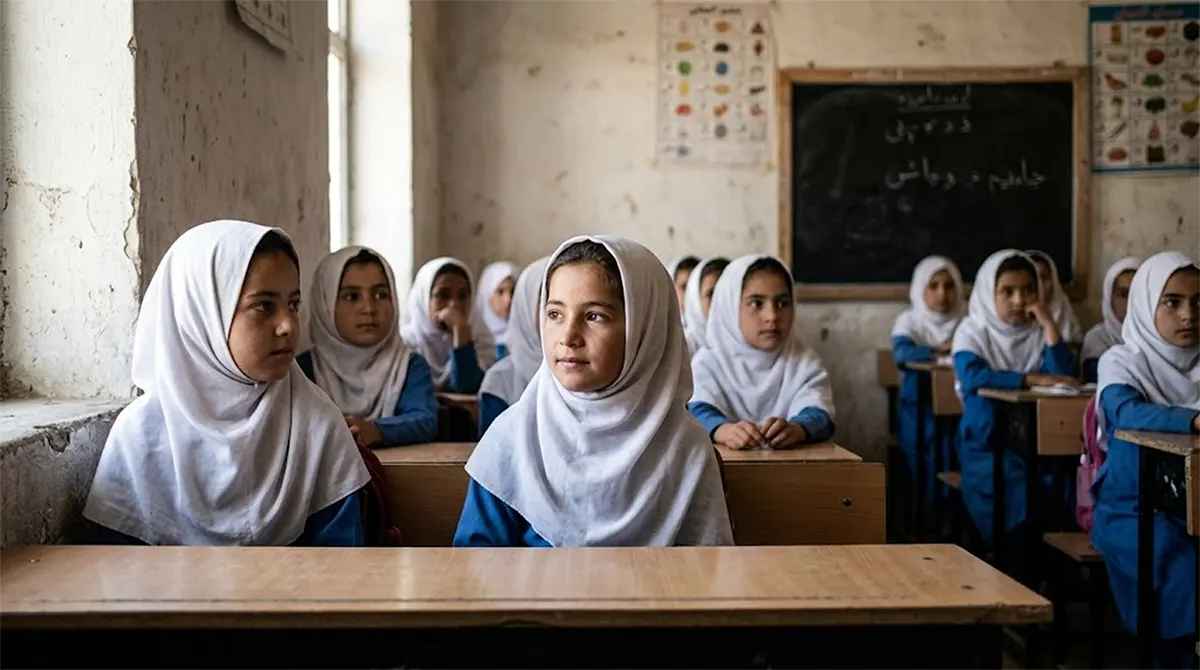
Restrictions on girls’ education reduce the number of future professionals entering the workforce.
The migration of skilled workers reduces existing expertise.
Economic hardship encourages younger professionals to seek opportunities outside the country.
Together, these trends create a widening gap between the number of specialists Afghanistan needs and the number available to fill essential roles.
This shortage is particularly visible in healthcare.
Many female doctors, nurses, and midwives currently practicing received their education before 2021. As they retire, relocate, or leave the profession, relatively few new graduates are available to replace them.
International organizations, including UNICEF, have warned that this trend could leave Afghanistan facing a significant shortage of female healthcare workers over the coming decade, particularly in rural provinces where medical services are already limited.
The consequences extend beyond hospitals.
Education systems require teachers.
Infrastructure projects require engineers.
Financial systems require accountants and banking specialists.
Every profession lost today reduces the country’s capacity to rebuild tomorrow.
Child Marriage Reflects Wider Social and Economic Pressures
Afghanistan has also seen growing international concern over the rise in child and early marriage.
Humanitarian organizations point to several overlapping factors contributing to the trend.
Economic hardship has left many families struggling to support their children.
Restrictions on girls’ education mean that many adolescents are no longer attending secondary school, removing one of the few structured environments available to them.
Changes to the legal framework governing marriage have also drawn criticism from human rights organizations, which argue that they weaken legal protections for girls.
Health experts warn that early marriage often leads to early pregnancy, increasing medical risks for both mothers and infants.
These risks become even greater in areas where access to skilled healthcare workers is already limited.
For international organizations, the issue illustrates how education, healthcare, poverty, and legal policy are increasingly interconnected.
Each challenge reinforces the others, making long-term solutions more difficult to achieve.
A Changing Diplomatic Landscape
Although many Western governments continue to withhold formal recognition of the Taliban administration, Afghanistan is no longer as diplomatically isolated as it was immediately after the 2021 transition.
In July 2025, Russia became the first country to formally recognize the Taliban-led government, marking a significant shift in regional diplomacy. Several other countries including China, Pakistan, India, Türkiye, the United Arab Emirates, and a number of Central Asian states have maintained working relationships with Kabul by accepting Taliban-appointed diplomats or allowing them to manage Afghan embassies, even without issuing formal political recognition.
This growing regional engagement reflects a pragmatic calculation.
Neighboring countries share concerns over border security, trade, migration, and regional stability. Maintaining diplomatic channels allows them to cooperate on practical issues regardless of broader political disagreements.
However, regional engagement has not translated into full reintegration with the global financial system.
Major Western sanctions, restrictions on financial transactions, and frozen Afghan state assets remain largely unchanged, continuing to limit investment and access to international finance.
Recovery Requires More Than International Recognition
Recognition alone is unlikely to transform Afghanistan’s economy.
Development economists generally agree that sustainable recovery depends on several interconnected factors working together.
The country needs functioning public institutions capable of delivering essential services.
Businesses require access to reliable banking systems, predictable regulations, and legal certainty.
Schools and universities must produce the skilled professionals needed to operate hospitals, utilities, construction projects, and financial institutions.
Healthcare systems require a continuous supply of trained doctors, nurses, and midwives.
Farmers need access to irrigation, transportation, and markets that allow legal crops to generate stable incomes.
Without these foundations, improvements in diplomatic relations or humanitarian assistance are unlikely to produce lasting economic growth.
The Importance of Rebuilding Institutions
Throughout this series, one theme has appeared repeatedly:
Afghanistan’s challenges are deeply interconnected.
Food insecurity affects health.
Economic decline influences education.
Education shapes the future workforce.
Healthcare depends on trained professionals.
Investment relies on legal certainty and functioning institutions.
None of these issues exists in isolation.
Political scientists often note that successful states are built not only through leadership but through institutions that continue functioning regardless of who holds political power.
These institutions include courts, schools, universities, central banks, public health systems, and professional civil services.
Rebuilding them is rarely quick.
It requires years of investment, technical expertise, and policy consistency.
For Afghanistan, strengthening these institutions may prove just as important as improving economic indicators or expanding humanitarian assistance.
A Generation Will Shape Afghanistan’s Future
Perhaps the greatest long-term challenge is time.
Every year that passes without broad improvements in education, healthcare, and employment affects an entire generation of young Afghans.
Children who experience prolonged malnutrition may face lifelong health consequences.
Students who miss years of formal education may find it harder to develop the skills needed in an increasingly competitive global economy.
Communities that lose experienced professionals may spend years rebuilding local expertise.
These are not problems that disappear once economic growth resumes.
Human capital takes decades to build but can be lost surprisingly quickly.
That is why many international organizations emphasize protecting education, healthcare, and livelihoods even during periods of political uncertainty.
Afghanistan’s Future Will Be Determined by More Than Aid
Humanitarian assistance remains essential.
Millions of Afghans continue to rely on food aid, emergency healthcare, and support from international organizations to meet basic needs.
Yet humanitarian agencies consistently stress that emergency relief is only one part of the solution.
Long-term recovery depends on creating an economy capable of supporting its own people.
That means encouraging investment, rebuilding infrastructure, restoring confidence in public institutions, expanding educational opportunities, strengthening healthcare systems, and creating conditions where businesses can grow.
These goals are difficult under any circumstances.
They become even more challenging when humanitarian crises, political uncertainty, climate change, and economic isolation occur simultaneously.
The Road Ahead Remains Uncertain
Afghanistan stands at a crossroads.
The country has experienced decades of conflict, political upheaval, economic shocks, and environmental disasters. Today, many of the immediate battles have subsided, but the challenge has shifted from securing territory to rebuilding a nation.
Whether Afghanistan can achieve long-term stability will depend on far more than international aid or diplomatic recognition.
It will require resilient institutions, skilled professionals, functioning public services, and policies capable of supporting sustainable economic development.
The humanitarian crisis has shown how vulnerable millions of Afghans remain.
The economic challenges have demonstrated the importance of rebuilding livelihoods.
The education and healthcare systems have highlighted the value of investing in human capital.
Taken together, these issues point toward a broader conclusion.
Afghanistan’s future will ultimately be shaped not only by political decisions made today but also by whether future generations have the opportunity to learn, work, innovate, and contribute to rebuilding their country.
The path forward remains uncertain, but one lesson has become increasingly clear: lasting recovery requires more than ending conflict, it requires building the institutions that allow a society to thrive.