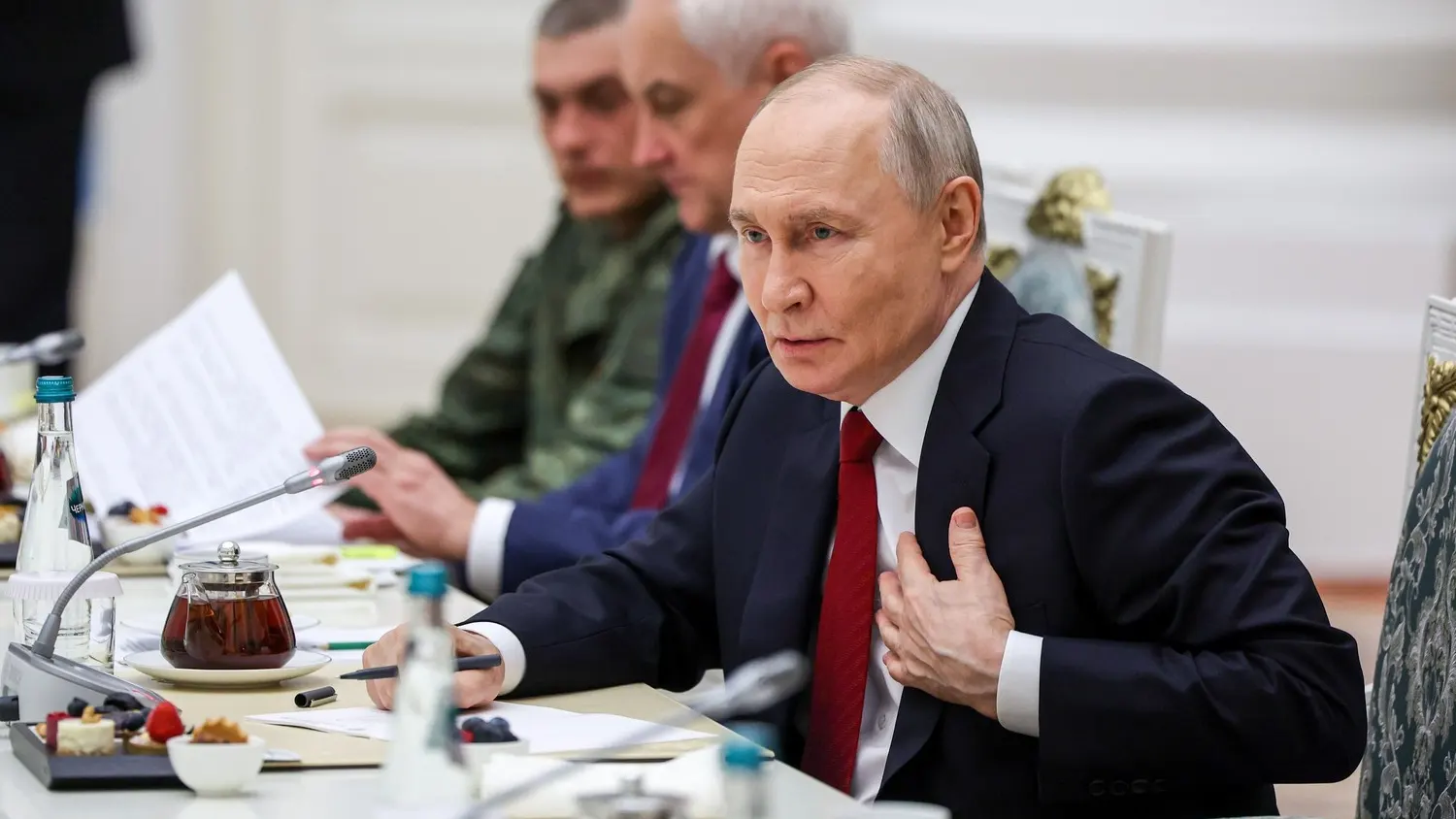
Vladimir Putin delivered what amounts to the clearest public summary of how the Kremlin frames the war in Ukraine not as a conflict with a neighboring country, but as an existential standoff between Russia and the entire Western world.
The language was blunt, the historical references deliberate, and the underlying message directed squarely at domestic audiences as much as foreign ones.
Here is what he said, what he meant, and what the historical record actually shows.
“They Will Never Succeed” The Core of Putin’s Argument
Putin opened with a defiant claim that has become something of a personal mantra: that the NATO alliance collectively decided to achieve the rapid “strategic defeat” of Russia, and that this goal has already failed.
“Never has anyone managed to achieve a strategic, final defeat of Russia,” he said, before drawing two historical parallels that Russian leaders have reached for consistently throughout this conflict — Napoleon’s invasion in 1812 and Hitler’s in 1941.
At Stalingrad, he noted, Soviet troops suffered fewer losses than the enemy for the first time in the war and the enemy at that point included soldiers from across occupied Europe, not just Germany. The implicit message: Russia has always been outnumbered, and it has always survived.
This framing is not accidental. By anchoring the present conflict inside the same historical bracket as those two invasions, Putin is telling Russians that what they are experiencing now is not a war of choice that Moscow initiated, it is the latest chapter in an ancient, recurring story of foreign powers trying and failing to break Russia.
The “Division of the Pie” Line and Who It Was Really Aimed At
One of the most loaded moments in the speech came when Putin mocked nations that, in his words, “joined NATO for the sake of participating in the division of the pie.”
This was not an offhand remark. It was a deliberate jab at the recent waves of NATO expansion and specifically at the idea that countries like Finland and Sweden, which abandoned decades of neutrality after Russia’s 2022 invasion of Ukraine, did so out of genuine security concerns.
From Moscow’s perspective, that explanation doesn’t hold. The Kremlin’s reading is that these nations saw an opportunity to join a dominant Western bloc at a moment when Russia was expected to crumble quickly to claim a seat at the table before the spoils of a weakened Russia were distributed.
The “pie” metaphor is doing real rhetorical work here. It implies that Western nations assumed Russia would fall apart under military and economic pressure, leaving its sphere of influence, resources, and strategic position open to be carved up. By asserting that they “rushed” and announced their goals too publicly, Putin is mocking what he characterizes as Western overconfidence, a miscalculation that he argues has now been exposed.
Crucially, this framing also serves to dismiss the security motivations of newer NATO members entirely, portraying their alignment with the West as purely opportunistic rather than rooted in any legitimate fear of Russian aggression.
Russia as the Lone Nation Against a Pack
Perhaps the most strategically important line in the speech was delivered almost in passing: “There are many of them, a whole pack, while we are one single, united multi-ethnic nation.”
This is the rhetorical engine that drives nearly everything else Putin said. By framing Russia as a solitary nation facing a coordinated coalition of technologically advanced, economically powerful adversaries, the speech is engineered to do several things at once.
It activates historical memory. Russians have lived through the Napoleon narrative and the “Great Patriotic War” narrative since childhood. Invoking them now places contemporary hardship inside a framework where sacrifice is not only expected, it is noble, and ultimately victorious.
It strips Ukraine of its own agency. By focusing almost entirely on NATO as the true adversary, the speech positions Ukraine not as a sovereign nation making independent choices, but as a proxy being wielded by Western powers to achieve their strategic goals. This matters enormously for domestic Russian audiences, because it reframes the war as something done to Russia, not by Russia.
It explains prolonged difficulty without admitting failure. Acknowledging that NATO countries have “highly developed economies” and advanced technology is an unusual concession for a leader to make in a wartime address but it serves a purpose. If the adversary is extraordinarily powerful, then the fact that Russia has not been defeated quickly becomes an achievement in itself, not a sign of strategic failure.
Is Putin Actually Right About NATO? The Honest Answer Is Complicated
Setting aside the rhetoric, the underlying question Putin’s speech raises is a real one with serious people on both sides: has NATO’s eastward expansion genuinely threatened Russia, or is that narrative a convenient justification for aggression?
The factual record of expansion is not in dispute. When the Soviet Union collapsed in 1991, NATO had 16 members. Today it has 32. Former Warsaw Pact nations Poland, Hungary, the Czech Republic joined in 1999. The Baltic states, which were once part of the Soviet Union itself, joined in 2004. Finland and Sweden, neutral for decades, formally joined in 2023 and 2024, doubling the length of Russia’s direct border with the alliance.
Geographically, NATO has moved significantly closer to Russia. That part is simply true.
Whether that movement constitutes a threat, however, depends entirely on which lens you apply.
The Western argument is that NATO is a defensive alliance built on voluntary membership. No country is recruited or coerced, independent sovereign states apply because they want the security guarantee. Countries like Poland and the Baltic states sought membership precisely because of their own historical experiences under Soviet domination. Finland only abandoned its long-standing neutrality after watching Russia invade a neighboring country. Under this view, a stable and secure Europe is not a threat to Russia, it is simply a free Europe.
The Russian argument is rooted in something closer to classical geopolitical realism. From Moscow, the view of a map looks very different: a massive, US-led military alliance with nuclear capabilities has moved steadily toward Russia’s borders over three decades. Russia also heavily emphasizes what it calls a broken promise, the claim that during the 1990 negotiations over German reunification, Western leaders gave verbal assurances to Soviet leader Mikhail Gorbachev that NATO would not expand “one inch eastward.” No such commitment was ever written into a binding treaty, but the perception of betrayal has remained central to Russian foreign policy thinking ever since.
Add to that Russia’s centuries-old strategic doctrine of maintaining buffer states in Eastern Europe, the logic that gave it breathing room against Napoleon and Hitler and the anxiety about NATO’s expansion becomes, at minimum, predictable, even if it does not justify what followed.
The Negotiation Offer With Conditions Attached
Putin closed his remarks with what sounded, on the surface, like an olive branch: “Let’s live in friendship and resolve all issues through negotiations.”
But the conditions he attached matter as much as the offer itself. He was explicit: talks must reflect Russia’s “national interests” not just immediate ones, but long-term, historically calculated ones. And they must not come in the form of ultimatums.
This is consistent with the Kremlin’s stated position throughout the conflict. Moscow has not ruled out diplomacy but the version of diplomacy it is describing would require the West to formally acknowledge Russia’s sphere of influence and accept the territorial and security realities that Russia has created on the ground.
Whether that constitutes a genuine opening or a rhetorical fig leaf dressed up as one is, at this point, a matter of heated debate among diplomats, analysts, and governments with no clear answer in sight.