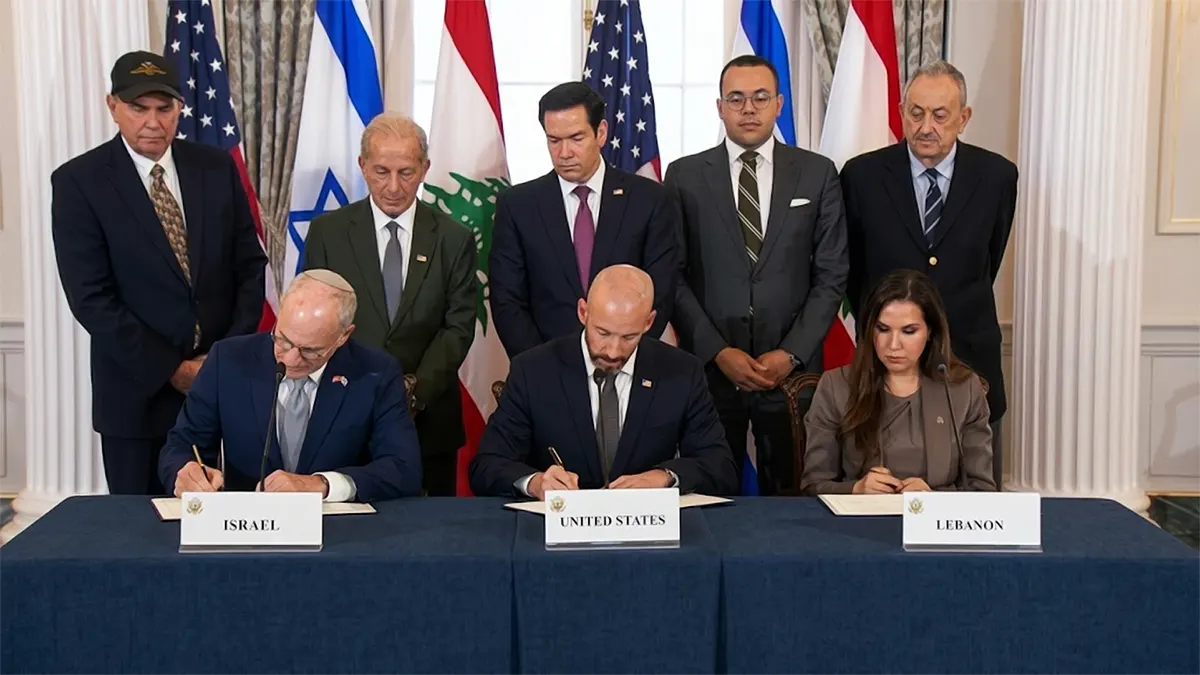
A U.S.-brokered framework agreement aimed at ending decades of hostilities between Israel and Lebanon has entered its first days under intense pressure, with Israeli military operations continuing in southern Lebanon despite the landmark diplomatic breakthrough. The agreement, signed in Washington, D.C., on June 26, lays out a phased roadmap toward peace, including the disarmament of Hezbollah, the restoration of Lebanese state authority, and the eventual withdrawal of Israeli forces. However, Hezbollah’s rejection of the accord and continued military activity on the ground underscore the challenges facing its implementation.
| Agreement | Trilateral Framework Agreement |
| Signed | June 26, 2026 |
| Location | Washington, D.C. |
| Parties | United States, Israel, Lebanon |
| Primary Goal | End the state of war and establish lasting peace |
| Major Challenge | Hezbollah rejects the agreement and refuses disarmament |
| Current Status | Framework signed; fighting and Israeli strikes continue |
Framework Outlines Roadmap Toward Peace
The agreement, announced by U.S. Secretary of State Marco Rubio, is the most significant diplomatic breakthrough between Israel and Lebanon in decades.
According to the framework, the Lebanese Armed Forces (LAF) would gradually restore sovereign control across Lebanese territory, particularly in the country’s south. The process is tied to the verified dismantlement and disarmament of non-state armed groups, principally Hezbollah.
In return, Israel has committed to a phased withdrawal from areas it occupies in southern Lebanon once the agreed security conditions are met. The framework also establishes a U.S.-facilitated trilateral Military Coordination Group to oversee implementation and verification.
Israeli Operations Continue Despite Agreement
Although the agreement establishes a political roadmap, it does not immediately halt Israeli military operations.
Israeli leaders have maintained that military action will continue until Hezbollah is no longer capable of threatening northern Israel. Since the signing, Israeli airstrikes targeting what Israel describes as Hezbollah infrastructure and militants have continued in southern Lebanon, illustrating the fragile nature of the current ceasefire environment.
The agreement links any broader Israeli withdrawal to measurable security progress rather than a fixed timetable, making implementation dependent on developments on the ground rather than diplomatic milestones alone.
Hezbollah Rejects the Deal
A central obstacle to the framework is Hezbollah, which was not a signatory to the Washington agreement.
The Iran-backed group has dismissed the accord, describing it as a surrender that undermines Lebanese sovereignty and reiterating that it will not disarm. Hezbollah has also warned that attempts to force disarmament could destabilize Lebanon internally.
Because Hezbollah remains outside the agreement, analysts say the framework cannot immediately end hostilities despite the commitments made by Israel and the Lebanese government.
Lebanese Government Backs Agreement While Seeking End to Strikes
Lebanese President Joseph Aoun and Prime Minister Nawaf Salam have presented the framework as the country’s best opportunity to restore full state authority after years of conflict.
Officials have emphasized that the Lebanese state not armed factions should ultimately control decisions on national security and war.
At the same time, Beirut has appealed to Washington to ensure Israel adheres to the framework and reduces military operations, arguing that continued strikes complicate the deployment of the Lebanese Armed Forces into areas designated for the agreement’s initial implementation.
Humanitarian Crisis Remains Severe
Despite diplomatic progress, the humanitarian situation remains acute.
Months of fighting have displaced more than one million people across Lebanon, according to humanitarian assessments cited in reporting on the conflict. While some residents have begun returning to damaged border communities during lulls in the fighting, aid organizations continue to warn that widespread returns remain unsafe because of ongoing military activity and damaged infrastructure.
Implementation Will Determine Whether Diplomacy Holds
The framework represents the clearest diplomatic pathway toward ending decades of conflict between Israel and Lebanon, but its success depends on conditions that remain politically and militarily contentious.
With Hezbollah refusing to participate, Israel continuing military operations, and the Lebanese government seeking to expand state control without provoking internal conflict, analysts say the agreement’s implementation will likely determine whether it evolves into a lasting peace process or another fragile ceasefire.