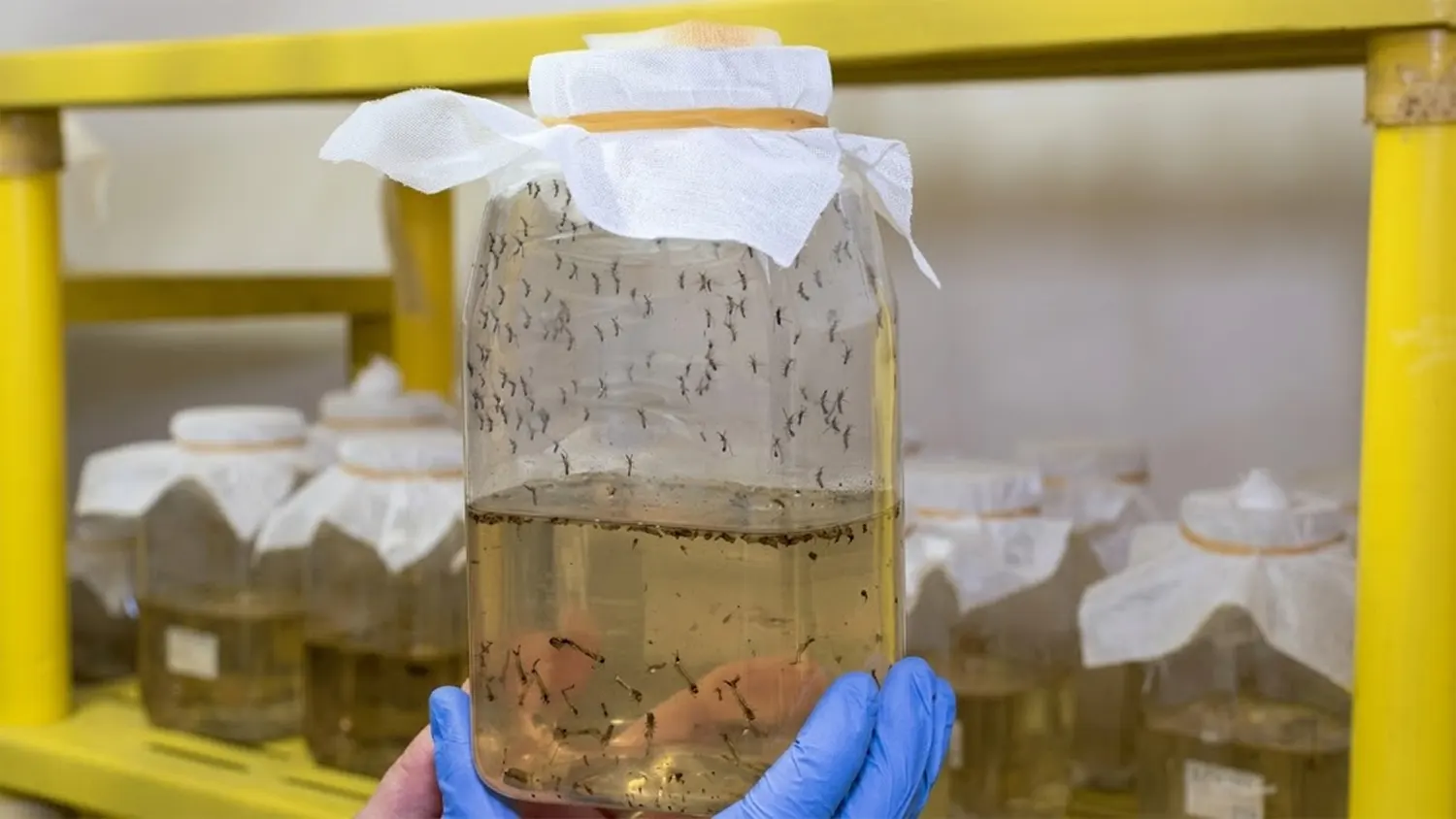
If you heard that a tech company is planning to release tens of millions of bacteria-infected mosquitoes over your neighborhood, your first instinct would probably be alarm. That’s a fair reaction. But once you understand what Verily, Google’s life sciences sister company under Alphabet is actually proposing, the alarm tends to give way to something closer to fascination.
The project is called Debug. Verily is currently seeking permission from the U.S. Environmental Protection Agency to release up to 64 million mosquitoes over two years, 32 million across California, 32 million across Florida. The EPA’s public comment window has just closed, and regulators are now reviewing the data before deciding whether to grant final rollout permits.
Here’s what’s actually going on and why public health experts aren’t panicking.
No Gene Editing, No Pesticides Just a Bacterium Nature Already Uses
The entire program rests on a biological phenomenon called cytoplasmic incompatibility, and it relies on something found in up to 60% of all insect species already living around you: a naturally occurring bacterium called Wolbachia pipientis.
The two mosquito species being targeted are Aedes aegypti, the primary spreader of Dengue and Zika and Culex quinquefasciatus, the southern house mosquito responsible for transmitting West Nile virus. Neither of these invasive species naturally carries Wolbachia. That gap is exactly what the Debug project exploits.
The process works in five steps:
Verily breeds millions of mosquitoes in high-tech lab facilities, then introduces them to Wolbachia. Before any mosquito leaves the lab, an AI-powered sorting system separates males from females with near-perfect accuracy only males are cleared for release. Those males are then deployed into targeted neighborhoods via automated vans or drones. When they mate with wild, uninfected females in the area, the resulting eggs are completely sterile. Zero hatch. Because wild adult mosquitoes naturally die within a few weeks and no new generation is replacing them, the local population quietly crashes within months.
It’s worth being precise about what this method is not: there is no genetic modification of the mosquitoes, no chemical spraying, and no alteration of the natural environment beyond temporarily flooding it with males that are already common in nature everywhere else.
The Part That Required Google-Scale Engineering
Preventing even a single biting female from slipping through into the wild is the most technically demanding part of the whole operation and historically, it was the bottleneck that made this kind of program impossible to scale.
Manual sorting using physical sieves is error-prone and hopelessly slow when you’re processing tens of millions of insects. So Verily built what is essentially a multi-stage security pipeline.
The first stage happens while the mosquitoes are still pupae before they can fly. Male and female pupae naturally grow to slightly different sizes: males are smaller and narrower, females are larger and wider. Precision-engineered sieving drums wash millions of pupae through gaps sized to let the smaller males pass while trapping the females. This mechanical step alone achieves roughly 97–99% accuracy.
The survivors are then hatched into adults and funneled single-file through narrow lanes under high-speed cameras that snap multiple macro-photographs per insect in milliseconds. A custom deep-learning model analyzes three physical traits invisible to the naked eye: the antennae (males have distinctively bushy, feathery ones used to detect the wingbeats of females; females have sparse, plain ones), the mouthparts (a female’s biting proboscis is structurally robust in a way a male’s is not), and the precise geometry of the body and wings.
Any insect the AI flags as female is immediately diverted by a micro-valve. Only verified males pass through to the packaging tubes.
Then comes the final check. Before the canisters are loaded onto vans or drones, acoustic AI listens to the collective hum of the sealed containers. Female mosquitoes are larger and beat their wings at a lower frequency (roughly 400–500 Hz) compared to males (600–800 Hz). If the system detects an anomalous low-frequency spike inside a canister, that entire container is flagged and pulled from the release queue.
Three layers of filtering. The result is a microscopic error rate across millions of insects.
The Three Reasons Experts Aren’t Worried
When public health researchers and entomologists look at this program, three facts consistently move them from skeptical to supportive.
Male mosquitoes don’t bite. Only females bite, because they need blood to develop eggs. Males feed exclusively on flower nectar and physically lack the mouthparts needed to pierce skin. Even if a million of these lab-bred males settled around you, you would not receive a single bite. The release adds zero biting pressure to any neighborhood.
Wolbachia cannot infect mammals. The bacterium is an obligate intracellular organism, it can only survive inside insect cells. It cannot replicate in, or interact with, human, dog, cat, or wildlife biology. If a person somehow swallowed a Wolbachia-carrying mosquito, the bacteria would die instantly in the digestive system. It cannot make us sick, and it cannot alter our DNA.
It leaves the ecosystem intact. Conventional mosquito control relies on chemical pesticides that are broadly toxic, they irritate human lungs, contaminate water supplies, and kill beneficial insects like honeybees and butterflies indiscriminately. The Debug method is 100% species-specific. It does nothing to insects that naturally carry Wolbachia (the majority of the insect world) and nothing to any mammal. It simply turns the targeted mosquito’s own mating instincts against its reproduction.
The Results From Trials Already Run
This isn’t a speculative technology. Smaller-scale versions have been running for years.
In Fresno, prior trials cut the biting female mosquito population by 95%. Singapore’s national program using the same approach suppressed mosquito populations by 80–90% and recorded a 70% drop in human Dengue fever cases as a direct result.
These aren’t lab projections. They’re field outcomes from real communities.
What This Actually Does to the Mosquito Population
It’s worth being precise about the mechanism, because “killing mosquitoes” isn’t quite right.
The lab-bred males don’t kill any living wild mosquitoes. What they do is stop the next generation from ever existing. When a Wolbachia-infected male mates with a wild, uninfected female, the bacterium alters the sperm in a way that triggers cytoplasmic incompatibility, the sperm and egg simply cannot fuse properly. The female still lays her eggs. None of them hatch.
Because adult mosquitoes naturally die within a few weeks regardless, and no new generation is being born to replace them, the local population quietly collapses over the course of a couple of months. No poison, no ecological disruption just a biological dead-end for that specific invasive species, playing out silently in backyards across California and Florida.
The EPA’s decision on whether to grant Verily’s final rollout permits will determine whether this approach scales from a promising field trial into a genuine public health tool for the diseases Dengue, Zika, West Nile that kill and disable tens of thousands of Americans every year.