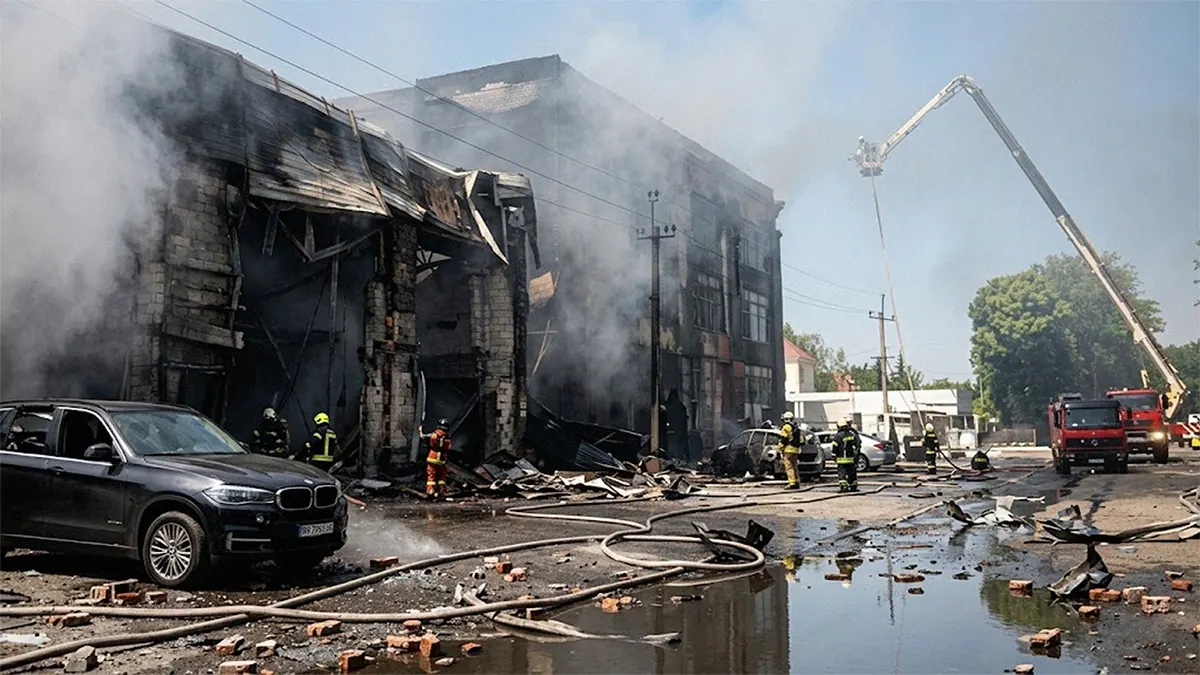
Russia has dramatically escalated its aerial assault on Odesa and the surrounding district, turning the region into one of the most battered civilian corridors in Ukraine’s south. Between May 23 and May 28, a relentless succession of missile and drone strikes tore through shopping centers, private homes, and energy facilities leaving one person dead, 25 injured, and tens of thousands without electricity.
A Drone Hits a Mall at Midday, Children Among the Wounded
The most jarring single incident came on the afternoon of May 27, when a Russian strike drone made a direct hit on a commercial hub in the Odesa district during peak daytime hours. The strike ignited a 1,700 square-meter fire that rapidly consumed a shopping mall, a pet store, a post office branch, a liquor store, and several vehicles parked nearby.
Eleven people were wounded in the blast among them two boys aged 11 and 12. The remaining victims were six men between the ages of 20 and 70, and three women aged 52 to 75. Eight required hospitalization, with three in serious condition at the time of reporting.
The Ukraine State Emergency Service later catalogued the range of injuries: shrapnel wounds, severe burns, limb injuries, traumatic brain injuries, and acute acoustic trauma caused by the shockwave alone. Emergency psychologists were deployed directly to the scene to treat survivors for acute stress on the spot.
What made this strike particularly alarming wasn’t just the scale of destruction, it was the timing. Hitting a crowded civilian hub in broad daylight, where families, workers, and shoppers were going about their day, underscores a deliberate pattern of targeting spaces where civilian presence is at its highest.
Hours Later, the Night Brought Another Wave
By May 28, a second drone wave swept across the southern Odesa region under cover of darkness. Oleh Kiper, head of the local military administration, confirmed that the overnight strike damaged a private residential home and an infrastructure facility, with shattered windows reported across surrounding buildings.
No casualties were recorded from this second wave but the damage to the sense of safety in the region is cumulative. When strikes follow each other back-to-back within the same 24-hour window, the psychological weight on residents compounds rapidly.
The Lights Went Out for Tens of Thousands
Separate from the drone waves, strikes over the same period successfully hit an energy facility managed by DTEK, Odesa’s major power operator. The attack triggered widespread blackouts, temporarily cutting electricity to tens of thousands of households across the region. Emergency repair crews worked continuously to clear debris and restore the grid, a process that stretched on for hours.
The Full Toll: May 23–28 at a Glance
Across the entire multi-day campaign, the civilian toll breaks down as follows:
| Date & Strike | Deaths | Injured | Notes |
|---|---|---|---|
| May 27 – Daytime Mall Strike | 0 | 11 | Includes 2 children; 3 in serious condition |
| May 28 – Overnight Drone Wave | 0 | 0 | Structural damage only |
| Full period (May 23–28) | 1 | 25 | Combined across all strikes in the week |
The single fatality and remaining 14 injuries in the broader count occurred across earlier strikes in the same week-long wave painting a picture of sustained, grinding civilian harm rather than one isolated event.
What This Wave Signals
Odesa has long been a target, its port, its symbolic value, its southern geography all make it strategically significant to Russian planners. But the shift toward daytime strikes on crowded civilian commercial spaces marks an escalation in the brazenness of the campaign. A shopping mall is not a military facility. A pet store is not an arms depot. A post office is not a command center.
The back-to-back strikes daytime commerce, nighttime residential, energy grid suggest a coordinated attempt to destabilize daily life on multiple fronts simultaneously: economic, residential, and logistical.
For Odesa’s residents, the message from each siren and each impact is the same: nowhere, and no hour, is guaranteed safe.